Kyeongsilryeon Seoul Building Analysis Over 100 Billion KRW Released
Last Year's Market Price Reflection Rate 35%, 30%P Lower Than Government Announcement
Seongsu-dong 'Musinsa Campus E1' and 'CORNER50' Lowest at 11%
"Calculation Criteria Disclosure, Uniform Realization Rate Should Be Raised to 80%"
An analysis revealed that the official land price realization rate (market price reflection rate) of buildings with actual transaction prices exceeding 100 billion KRW in Seoul is 30 percentage points lower than the rate announced by the government. Accordingly, it is claimed that owners of high-priced buildings are receiving tax reduction benefits such as property tax cuts.
The Citizens' Coalition for Economic Justice (CCEJ) held a press conference on the 10th at the CCEJ auditorium in Hyehwa-dong, Jongno-gu, Seoul, to announce the results of the "Analysis of Official Land Prices for Buildings with Actual Transaction Prices Over 100 Billion KRW."
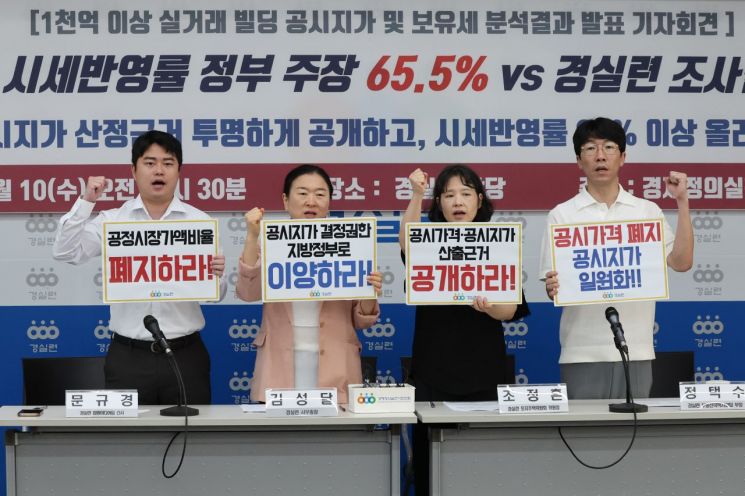
"Realization Rate 30 Percentage Points Lower Every Year"
According to CCEJ, the average realization rate of buildings with transaction prices over 100 billion KRW (13 cases) in Seoul last year was 35%. This value is obtained by dividing the total official land price (966.7 billion KRW) of these buildings by the land market price (2.7655 trillion KRW). This figure is 30.5 percentage points lower than the government's announced realization rate of 65.5% for last year. The realization rate is an indicator showing how much the official land price reflects the market price. A realization rate of 65% means that a building with a market price of 10 billion KRW has an official land price of 6.5 billion KRW.
In 2022 (36 cases), there was also a 33.6 percentage point gap between the realization rate (38%) and the government’s announced figure (71.6%). Similar discrepancies were observed in 2021 (14 cases, 32.6 percentage points) and 2020 (34 cases, 29.5 percentage points). CCEJ stated, "Even considering regional differences between nationwide and Seoul, it is difficult to understand why the realization rate differs by about 30% every year."
The buildings with the lowest realization rates over the past four years were ‘Musinsa Campus E1’ in Seongsu-dong, Seongdong-gu, traded in 2023, and ‘CORNER50’ in Seongsu-dong 2-ga, traded in 2022, both with realization rates around 11%. For Musinsa Campus E1, the land market price was 98.4 billion KRW, but the official land price was 10.9 billion KRW. CORNER50 had a land market price of 109.4 billion KRW and an official land price of 12.5 billion KRW. Following these were the Samil Building in Gwancheol-dong, Jongno-gu (2021, 16%), Young City in Mullae-dong, Yeongdeungpo-gu (2020, 17%), and LG Electronics Gasan B Research Center in Gasan-dong, Geumcheon-gu (2022, 19%).
"Current Official Land Prices Result in Property Tax Reductions"
CCEJ argued that applying the current official land prices as they are results in tax reduction benefits for owners of high-priced buildings. Since official land prices are used as the basis for various tax assessments such as property tax, a lower realization rate means paying less tax. CCEJ stated, "If the market price reflection rate for buildings over 100 billion KRW traded in the past four years is raised to only 80%, total property tax would increase by 45 billion KRW, meaning that owners are currently paying less tax."
The building with the greatest property tax reduction effect when applying the current official land price versus an 80% realization rate was the Samsung SDS Tower in Sincheon-dong, Songpa-gu, traded in 2023. Under the current official land price, the property tax was 1.36 billion KRW, but it jumped to 3 billion KRW when applying an 80% realization rate. Following this were Grand Central in Namdaemun-ro 5-ga, Jung-gu (2020, 1.58 billion KRW), Shinhan Investment Securities Tower in Yeouido-dong, Yeongdeungpo-gu (2022, 1.44 billion KRW), Emart Gayang Branch in Gayang-dong, Gangseo-gu (2021, 1.4 billion KRW), and Park One Tower 2 in Yeouido-dong, Yeongdeungpo-gu (2020, 1.39 billion KRW), all showing significant differences in property tax.
CCEJ emphasized, "If tax standards are arbitrary, citizens inevitably develop doubts about tax fairness," and called for "consistently raising the official land price realization rate to over 80% and transparently disclosing the basis and standards for calculating official land prices."
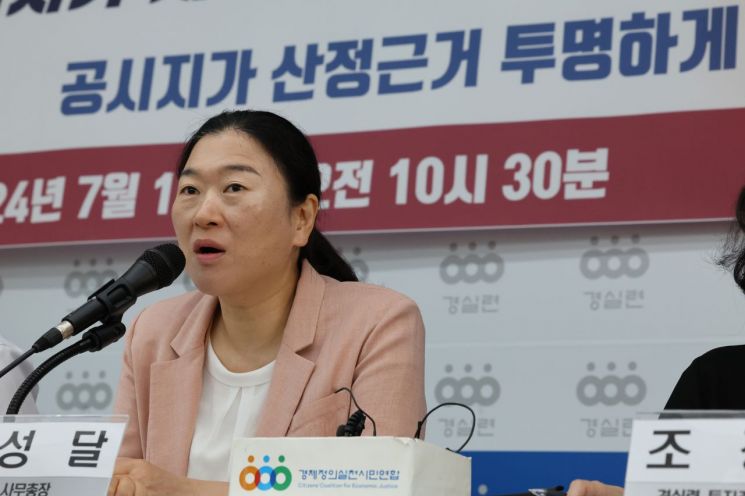
"Polarization Deepens"
They also pointed out that under this system, real estate polarization is intensifying. CCEJ stated, "Most owners of high-priced buildings over 100 billion KRW are not individuals but large corporations or their affiliates, who have benefited from tax reductions such as property tax by owning buildings for a long time," emphasizing, "They also enjoy capital gains by selling land at high prices."
They added, "On the other hand, developers purchase land and build apartments, officetels, etc., selling them at high prices, thereby passing on the high land prices directly to ordinary citizens," criticizing, "This is like emptying the pockets of ordinary people to fill the pockets of real estate wealthy elites."
© The Asia Business Daily(www.asiae.co.kr). All rights reserved.


















