Ancient History and Archaeology Circles Focus on Daegaya as an Ancient State Theory Emerges
Was Gaya a confederation of tribal states or an ancient kingdom? A major clue that could productively fuel the ongoing debate about the true nature of ancient Gaya has been discovered, drawing significant attention from the Korean academic community.
Goryeong County (Governor Lee Namcheol) announced on the 10th that a fragment believed to be a pottery piece inscribed with the characters for "Great King" (大王) was found during a detailed excavation of the Daegaya Palace Site, part of the ongoing "Daegaya Palace Site Excavation and Restoration Project." The county held a public briefing on the discovery on the 9th.
This fragment, found inside the palace site's moat, clearly bears the character "大" (Great), with a partial character below it presumed to be "王" (King). On the day of the briefing, scholars specializing in ancient history and archaeology attended and showed great interest in the artifact. If the fragment is indeed part of pottery used in this region and if its owner was a Great King, it would indicate that Daegaya had a royal system surpassing that of a tribal chief-led state.
Since March of this year, Goryeong County has been conducting a detailed excavation in Yeonjo-ri, Daegaya-eup, to uncover the true nature of the Daegaya Palace Site. Earlier in the process, traces of an earthen fortress wall and moat from the Daegaya period were identified, prompting a public on-site briefing for experts and local residents on the 21st of last month.
Subsequently, while recovering and cleaning artifacts from the lowest layer of the Daegaya-period moat, a pottery fragment with raised characters "大" and a presumed "王" was discovered. To verify and disclose this, a public briefing was held for professors specializing in ancient history and archaeology from the Daegu and Gyeongbuk regions.
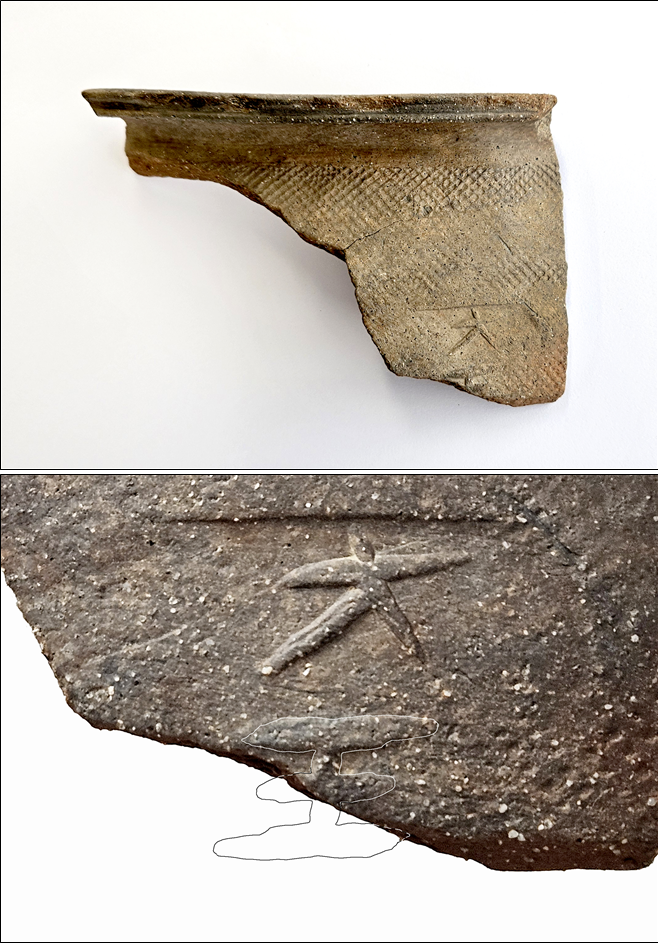 A pottery inscribed with '大王' unearthed inside the moat of the Goryeong Daegaya Palace site. The characters below are presumed to be part of 王.
According to Goryeong County, the artifact is presumed to be a Jangdong earthenware vessel decorated with comb patterns, though only a portion remains. The inscription, stamped with an intaglio seal, shows the character "大" clearly, with a partially preserved character below, likely "王." Unfortunately, the lower part is missing, making definitive identification difficult.
The interpretation of the missing character drew significant attention during the public briefing. Most attending experts agreed that the character should be read as "王," with two main opinions emerging.
Some suggested the character could be either "王" or "干," but considering that in the case of "王," the second horizontal stroke is shorter than the first, and in "干," the second stroke is longer than the first, the evidence points more strongly to it being "王."
Additionally, the Daewang-myeong lidded long-neck jar in the collection of Chungnam National University, though its excavation site is unclear, is considered complementary to this newly discovered inscribed pottery. Given the precedent of the Daewang-myeong lidded long-neck jar produced in the mid-to-late 6th century, most experts agreed that the character is likely "王."
The discovery of this inscribed pottery is expected to mark a significant milestone in the study of Daegaya history. As the first inscription of its kind found in Goryeong, the royal capital of Daegaya, reading it as "Great King" could resolve debates about the true nature of the Daegaya Palace Site. This would lend considerable support to recent arguments for Daegaya as an ancient kingdom. Until now, Gaya?from Geumgwan Gaya to Daegaya?had been regarded as a confederation of tribes, with little support for the view of Gaya as an independent kingdom ruled by a powerful monarch.
However, all participants agreed that, at this stage, it is premature to draw definitive conclusions about the inscription and the significance of the inscribed pottery. They emphasized the need to report the findings to the academic community and hold scholarly forums for further discussion.
Accordingly, Goryeong County plans to collaborate with the excavation agency to hold an academic forum on the "Daewang-myeong pottery" to discuss the historical value of the artifact.
The county also noted that, since the inscription was stamped with a seal, mass production would have been possible. Given that the moat and stone wall sections of the Daegaya Palace Site extend eastward within the excavation area, the "Daegaya Palace Site Excavation and Restoration Project" will be pursued as a long-term plan.
Although the study of Gaya history has long been marginalized compared to the histories of the Three Kingdoms, ongoing investigation, research, restoration, and maintenance are gradually revealing the true nature of its historical and cultural legacy. As a result, in September 2023, the Goryeong Jisan-dong Tumuli and other Gaya tumuli were inscribed as World Heritage Sites, and in July 2024, Goryeong County was newly designated as an ancient capital for the first time in 20 years.
From the second half of this year, Goryeong County plans to conduct academic excavations on major sites such as "Jisan-dong Tomb No. 5," the largest tomb in the Daegaya region; "Hapga 1-ri Pottery Kiln Site," the largest pottery kiln site in Goryeong; and "Bonghwasanseong," a fortress built on the border between Daegaya and Silla. The county also intends to establish Goryeong as a historical and cultural city through a comprehensive project to research and restore Daegaya history.
© The Asia Business Daily(www.asiae.co.kr). All rights reserved.

















