An octogenarian who was sentenced to seven years in prison in 1969 for involvement in the so-called 'European Spy Group' case was acquitted after a retrial, receiving a final not guilty verdict 55 years after the first-instance guilty judgment.
According to the legal community on the 10th, the Supreme Court's 2nd Division (Presiding Justice Kim Sang-hwan) upheld the original acquittal verdict for Kim Sin-geun (82), who was prosecuted for violating the National Security Act and the Anti-Communism Act.
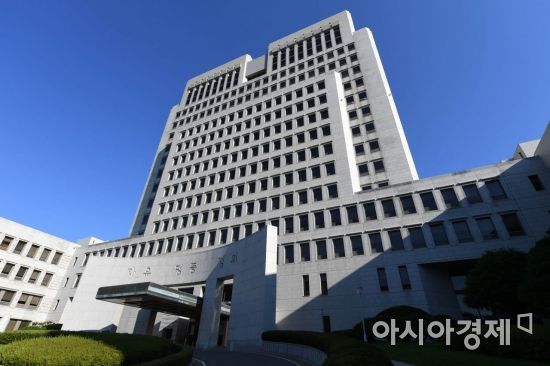
The court stated, "Regarding the charges subject to retrial against the defendant, there is no proof of the crime, so the first-instance judgment that found guilt is overturned, and the original acquittal judgment is upheld. There is no error in the appellate court's judgment that did not violate the rules of logic and experience, did not exceed the limits of free evaluation of evidence, and did not misinterpret the law concerning voluntariness of statements, admissibility of evidence, or the establishment of crimes under the National Security Act and the Anti-Communism Act," explaining the reason for dismissing the prosecutor's appeal.
Kim, who was a graduate student at Korea University, was prosecuted for meeting with North Korean agents and delivering directive letters as well as reading socialist-related books while studying abroad in Cambridge, UK, in 1966. The prosecution claimed that Kim was recruited by the late Professor Park No-su.
Kim was sentenced to seven years in prison and seven years of disqualification in the 1969 trial. He appealed the verdict, but the same sentence was upheld in the second trial and by the Supreme Court.
Co-defendants Professor Park and the late Assemblyman Kim Gyu-nam were sentenced to death by the Supreme Court in 1970, and the sentence was carried out in July 1972.
Kim filed for a retrial in January 2022, and last September, the Supreme Court decided to commence the retrial, citing that the judicial police officers involved in the investigation committed illegal detention and confinement under Article 124 of the Criminal Act and assault and cruel acts under Article 125, which constitutes grounds for retrial under the Criminal Procedure Act.
The Seoul High Court, which re-examined the case, acquitted Kim in February.
The court at that time acknowledged that Kim was subjected to harsh forced interrogation, including beatings, water torture, and electric shocks, after being taken to the Central Intelligence Agency, and that he gave statements under duress after illegal detention and arrest.
The court cited Supreme Court precedents, stating, "If the defendant made involuntary confessions due to torture or other cruel acts by investigative agencies before the prosecutor's involvement, and the involuntary mental state continued during the prosecutor's investigation, then even if there was no coercion during the prosecutor's investigation, the confession before the prosecutor should also be considered involuntary."
It continued, "It can be acknowledged that the defendant and co-defendants were arrested and detained by Central Intelligence Agency investigators and subjected to investigation under such conditions, and there is a substantial likelihood that they suffered cruel acts during the investigation. The statements made by the defendant and co-defendants consistent with the charges are suspected to have been made involuntarily due to illegal detention and cruel acts at the Central Intelligence Agency (police), and this involuntary mental state continued during the prosecutor's investigation, resulting in identical confessions. It is also difficult to find that the prosecutor eliminated doubts about voluntariness during the trial process."
The court further ruled, "Therefore, the suspect interrogation records prepared by the police and prosecutors and the statements and written confessions made by the defendant and others, which appear to correspond to the charges, cannot be recognized as admissible evidence under Articles 309 and 317 of the Criminal Procedure Act."
Moreover, the court concluded that the remaining evidence was also illegally obtained and thus difficult to consider as evidence of guilt, stating, "The charges in this case correspond to a situation where there is no or insufficient evidence to prove the crime."
At the time, the prosecution sought a sentence of three years in prison with four years of probation for some of Kim's charges, but the court rejected this.
Although the prosecution appealed, the Supreme Court found no error in the appellate court's acquittal verdict for Kim.
Meanwhile, the bereaved families of Professor Park and Assemblyman Kim also filed for retrials and received not guilty verdicts from the Seoul High Court in 2013. The court at that time acknowledged that "(the two) were arrested and interrogated without warrants by investigative agencies and made involuntary statements due to torture and threats." The Supreme Court confirmed the acquittal verdict in 2015.
© The Asia Business Daily(www.asiae.co.kr). All rights reserved.

















