Strengthening Nuclear Cooperation Including New Nuclear Power Plants and Uranium Trade
Expansion of Nuclear Transactions Following Oil, Gas, and Weapons
US and Western Position Difficulties in Maintaining the Quad
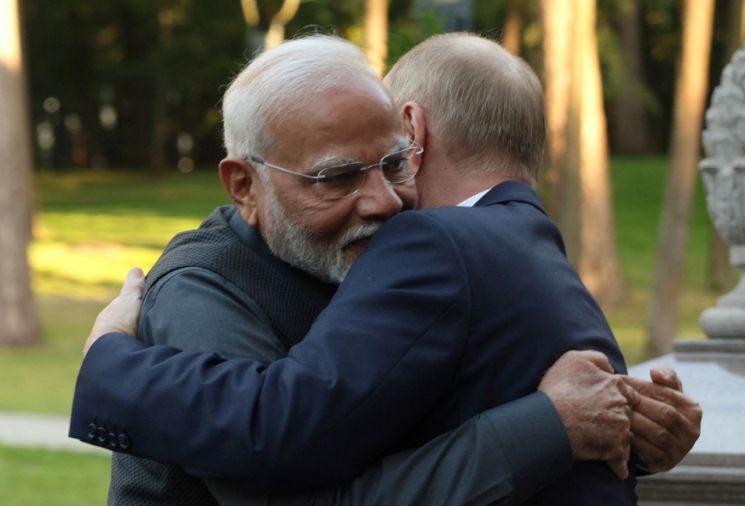 Russian President Vladimir Putin (right) and Indian Prime Minister Narendra Modi (left) are meeting and embracing at President Putin's residence near Moscow.
 [Image source=Reuters·Yonhap News]
At the time of the North Atlantic Treaty Organization (NATO) summit held in the United States, Indian Prime Minister Narendra Modi met with Russian President Vladimir Putin to discuss strengthening nuclear cooperation between the two countries. As India, which has effectively nullified sanctions against Russia by expanding trade in oil, gas, and weapons, is expected to engage in nuclear weapons transactions, the United States and Western countries are deeply concerned. In particular, the U.S. government finds itself in a very difficult diplomatic position because its relationship with India, an important member of the Quad military alliance aimed at countering China, is crucial.
Rosatom: "Discussing the establishment of six new high- and low-output nuclear power plants in India"
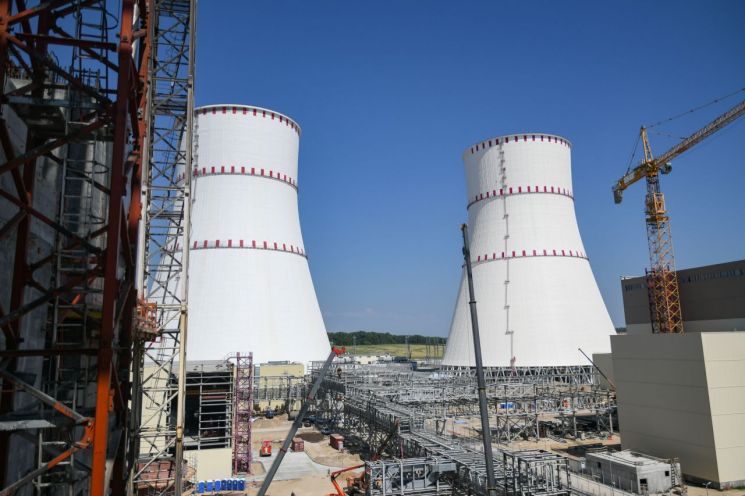
According to TASS news agency, on the 9th (local time), Russian state-owned nuclear company Rosatom issued a statement immediately after the summit between President Putin and Prime Minister Modi, saying, "We are discussing a joint project to establish six high- and low-output nuclear power plants in India." Earlier, the two leaders visited the Russian nuclear exhibition pavilion, where it is presumed they exchanged talks on nuclear cooperation between the two countries.
Russia and India already began nuclear power cooperation projects in the early 2000s. Atomstroyexport, a subsidiary of Rosatom, has been constructing India's largest nuclear power plant in the Kudankulam region of Tamil Nadu since 2002, commissioned by the Nuclear Power Corporation of India Limited (NPCIL). The plant is planned to have six pressurized water reactors; units 1 and 2 have already been completed, and units 3 and 4 are currently under construction.
Along with nuclear power plant construction cooperation, there is also the possibility of concluding a uranium supply agreement. According to Bloomberg News, the Indian government currently meets domestic demand through uranium mined in the northern state of Jharkhand, but the reserves there are rapidly depleting, creating a need for new supply sources. Moreover, since 2020, uranium prices have more than tripled, making relatively inexpensive Russian uranium imports an emerging alternative.
"Possibility of trading floating nuclear power plants usable for nuclear submarines and nuclear aircraft carriers"
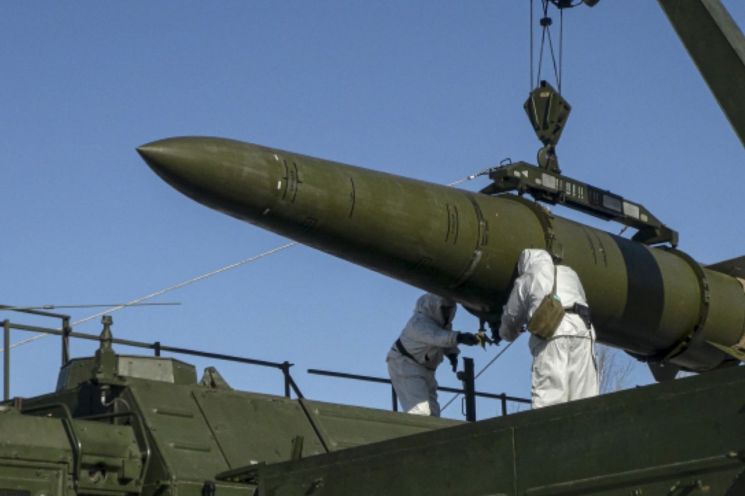
Some speculate that India may purchase floating nuclear power plants from Russia, which can be adapted for the construction of nuclear submarines and nuclear-powered aircraft carriers. Floating nuclear power plants refer to small reactors installed on large ships, capable of supplying power while in transit. Al Jazeera reported, "Nuclear energy was also included in the discussion during this summit. Several of India's reactors were manufactured in Russia, and negotiations are underway for India to purchase Russia's floating and maritime nuclear reactors," adding, "This could be useful for the construction of submarines and large naval vessels."
The reason for the analysis that nuclear cooperation between the two countries will not be limited to civilian nuclear power development is that the scale of arms trade between India and Russia continues to expand. India imports almost all types of weapons from Russia, ranging from small arms such as approximately 35,000 AK203 assault rifles, to heavy weapons like T-90 tanks, licensed production of Su-30 fighter jets, and maintenance of MiG-29 aircraft.
India continues its non-alignment policy... Increasing diplomatic burden on the U.S. and the West
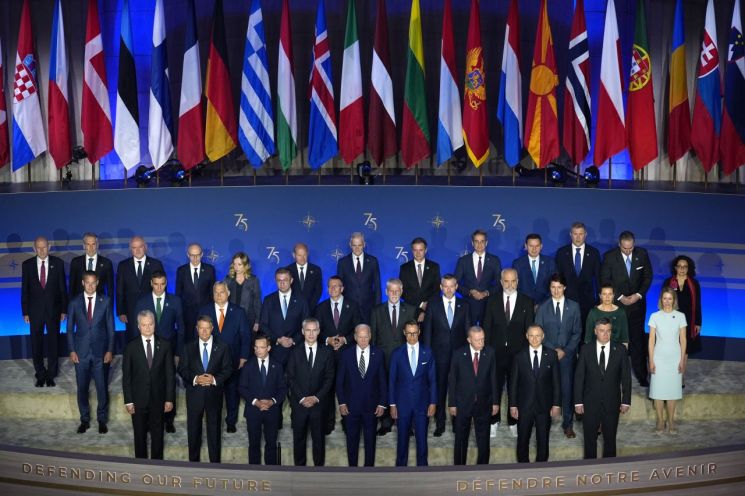 On the 9th (local time), leaders from various countries participating in the North Atlantic Treaty Organization (NATO) summit held in Washington DC, USA, are taking a commemorative photo. [Image source=AP·Yonhap News]
The United States, which formed the Quad military alliance with India, Australia, and Japan to counter China, is in a difficult position. Despite India strengthening military ties with Russia and refusing to join sanctions against Russia, and even engaging in nuclear cooperation, the U.S. must continue military cooperation with India.
For now, the U.S. government has drawn a line, stating that India acts as a bridge between the West and Russia and will contribute to ending the war in Ukraine, indicating no change in relations with India. White House spokesperson Karine Jean-Pierre said in a press briefing, "We confirm that India is a strategic partner engaged in full and honest dialogue with the United States, including its relationship with Russia," adding, "We believe that India's long-standing relationship with Russia can persuade President Putin to end the invasion war in Ukraine."
Meanwhile, India is expected to continue its traditional non-alignment diplomatic policy between the U.S. and Russia, pursuing national interests from both sides. Elizabeth Bro, senior fellow at the Atlantic Council, a U.S. think tank, told CNN, "India's diplomatic approach is very pragmatic and opportunistic," pointing out, "India has significant benefits from importing Russian crude oil, and there is no harm in strengthening relations with Russia, so there is no reason for India not to engage with Russia."
© The Asia Business Daily(www.asiae.co.kr). All rights reserved.



















