Woori Jonggeum Leads 30 Billion Won Fundraising
Credit Rating Downgrade Possible After 10 Consecutive Quarters of Losses
Lotte Chemical and Hyosung Chemical Also in Similar Situation
Yeocheon NCC, a joint venture between Hanwha Solutions and DL Chemical, raised funds by securitizing private bonds. As the possibility of credit rating downgrades increases for petrochemical companies primarily producing olefin (ethylene, propylene) products, private bond issuance by these companies, including Yeocheon NCC, is expected to rise.
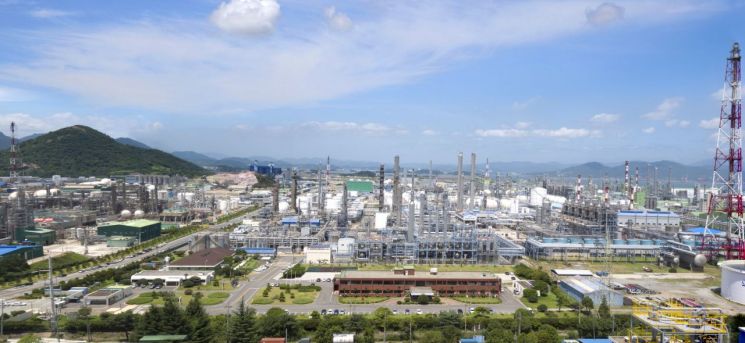
According to the investment banking (IB) industry on the 10th, Yeocheon NCC secured funds by securitizing 30 billion KRW worth of 3-year maturity private bonds under the management of Woori Comprehensive Financial. The method involves transferring private bonds to a special purpose company (SPC) established by Woori Comprehensive Financial and then issuing short-term bonds with a 3-month maturity secured by the principal and interest of the bonds. The short-term bonds are issued with a 3-month maturity and are refinanced over three years.
There is a condition that if Yeocheon NCC’s credit rating falls below BBB+ (corporate, corporate bonds) or A3+ (short-term credit rating) or is extinguished, it will face an event of default (EOD). Yeocheon NCC’s current credit rating is A, with three notches remaining before the EOD trigger. If Yeocheon NCC fails to pay interest on the private bonds on time, Woori Comprehensive Financial has agreed to lend the necessary funds to the SPC to cover the interest payments.
Yeocheon NCC raised funds through private bond securitization due to downward pressure on its creditworthiness. Credit rating agencies recently maintained Yeocheon NCC’s credit rating at A but changed the outlook from ‘Stable’ to ‘Negative.’ This signals a warning that if performance and financial structure continue to deteriorate, the credit rating will be downgraded.
Yeocheon NCC recorded losses for 10 consecutive quarters through the first quarter of this year. Oversupply continued as Chinese companies completed large-scale expansions, and the global economic downturn further weakened petrochemical product margins (spreads). As losses continued, borrowings also increased. Net borrowings rose from about 460 billion KRW at the end of 2019 to 2.08 trillion KRW in the first quarter of this year.
Along with Yeocheon NCC, other companies primarily producing olefin products such as Lotte Chemical, SK Advanced, and Hyosung Chemical are also under downward pressure on their credit ratings due to prolonged industry downturns. SK Advanced and Hyosung Chemical have a high proportion of propylene production, which has seen a significant deterioration in supply and demand conditions, accelerating the worsening of their financial structures. In particular, Lotte Chemical’s net borrowings increased from 300 billion KRW at the end of 2021 to 6.4 trillion KRW in the first quarter of this year, as it invested large sums in acquisitions such as Iljin Materials and expansion of the Indonesian NCC (naphtha cracking plant) amid worsening performance.
An IB industry official said, "Olefin-related petrochemical companies face high uncertainty regarding their performance and financial structure, making it difficult to secure demand for public bond investments," adding, "It is highly likely that they will raise funds through private bonds instead of public bonds, where demand is uncertain."
© The Asia Business Daily(www.asiae.co.kr). All rights reserved.
![User Who Sold Erroneously Deposited Bitcoins to Repay Debt and Fund Entertainment... What Did the Supreme Court Decide in 2021? [Legal Issue Check]](https://cwcontent.asiae.co.kr/asiaresize/183/2026020910431234020_1770601391.png)















