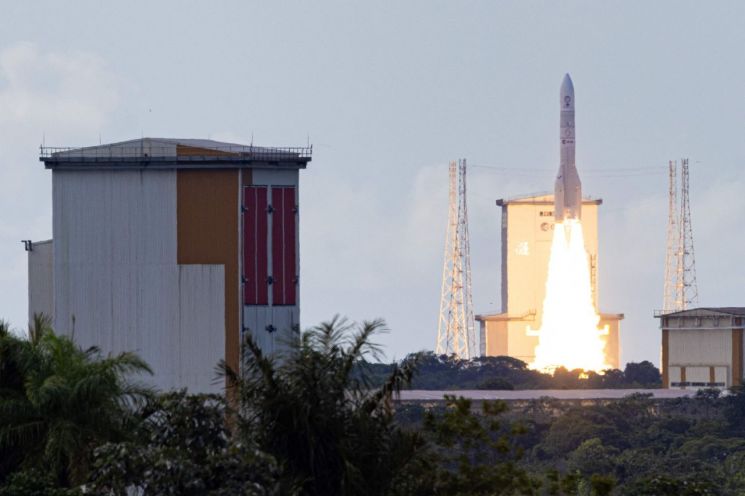
Europe's Ariane 6 rocket was launched successfully into orbit after a four-year delay. Attention is focused on how it will compete with SpaceX's Falcon 9, which has rapidly dominated the global satellite launch market.
The European Space Agency (ESA) launched Ariane 6 on the 9th (local time) around 4 p.m. from the Guiana Space Centre, ESA's launch site in Kourou, French Guiana. ESA announced that about 1 hour and 6 minutes after the launch, the satellites successfully separated from the rocket and settled into orbit.
J?zef Aschbacher, ESA Director General, smiled brightly during a speech broadcast on YouTube, calling it "a historic day for Europe," and ESA staff at the ground communication station responded with applause.
The rocket's most important mission, lasting about three hours, was to carry 11 research microsatellites developed by universities into low Earth orbit. Among them, a satellite from a Korean research team is also known to be included.
ESA stated that the first launch of Ariane 6 will be considered a success if the reusable upper stage of the rocket safely falls into the Pacific Ocean. Ariane 6 is scheduled to be launched once this year, six times next year, and eight times in 2026.
Measuring 56 meters in length, Ariane 6 is Europe's next-generation rocket, replacing Ariane 5, which served as Europe's representative large space launch vehicle 117 times over 27 years until last year. The launch of Ariane 6 was originally planned for 2020 but was delayed by four years due to COVID-19 and technical issues.
As competition intensified with relatively low-cost private space companies such as SpaceX, ESA partnered with the private company ArianeGroup to promote the development of next-generation space launch vehicles.
The current competitor to this rocket is SpaceX's Falcon 9, led by Elon Musk. Launched in 2017, Falcon 9 has virtually monopolized various missions worldwide by leveraging its advantage as a reusable launch vehicle. Last year, SpaceX conducted 96 orbital missions overwhelmingly, while ArianeGroup followed with only three.
Following the Ukraine war, restrictions on the use of Russian rockets such as Soyuz have increased demand not only for SpaceX but also for ArianeGroup. Bloomberg reported that "rockets from Europe, the United States, and other countries can meet the expectations of governments that do not want sensitive assets launched from other countries."
© The Asia Business Daily(www.asiae.co.kr). All rights reserved.

















