Proposal to the Ministry of Economy and Finance for 'Preliminary Feasibility Study System Improvement Plan' in the Transportation Sector
Delays in Projects like Gangbuk Transversal Line Due to Economic Feasibility-Focused Evaluation Compared to Non-Capital Regions
City: "Improvement of Preliminary Feasibility Study System Positive for Expanding Metropolitan Area Urban Rail Infrastructure"
The Seoul Metropolitan Government has requested the central government to lower the weighting of the 'regional economic feasibility' evaluation in the preliminary feasibility study (PFS) process for transportation projects such as metropolitan area railway projects. They also asked to newly include 'congestion relief' as a factor in the economic feasibility evaluation. The intention is to lower the PFS passing criteria to quickly secure metropolitan railway infrastructure, enhance citizen convenience, and promote balanced development between Gangnam and Gangbuk areas.
On the 10th, Seoul City announced that considering the delay caused by the 'Gangbuk Transversal Line,' which was planned for transportation-disadvantaged areas but failed to pass the PFS, they have proposed transportation-related PFS improvement measures with these points to the government.
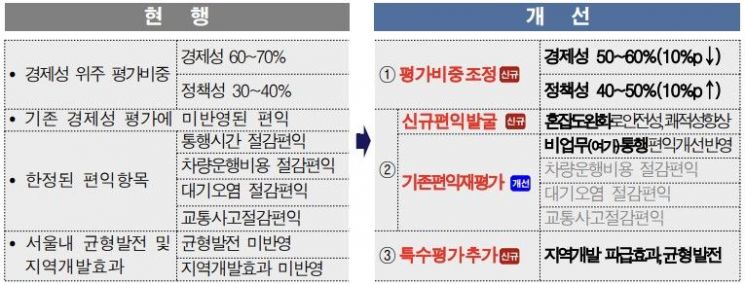 Preliminary Feasibility Study Improvement Proposal Submitted by Seoul Metropolitan Government to the Central Government. [Data Provided by Seoul Metropolitan Government]
The 'preliminary feasibility study' is a system led by the Ministry of Economy and Finance to verify and evaluate the feasibility of fiscal projects such as roads and railways according to relevant laws. The evaluation criteria consist of three categories: ▲economic feasibility ▲policy feasibility ▲regional balanced development. Since the system reform in May 2019, Seoul City projects have been evaluated only on 'economic feasibility (B/C)' and 'policy feasibility,' excluding 'regional balanced development.'
However, under the current system, metropolitan area urban railway projects have an excessively high weighting for economic feasibility evaluation (60-70%) compared to non-metropolitan areas (30-45%), and factors such as the regional balanced development effect in underdeveloped areas within Seoul are not reflected, making it difficult to pass the PFS. Moreover, since May 2019, 'regional balanced development' has been excluded from the evaluation criteria for projects in Seoul and the metropolitan area, making 'economic feasibility' the decisive factor for passing the PFS. Representative examples include the 'Northwest Extension of the Shinbundang Line,' which passes through Seoul, and the 'Gangbuk Transversal Line,' planned for sections with poor railway accessibility, both of which failed to pass the PFS for these reasons.
Accordingly, Seoul City has prepared a proposal for system improvement through academic research, large-scale forums, and expert consultations to address unreasonable aspects such as the excessive weighting of 'economic feasibility' in the current PFS system for the metropolitan area.
The government proposal prepared by Seoul City includes improvements in three major areas: ▲adjustment of the weighting for each comprehensive evaluation criterion ▲discovery of new benefits and improvement of existing benefits ▲evaluation of regional balanced development effects within Seoul. First, they requested to lower the weighting of 'economic feasibility' in the metropolitan area from the current 60-70% to 50-60%, and to raise the weighting of 'policy feasibility' from 30-40% to 40-50%. Given the characteristics of metropolitan urban railways where economic feasibility scores tend to be low, reducing the economic feasibility weighting and increasing the policy feasibility weighting is expected to raise the overall evaluation score and increase the likelihood of passing the PFS.
They also requested to newly add 'congestion relief' among the benefits reflected in the economic feasibility evaluation and to re-evaluate the existing benefit of 'travel time reduction.' This is expected to improve the benefits relative to costs and increase the score in the 'economic feasibility' category. Additionally, they proposed applying 'railway project ripple effects' and the 'regional balanced development effects,' which were excluded from metropolitan area evaluation criteria since 2019, as special evaluation items under 'policy feasibility.' Applying benefits expected from railway projects or regional development ripple effects, which were not recognized at the time of the PFS but have future value, is expected to raise the 'policy feasibility' score and increase the chances of passing the PFS.
Kim Seung-won, head of Seoul City's Balanced Development Headquarters, stated, "The current PFS system, which considers national balanced development, is not suitable as a project evaluation tool for Seoul's urban competitiveness or balanced development of underdeveloped autonomous districts within Seoul." He added, "If the PFS system is improved based on this government proposal, it is expected to have a positive impact not only on Seoul but also on the expansion of metropolitan urban railway infrastructure."
© The Asia Business Daily(www.asiae.co.kr). All rights reserved.