APR "25% Net Profit Return to Shareholders Over 3 Years
Kolmar Holdings to Cancel 20 Billion Won Worth of Treasury Shares
Expected Increase in Per-Share Value as Number of Shares Decreases
Also Part of Government Value-Up Program Participation"
Domestic distribution companies are consecutively announcing plans for share buybacks or cancellations to enhance shareholder value.
According to the industry on the 11th, cosmetics company APR disclosed a shareholder return policy to enhance shareholder value through the Financial Supervisory Service's electronic disclosure system (DART) on the 1st of this month. APR's shareholder return policy is scheduled to be implemented over three years from this year until 2026, including cash dividends, share buybacks, and cancellations. The scale of shareholder returns is set at 25% or more of the adjusted consolidated net income each year.
Since APR was listed on the KOSPI market in February this year, it has announced shareholder return-related policies three times over four months. In May, APR's management, including CEO Kim Byung-hoon, purchased treasury shares. At that time, the management bought a total of 12,100 shares, including CEO Kim purchasing 11,000 shares worth approximately 3.2 billion KRW. The company explained that this management share purchase demonstrates confidence in long-term growth potential.
Last month, APR also announced a company-level acquisition of treasury shares worth 60 billion KRW.
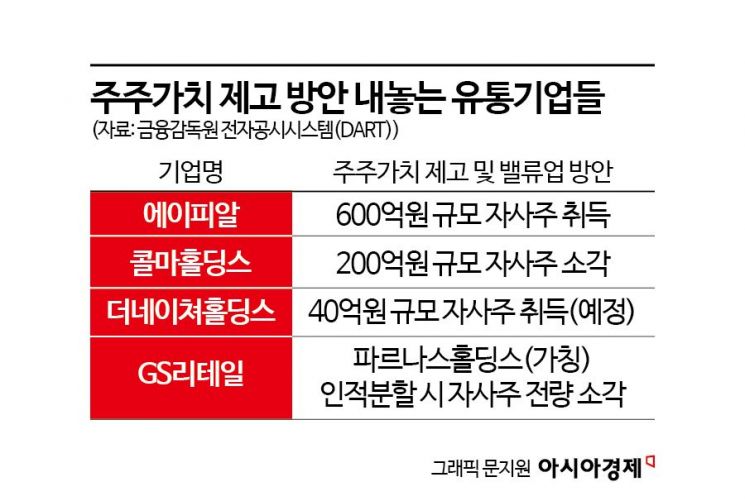
Some companies have decided to cancel treasury shares they have already acquired. Kolmar Holdings, the holding company of the Kolmar Group, announced on the 26th of last month that it decided to cancel treasury shares worth 20 billion KRW. The cancellation targets 2,473,261 shares, equivalent to 6.73% of Kolmar Holdings' treasury shares, with a planned cancellation amount of approximately 19.988 billion KRW.
Kolmar Holdings' treasury share cancellation was also decided as part of shareholder returns. Kolmar Holdings simultaneously disclosed a 'corporate value enhancement plan (Value-Up)' that includes voluntary corporate value enhancement and shareholder returns. This treasury share cancellation was also carried out as part of the 'Value-Up program.' Previously, Kolmar Holdings announced in its shareholder return policy in July last year that it would return more than 50% of net income excluding non-recurring gains to shareholders.
The Nature Holdings also announced that it would acquire treasury shares worth a total of 4 billion KRW in two installments during the second half of this year. The Nature Holdings operates fashion brands such as National Geographic Apparel and Barrel in Korea. The company explained the decision to acquire treasury shares as "part of the company's commitment to stabilizing stock prices and enhancing shareholder value."
GS Retail, which is promoting the spin-off of Parnas Hotel, also decided to cancel all 279,666 treasury shares (1.2% of total shares) simultaneously with the spin-off. This is to increase the stock value during the spin-off process and prevent the so-called 'treasury share magic' trick. Treasury share magic refers to the phenomenon where, during a company's spin-off, the new company's new shares are allocated to the existing company's treasury shares, thereby strengthening the controlling shareholder's control.
In addition, Aekyung Industrial (about 10 billion KRW) and Fila Holdings (up to 50 billion KRW) announced treasury share acquisition plans in March.

Share buybacks reduce the number of shares in circulation, increasing the value per share held by shareholders. For this reason, the stock market views share buybacks and cancellations as positive news. In fact, on the 26th of last month, when Kolmar Holdings' treasury share cancellation was announced, Kolmar Holdings closed at 10,050 KRW, up 4.06% from the previous trading day, and its subsidiary, Korea Kolmar, closed at 68,400 KRW, up 3.01% from the previous trading day.
The reason distribution companies are actively pursuing shareholder returns is that the government is actively promoting the 'corporate value-up program.' The government is implementing various incentives to resolve the 'Korea discount,' a phenomenon where the Korean stock market is undervalued compared to neighboring countries. In particular, companies that increase shareholder return amounts beyond a certain level will receive partial corporate tax deductions, and shareholders will be allowed to have the increased dividends taxed separately at a lower rate. Additionally, the government plans to abolish the controlling shareholder premium evaluation and expand the targets and limits for business succession tax deductions.
© The Asia Business Daily(www.asiae.co.kr). All rights reserved.
![Clutching a Stolen Dior Bag, Saying "I Hate Being Poor but Real"... The Grotesque Con of a "Human Knockoff" [Slate]](https://cwcontent.asiae.co.kr/asiaresize/183/2026021902243444107_1771435474.jpg)

















