73.3% of Respondents Have Purchased Alternative Foods
Appropriate Pricing Key to Future Market Growth
Seven out of ten consumers have experience purchasing 'alternative foods' that replace animal-based protein. In particular, since the majority of consumers empathize with the sustainability of alternative foods, the related market is expected to continue steady growth in the future.
On the 10th, market research firm Embrain Trend Monitor conducted a 'U&A survey on alternative foods' targeting 1,000 adult men and women aged 19 to 69 nationwide. The results showed that 73.3% of respondents had experience purchasing alternative foods. Additionally, many consumers felt the popularization of alternative foods, with high responses indicating that the variety of alternative foods has recently increased (86.8%) and that the number of consumers purchasing alternative foods seems to be rising (75.2%).
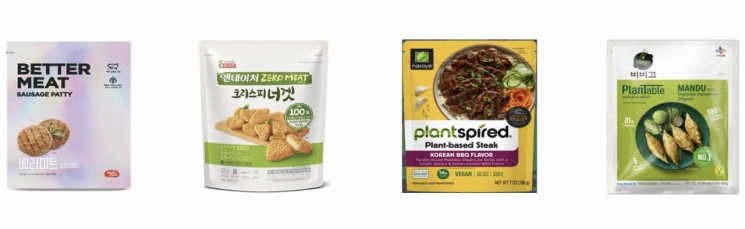 Alternative food products from domestic companies. (From left) Shinsegae Food, Lotte Wellfood, Pulmuone, CJ CheilJedang.
According to the Ministry of Food and Drug Safety, alternative foods are foods labeled and sold as manufactured using plant-based ingredients, microorganisms, edible insects, cell cultures, etc., instead of animal-based raw materials, to have similar forms, tastes, and textures as existing foods. Generally, it refers to foods that replace animal-based protein and are classified according to raw materials. It mainly refers to foods using ingredients such as alternative meat made from plant-based protein extracted from soybeans and mushrooms, as well as plant-based sauces and plant-based cheese.
Among alternative foods, processed meats such as ham and sausages (31.0%) were the most purchased, followed by prepared foods containing alternative meat (28.7%) and processed foods (27.5%). Consumers generally tended to purchase cooked and processed forms of food rather than raw ingredients (processed/cooked foods 52.8%, uncooked ingredients 36.3%, others 10.9%), which is interpreted as cooked alternative foods providing a familiar taste that consumers already know, resulting in less rejection.
The main reason for purchasing alternative foods was simple curiosity at 39.3%, but many also bought them for health management (38.1%) and weight management (27.7%). Considering that satisfaction with the taste and texture of alternative foods is still not high, it seems that consumers view them more as a curiosity to try for health and weight management rather than expecting a taste similar to regular foods. In particular, satisfaction with price was only 13.9%, indicating that forming a price range acceptable to the general consumer will be key to the growth of the alternative food market.
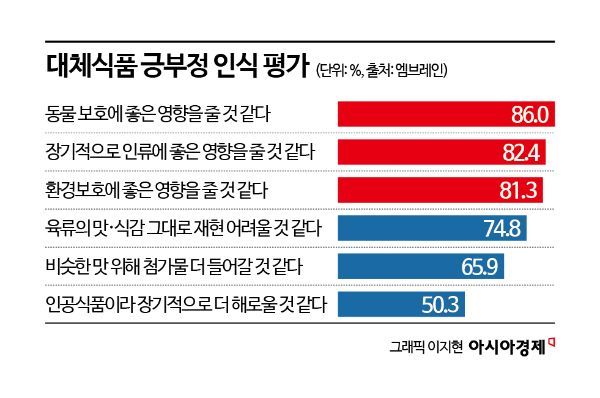
Most respondents agreed on the sustainability of alternative foods. 82.4% of all respondents evaluated that alternative foods would have a positive impact on humanity in the long term, and 79.9% thought they would be a good choice not only for vegetarians but for everyone. Of course, concerns remain that even with technological advances, it is difficult to replicate the taste and texture of meat (74.8%), and that more additives might be used to achieve a taste similar to regular foods (65.9%), but overall, positive evaluations were more prevalent.
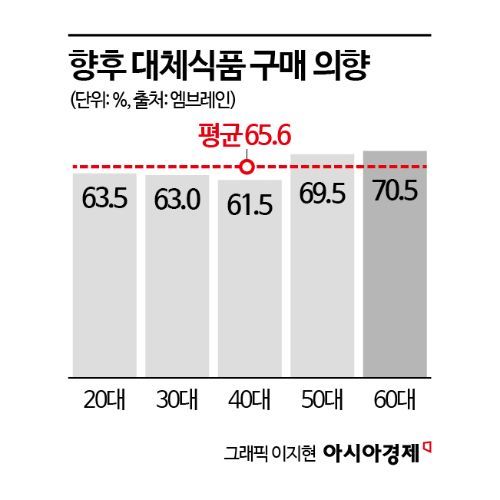
Accordingly, 65.6% of all respondents, or seven out of ten, plan to purchase alternative foods in the future. Notably, compared to those in their 20s (63.5%) and 30s (63.0%), purchase intentions were higher among older age groups such as those in their 50s (69.5%) and 60s (70.5%), suggesting that these generations are more sensitive to the environmental and ethical benefits of alternative foods.
Meanwhile, in South Korea, major companies such as CJ CheilJedang (Plantable), Shinsegae Food (Better Meat), and Pulmuone (Jigu Sikdan) are launching brands through the in-house development of plant-based meat, but the level of popularization remains low. The plant-based dairy market, except for soy milk which holds 80% market share, is still in the early stages of growth. Additionally, although the production and sales scale of insect foods are still small, the market is continuously expanding, centered on startups manufacturing alternative meat using protein extracted from mealworms.
© The Asia Business Daily(www.asiae.co.kr). All rights reserved.
![Clutching a Stolen Dior Bag, Saying "I Hate Being Poor but Real"... The Grotesque Con of a "Human Knockoff" [Slate]](https://cwcontent.asiae.co.kr/asiaresize/183/2026021902243444107_1771435474.jpg)


















