Spinach and Cucumber Double, Napa Cabbage Up 23.3%
"Poor Growth and Decreased Production Are the Causes"
As the monsoon season begins in earnest, the prices of vegetables are soaring. In particular, lettuce, which is vulnerable to heavy rain, has seen its price triple in just two months. Additionally, with Chobok (July 15) approaching, prices of livestock products are also on the rise, raising concerns that price volatility could increase further due to weather changes such as heatwaves and typhoons after the monsoon season.
According to the agricultural product distribution information released on the 9th by the Korea Agro-Fisheries & Food Trade Corporation (aT), the wholesale auction price of premium lettuce at Garak Market in Songpa-gu, Seoul, was 30,207 KRW for 4 kg as of the 8th, nearly double compared to last month (16,694 KRW). Compared to the price at the end of May (10,088 KRW), it has surged nearly threefold.
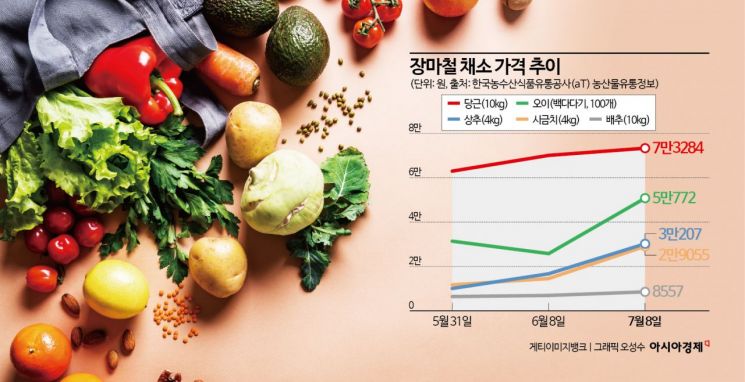
Prices of other vegetables are also on the rise. As of the previous day, spinach (4 kg) was priced at 29,055 KRW, doubling from the previous month (14,545 KRW), marking a 147.9% increase compared to the end of May (11,719 KRW). Napa cabbage (10 kg) recorded 8,557 KRW, up 23.3% from a month ago (6,936 KRW).
Additionally, carrots (20 kg) rose 4.6% to 73,284 KRW compared to the previous month, and cucumbers (Baekdadagi variety, 100 pieces) surged nearly twofold to 50,772 KRW from 25,796 KRW the previous month.
The problem is that the upward trend in vegetable prices may continue. aT stated regarding the outlook for major vegetable prices, "It is expected that the volume of work in production areas will decrease due to the impact of the monsoon," adding, "A firm upward trend is anticipated due to poor growth and reduced production."
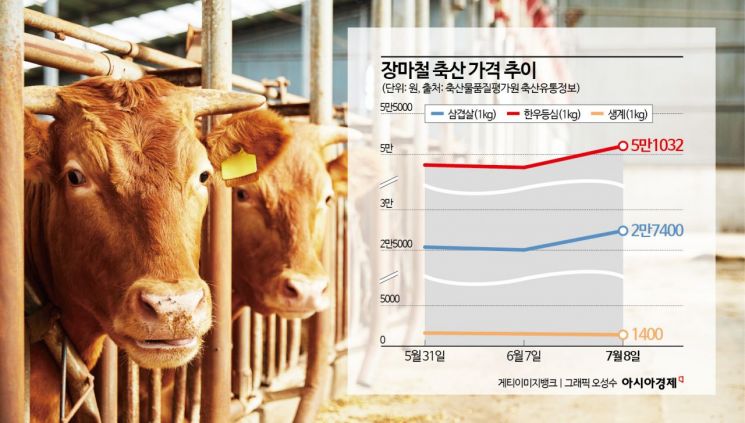
Following the sharp rise in vegetable prices, livestock product prices are also recording steep increases. According to the Livestock Products Quality Evaluation Service's livestock distribution information, as of the 8th, the consumer price of pork belly (1 kg) was 27,400 KRW, up 9.4% compared to 25,040 KRW on the 7th of last month. The wholesale price of Korean beef sirloin (1 kg) was 51,032 KRW, a 5.4% increase from 48,382 KRW on the 7th of the previous month. However, the wholesale price of chicken, a representative health food for Boknal (the hottest days of summer), remained stable at 1,400 KRW per kg, compared to 1,521 KRW on the 7th of last month.
The rapid rise in agricultural product prices appears to be caused by poor growth and shipment delays in major production areas, leading to reduced market supply. aT explained through trading trends, "Due to continued heat and rain, growth is poor," and as shipment volumes decrease, prices are rising.
The monsoon and heatwaves can cause delayed growth and poor quality in vegetables, as well as attract pests and diseases. Especially for highland vegetables vulnerable to rain and heat, there can be melting phenomena, and even facility-grown vegetables suffer from delayed growth and other adverse effects. Delays in growth in production areas directly affect prices. According to the Korea Rural Economic Institute, this month's summer napa cabbage production is expected to decrease by 4.3% compared to last year, open-field spring radish by 15%, and carrots by 11.5%.
The distribution industry is closely monitoring the rise in vegetable and livestock product prices ahead of peak seasons such as vacation periods and Boknal. While the sharp rise in agricultural product prices is a seasonal issue that can be resolved relatively quickly, the burden inevitably increases if wholesale prices rise amid rising labor costs.
Major large retailers such as E-Mart, Lotte Mart, and Homeplus are diversifying production areas and expanding supply through smart farm cultivation of leafy vegetables vulnerable to the monsoon. A representative from a major retailer said, "Major distributors have already secured some volume through advance purchases," adding, "However, if wholesale prices rise, we cannot avoid being affected, so we are closely monitoring the situation."
© The Asia Business Daily(www.asiae.co.kr). All rights reserved.
![Clutching a Stolen Dior Bag, Saying "I Hate Being Poor but Real"... The Grotesque Con of a "Human Knockoff" [Slate]](https://cwcontent.asiae.co.kr/asiaresize/183/2026021902243444107_1771435474.jpg)

















