41% of Rainy Season Traffic Accidents Over 5 Years
Hydroplaning Causes Severe Slipping
Increased Braking Distance and Poor Lane Visibility Also Issues
During the rainy season, when the rate of traffic accidents increases, "stealth lanes"?lanes that appear blurred due to accumulated rainwater?are threatening driver safety. Experts emphasize the need to repair old lanes with reduced reflective performance using high-visibility functional paint.
According to the Ministry of the Interior and Safety, from 2019 to 2023, a total of 27,266 traffic accidents occurred on wet roads during the summer months (June to August), accounting for 41% of all wet road traffic accidents. Among these, July recorded the highest number of wet road traffic accidents in the year, with 10,325 cases resulting in 177 deaths and 15,406 injuries.
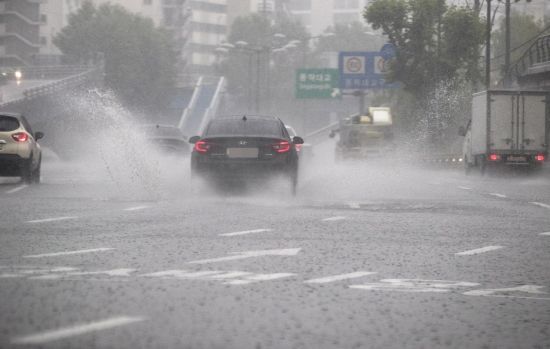 During the rainy season, cars are driving on wet roads.
 [Photo by Yonhap News]
An official from the Ministry of the Interior and Safety stated, "During the summer, the rate of traffic accidents increases significantly due to slippery roads and driver glare. Recently, due to climate change, short and intense localized heavy rains have become more frequent, and especially this summer, more rainfall than average is expected, so special caution is needed to prevent wet road traffic accidents."
During the rainy season, when rain falls frequently, the "hydroplaning phenomenon" that occurs between tires and the road surface causes a sharp increase in traffic accidents. Hydroplaning refers to the phenomenon where a layer of water forms between the tire and the road surface when driving at high speed on a water-covered road. When hydroplaning occurs, the wheels fail to properly grip the road and move as if floating on water, which significantly increases vehicle skidding. Another problem is the extended braking distance. As the friction between the road surface and the car tires weakens, the braking distance lengthens, causing the vehicle not to stop immediately even when the brakes are applied, sometimes leading to major accidents.
Dr. Woo Seung-guk of the Korea Transport Institute explained, "Braking distance measures how far a vehicle travels before stopping after the brakes are applied. When it rains, the friction between the road surface and tires decreases, lengthening the braking distance," and advised, "Drivers should reduce their speed by about 20-30% of the speed limit on rainy days to prevent accidents."
The phenomenon of rainwater accumulating and blurring lane markings is also one of the causes that increase traffic accident rates during the rainy season. When painting lanes, tiny glass beads are added to the paint to reflect car headlights well at night or on rainy days, but when rainwater accumulates, this reflective ability significantly decreases.
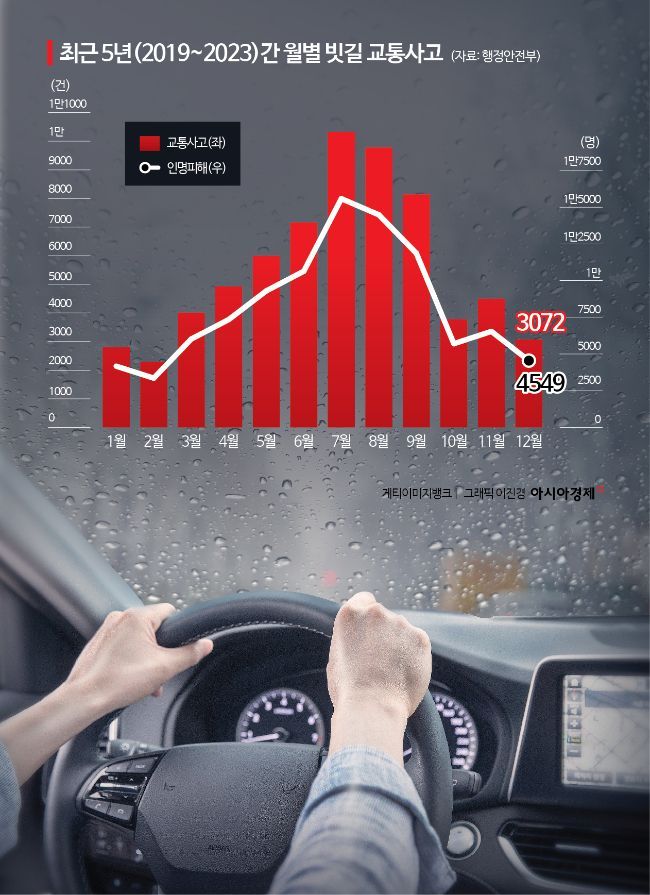
Domestically, repair work is underway to repaint lanes with high-visibility paint. Korea Expressway Corporation, the Ministry of Land, Infrastructure and Transport, and local governments plan to gradually expand the work from high-risk highways to local national roads and city streets.
However, the cost of the work is considerable, so progress is slow. According to officials, the unit price of functional paint is about 6,200 to 6,300 KRW per meter, which is up to 1.8 times more expensive than regular paint. Among local governments, Seoul was the first to start replacing existing lanes with functional lanes in 2021, but progress remains slow. From 2021 to June this year, Seoul repainted a total of 1,994 km of lanes, which accounts for only 27.6% of the total lanes in Seoul (7,216 km).
Professor Choi Jae-won of the Road Traffic Authority said, "The degree to which objects are visible from a distance is called 'luminance' in technical terms, and the luminance of lane markings in Korea is lower compared to advanced countries like Japan," adding, "The problem of poorly visible lanes is critical on rainy days, so repair work is urgent, but progress is slow due to budget and other issues."
© The Asia Business Daily(www.asiae.co.kr). All rights reserved.

















