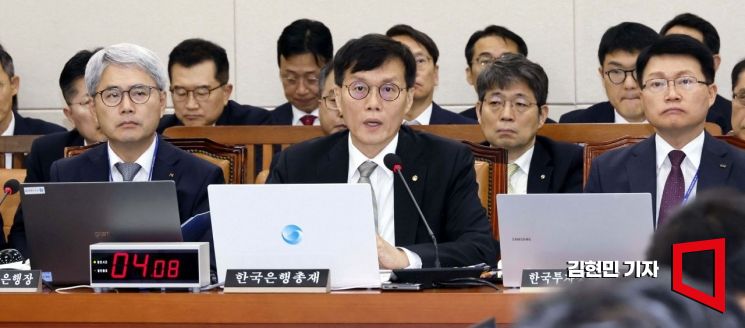
 Lee Chang-yong, Governor of the Bank of Korea, is speaking at the plenary meeting of the Planning and Finance Committee held at the National Assembly on the 9th. Photo by Hyunmin Kim kimhyun81@
Lee Chang-yong, Governor of the Bank of Korea, once again emphasized the independent decision-making of monetary policy. He also stated that the government's use of the Bank of Korea's overdraft facility helps reduce fiscal costs for the overall national economy.
Governor Lee said on the morning of the 9th during a special session of the Planning and Finance Committee at the National Assembly in Yeouido, Seoul, in response to a question about the Bank of Korea's independence, "We will listen to opinions from various sectors, but decisions will be made independently in consultation with the Monetary Policy Committee."
This response came during a question from Ahn Doo-gul, a member of the Democratic Party, who asked about the governor's stance amid recent pressure from the government and ruling party to lower the base interest rate.
Governor Lee stated, "I believe that all opinions should be heard, and based on those opinions, the Monetary Policy Committee should independently decide (monetary policy)."
He also explained that the government's use of the Bank of Korea's overdraft facility helps reduce fiscal costs for the national economy as a whole.
Governor Lee responded this way to a point raised by Kim Tae-nyeon, a Democratic Party lawmaker, who noted that the government, facing a tax revenue shortfall, borrowed a record high of 91.6 trillion won through the Bank of Korea's temporary loan system in the first half of this year alone.
Governor Lee said, "The average balance of temporary borrowings does not exceed the average balance of fiscal bonds, and we are consulting with the government in advance to ensure that the funds are recovered before the 63-day maturity of the fiscal bonds."
He added, "When the government faces a tax revenue shortfall and needs to secure liquidity, there are two methods: issuing fiscal bonds or issuing Monetary Stabilization Bonds (after borrowing). Using the Bank of Korea's window has the advantage of reducing financial costs."
He also said, "Whether to issue fiscal bonds or Monetary Stabilization Bonds is a matter for the National Assembly to decide."
© The Asia Business Daily(www.asiae.co.kr). All rights reserved.
![Clutching a Stolen Dior Bag, Saying "I Hate Being Poor but Real"... The Grotesque Con of a "Human Knockoff" [Slate]](https://cwcontent.asiae.co.kr/asiaresize/183/2026021902243444107_1771435474.jpg)
















