First Senior Appointment Process After Confirmation of Public Research Institute Deregulation and Innovation Plan
Attention on Whether Changes Will Occur Amid Concerns of Research Gaps
The appointment process for the heads of government-funded research institutes under the Ministry of Science and ICT has resumed after about seven months. With the public institution status of science and technology research institutes lifted and innovation plans finalized, there is growing pressure to expedite personnel appointments that have been stalled and accelerate research efforts.
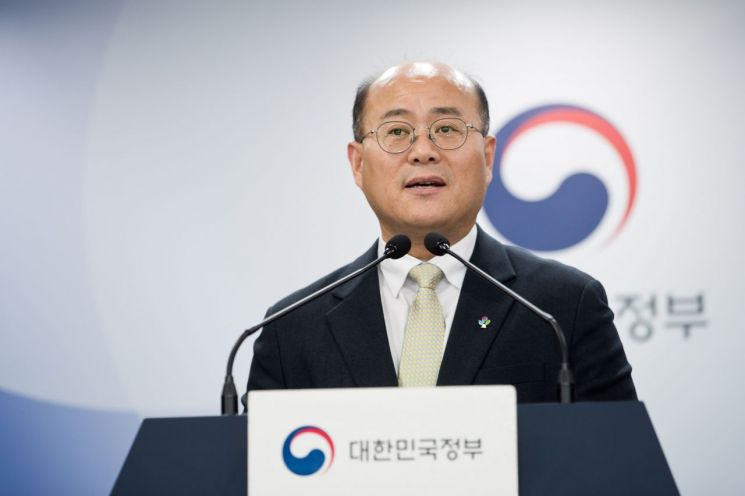 Lee Chang-yoon, 1st Vice Minister of the Ministry of Science and ICT, is giving a briefing on the "Measures to Promote the Dynamism of the R&D Ecosystem and Activation of Knowledge Fluidity in Science and Technology Research Institutes" on the 26th at the Government Seoul Office in Jongno-gu, Seoul.
 [Image source=Yonhap News]
According to the National Science and Technology Council (NST) on the 9th, the recruitment process for the heads of three research institutes?the Korea Food Research Institute, Korea Railroad Research Institute, and Korea Institute of Oriental Medicine?is currently underway this month. The director of the Safety Evaluation Research Institute affiliated with the Korea Research Institute of Chemical Technology is also being recruited. Although the terms of these institute heads ended in April, the procedures to select successors only began this month, about three months later.
This marks the first time in about seven months since last December that NST has initiated the appointment process for heads of affiliated research institutes, following the announcement of recruitment for the Korea Institute of Science and Technology (KIST) and the Korea Institute of Materials Science.
Although the successor appointment process should begin before the incumbent's term ends, the process has started only after the terms expired, resulting in an abnormal situation where outgoing heads continue to lead their organizations temporarily until successors take office. The scientific community expects that even if the process proceeds normally, appointments will likely be finalized around autumn. This means the new heads will have to prepare management plans for the new year within just two to three months of taking office.
That is the best-case scenario. In some research institutes such as KIST and the Materials Institute, candidates who reached the board level were found unsuitable, leading to repeated re-advertisements and causing successor appointments to take up to a year.
Since no one has succeeded in renewing their term despite being eligible under the current administration, attention is also focused on whether any will succeed in reappointment. The Korea Institute of Science and Technology Information (KISTI) and the Korea Institute of Civil Engineering and Building Technology have received excellent ratings in institutional evaluations, and NST is currently reviewing their reappointment. Lee Kwang-bok, chairman of the Korea Research Foundation, whose term ends in September, has also expressed his intention to seek reappointment. NST itself must find a new leader, as the current NST chairman Kim Bok-cheol’s term ends at the end of this month.
The delay in appointing heads of research institutes is not unique to NST. The Science and Technology Policy Institute (STEPI), under the National Research Council for Economics, Humanities and Social Sciences, has only recently finalized three candidates for its head position about five months after the resignation of former director Moon Mi-ok, and is awaiting approval from the council’s board.
The situation is even more ambiguous for the Korea Aerospace Research Institute and the Korea Astronomy and Space Science Institute, which were transferred to the newly established Space Agency under NST. The Space Agency is supposed to reorganize the boards of these institutes and lead the appointment of new heads, but it has instead started work consultations with the outgoing directors whose terms have expired. There is effectively no plan for appointing successors.
Beyond research institutes, leadership positions at public institutions under the Ministry of Science and ICT whose terms have expired or are about to expire also need to be filled. The heads of the Korea Institute of S&T Planning and Evaluation (KISTEP), the Korea Foundation for the Advancement of Science and Creativity, and the University of Science and Technology (UST) have either completed their terms or are nearing expiration, but solutions remain elusive.
© The Asia Business Daily(www.asiae.co.kr). All rights reserved.

















