Heart Attack Death the Day After Posting Mukbang
Health Minister: "Overeating Promotion Threatens Public Health"
A famous YouTuber in the Philippines died the day after a 'mukbang' video, prompting Philippine authorities to consider banning mukbang content. On the 8th (local time), local media Inquirer reported that Teodoro Herbosa, the Philippine Secretary of Health, is reviewing a ban on mukbang content. This follows the death of the popular mukbang YouTuber 'Dongjeu Apatan,' who had 470,000 Facebook followers and passed away on the 14th of last month.
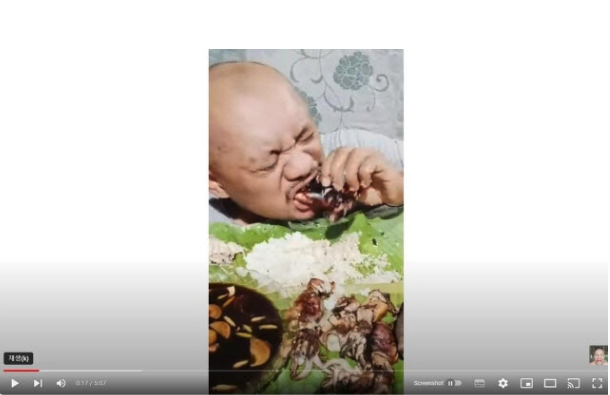 Famous mukbang YouTuber 'Dongjeu Apatan,' who has 470,000 followers on Facebook, suddenly passed away from a heart attack on the 14th of last month.
 [Photo by YouTube channel 'Dongjeu Apatan']
Apatan, who lived in Iligan City, Lanao del Norte province on the southern island of Mindanao, posted a mukbang video cooking and eating chicken and rice the day before he died of a heart attack. Secretary Herbosa criticized, "They (mukbang YouTubers) are encouraging people to eat like gluttons," adding, "Overeating is unhealthy. It leads to obesity." He continued, "(Mukbang YouTubers) are promoting unhealthy behaviors to the Filipino public," emphasizing, "We must stop making money through something that poses a public health threat." Herbosa also stated, "We need to first investigate why this person died and determine whether health-related regulatory authorities can ban such activities on the grounds that they are harmful to health."
The Department of Health plans to push for a ban on mukbang content on websites and social networking service (SNS) platforms if investigations reveal a link between mukbang and Apatan's death. Finally, Secretary Herbosa stressed, "Since this is basically 'food porn,' we may request the Department of Information and Communications Technology (DICT) to block such sites."
Watching Mukbang Harms Public Health... Youth Obesity Risk Increases by 22%

Mukbang is considered a new culture that first emerged in South Korea in the early 2000s. At that time, some young people who had to eat alone connected online through others' mukbang videos, turning eating from a simple act into a social activity. Over 20 years later, mukbang has expanded its scope, spreading into related genres such as 'cookbang,' which focuses on cooking, and 'sulbang,' which involves drinking alcohol. However, concerns have been raised that watching mukbang may lead to poor eating habits or health problems.
Videos showing excessive consumption of nutritionally poor or high-calorie foods can induce overeating in viewers, potentially causing obesity or eating disorders. Recent domestic research has confirmed these concerns.
A research team from Yonsei University College of Medicine's Department of Preventive Medicine (Park Eun-cheol, Kim Jin-hyun) reported in the latest issue of the international journal Nutrition Journal that an analysis of 50,453 middle and high school students (25,749 boys, 24,704 girls) from over 800 schools participating in the 2022 Korea Youth Risk Behavior Survey found an association between watching mukbang and increased obesity risk.
The research team categorized the students' body mass index (BMI) into four groups: underweight, normal, overweight, and obese, and analyzed their frequency of watching mukbang over the past 12 months. The results showed that 63.9% of boys and 79.2% of girls watched mukbang. Among boys who watched mukbang, the rates of overweight (11.2%) and obesity (16.7%) were significantly higher than underweight (6.9%), while among girls, the differences among underweight (9.5%), obese (9.2%), and overweight (8.0%) were less pronounced than in boys.
The team estimated that boys who watched mukbang at least once a week had a 22% higher risk of becoming obese compared to boys who did not watch mukbang at all. Particularly, boys who combined mukbang viewing with smoking, drinking, frequent fast food consumption, and sugary drink intake were more likely to be obese. In contrast, under the same conditions, the obesity risk for girls was only 0.9%, showing no significant association as seen in boys.
© The Asia Business Daily(www.asiae.co.kr). All rights reserved.


















