China Rejects All UPR Recommendations Including Protection of Talbukmin
Government Tried Public Discussion but Could Not Specify 'Refugees'
Preparing for Year-End North Korea UPR... Must Include 'Clear Criticism'
The government first recommended "protect North Korean defectors" during the Universal Periodic Review (UPR) against China held at the United Nations Human Rights Council in January this year, but it has been confirmed that China expressed a position of "rejection" to all recommendations. China repeated the argument that North Korean defectors are not refugees.
According to the United Nations Office of the High Commissioner for Human Rights (OHCHR) on the 9th, the Chinese government recently submitted the review results of the recommendations made by various countries during the UPR held in January to the UN. In the report, China maintained its existing policy of "not recognizing North Korean defectors as refugees." It considers North Korean defectors in China as "illegal border crossers (illegal residents) who crossed the border illegally to earn money" and does not protect them.
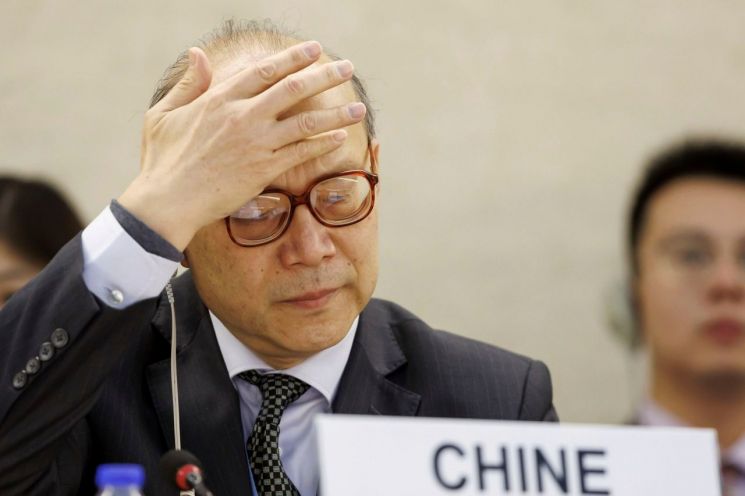 Chen Xu, Ambassador of the Permanent Mission of China in Geneva, attending the Universal Periodic Review (UPR) on China held in Geneva, Switzerland, in January 2024.
 [Photo by AP Yonhap News]
The UPR is a representative UN human rights protection mechanism. It regularly reviews the human rights situation of all member states and recommends that countries under review amend laws, systems, and policies. This time, the China UPR attracted attention because the government, which had focused on "quiet diplomacy," explicitly mentioned and recommended the issue of "North Korean defectors" for the first time. At that time, South Korea recommended four items to China: ▲Providing appropriate protection for North Korean defectors ▲Adhering to international norms such as the principle of non-refoulement ▲Considering the introduction of domestic refugee laws to implement the Refugee Convention ▲Measures to ratify the International Covenant on Civil and Political Rights.
According to the report, China rejected the recommendation to protect North Korean defectors with the response that "North Korean entrants who illegally entered for economic reasons are not refugees." Regarding the demand to comply with international norms such as the principle of non-refoulement, China argued that it is "already implementing" them. Also, regarding the recommendation to consider introducing domestic laws to implement the Refugee Convention, China practically expressed refusal, saying "domestic conditions must be considered." The only recommendation China accepted was related to the International Covenant on Civil and Political Rights. This did not require immediate ratification but only to take necessary steps, so it did not impose a significant burden.
UPR recommendations do not have legal binding force. Therefore, recommendations made by countries conducting "human rights audits" must be clear to increase the burden on the country under review. In this regard, the government's first mention of the North Korean defector issue was a progressive achievement, but there are also evaluations that the content was somewhat disappointing. Critics argue that by not clearly expressing North Korean defectors exposed to the risk of forced repatriation as "refugees," the government accepted China's logic.
When recommending protective measures for North Korean defectors, the government used the expression "escapees of foreign origin, including from the DPRK." Escapees is a comprehensive term referring to North Korean defectors and others. When implying protection under the Refugee Convention, such as in the case of forced repatriation, the term refugees is used. A representative example is the Czech government’s recommendation in this UPR to "Refrain from the forcible repatriation of North Korean 'refugees' to the DPRK."
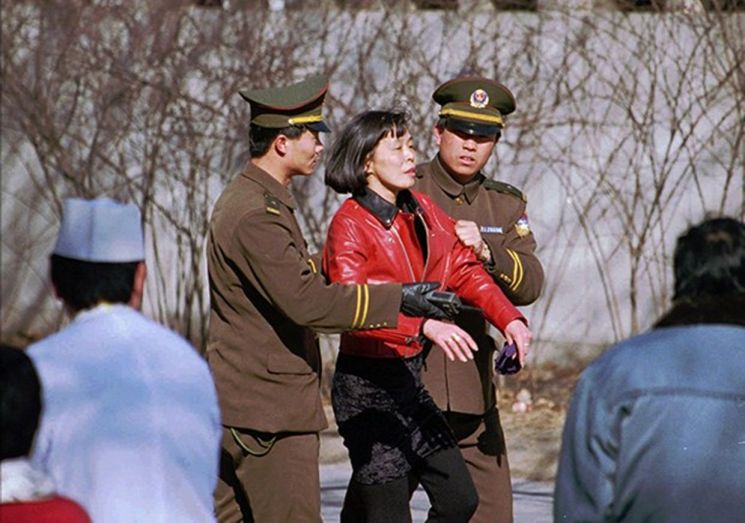 A woman being dragged by Chinese police outside the Korean Consulate in Beijing, China. [Image source=AP Yonhap News]
Shin Hee-seok, former legal analyst at the Transitional Justice Working Group (TJWG), pointed out, "Even if they defected to earn money, forced repatriation exposes them to political prison camps and torture, which falls under the principle of non-refoulement," and emphasized, "It is important to point out such logical loopholes and use the clear term refugees." He added, "If there are concerns about rebuttal, expressions such as 'refugees and other persons' can be used according to the wording adopted annually in the UN General Assembly and Human Rights Council resolutions on North Korean human rights."
Meanwhile, the North Korea UPR is scheduled for November. Since South Korea should lead the discussion more than any other member state, attention is focused on whether it will demand clearer accountability than in the China UPR. Kang Jong-seok, Director of the Human Rights and Humanitarian Affairs Division at the Ministry of Unification, said, "We should urge North Korea to join the 'Convention against Torture' during the North Korea UPR review." On the 4th, Lee Cheol, Director of the International Organizations and Nuclear Affairs Bureau at the Ministry of Foreign Affairs, held a briefing session for civil society and academia in preparation for the North Korea UPR and stated, "Since this is a rare opportunity to engage North Korea through UN mechanisms, it must be utilized well."
© The Asia Business Daily(www.asiae.co.kr). All rights reserved.
![User Who Sold Erroneously Deposited Bitcoins to Repay Debt and Fund Entertainment... What Did the Supreme Court Decide in 2021? [Legal Issue Check]](https://cwcontent.asiae.co.kr/asiaresize/183/2026020910431234020_1770601391.png)

















