Atacama Desert in Chile Rarely Begins Blooming in July
Usually Observed in Years with Heavy Rainfall Due to El Ni?o
'Driest Region'... Also a Center for Copper Production
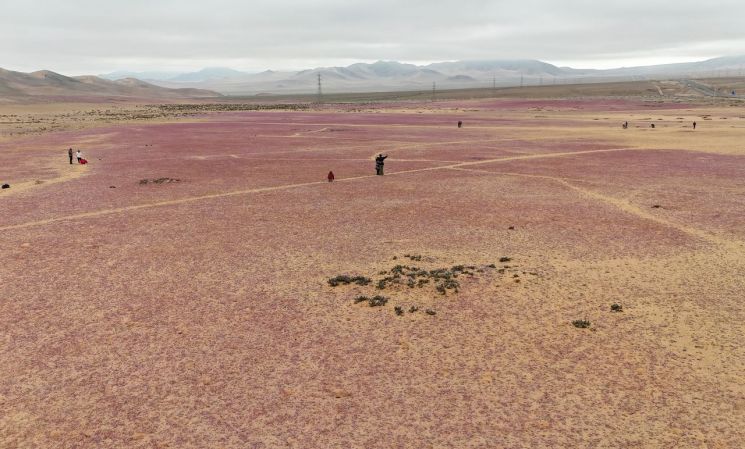
In the Atacama Desert in Chile, known as the driest place on Earth, blooming flowers have been observed in the middle of winter, drawing attention. On the 8th (local time), the Chilean media outlet La Tercera reported, "In the Atacama Desert located west of the Andes Mountains in northern Chile, colorful flowers have bloomed over the past few days." Flowering in the Atacama Desert is generally known to occur once every 5 to 7 years, usually unfolding into vast flower fields between September and mid-October, which corresponds to spring in the Southern Hemisphere.
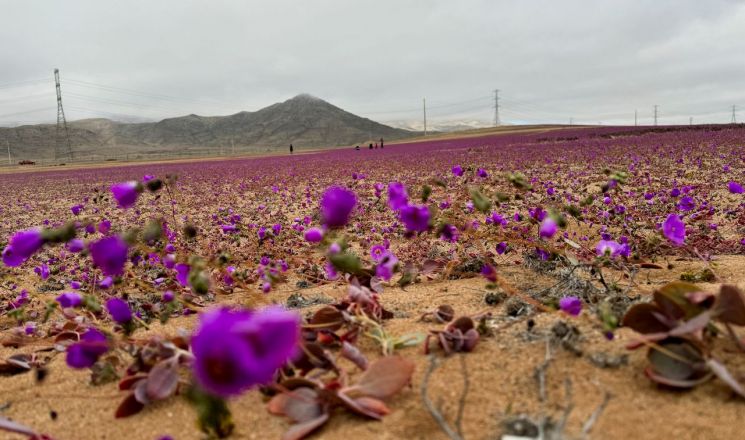
However, this year, blooming occurred around July, which corresponds to midwinter, and the desert is now adorned with flowers. It is reported that this blooming after enduring such harsh conditions is the first time in nine years since April to May 2015. Although flowers were also observed in June 2021, local media reported that they bloomed only in small, localized areas.
This blooming in the arid desert is usually witnessed in years when there is more rainfall than usual, often due to El Ni?o. Regarding this blooming, C?sar Pizarro, head of the Atacama Biodiversity Conservation Team at the Chilean National Forest Corporation (CONAF), said, "It appears to be due to rainfall that started in autumn." He explained, "At least 15mm of rainfall is expected in the Atacama Desert within the next six weeks," adding, "By July to August, the 'flowering desert phenomenon' (Desierto Florido) will be fully visible."
In fact, heavy rain poured in Chile last month. According to the Chilean National Emergency Office, from the 13th of last month for three days, central Chile recorded up to 350mm of rainfall, which is more than the total rainfall for the entire year of 2023. The Chilean Meteorological Agency forecasted that by the 14th, around 80mm of rain?equivalent to the average rainfall for the entire month of June?would fall in the capital, Santiago. In response, the Chilean government has issued the highest level of disaster warnings in five out of sixteen regions.
The Atacama Desert is one of the driest deserts on Earth, with some areas reportedly not having received rain for over 500 years. Although it appears barren, it is the center of Chile’s copper production, producing one-third of the world’s copper, and is also a tourist attraction. Since the late 20th century, local governments have strictly prohibited picking flowers during the Atacama Desert’s blooming period through their own laws and regulations, and have restricted vehicle traffic to preserve the 'flowering desert phenomenon.' The Chilean central government also established a national park in July 2023 to protect over 200 species of flowers and plants and manage the area.
© The Asia Business Daily(www.asiae.co.kr). All rights reserved.
![Clutching a Stolen Dior Bag, Saying "I Hate Being Poor but Real"... The Grotesque Con of a "Human Knockoff" [Slate]](https://cwcontent.asiae.co.kr/asiaresize/183/2026021902243444107_1771435474.jpg)

















