Completion of Major Overhaul in 2022
Total Storage Capacity Secured at 930,000㎘
Stable Domestic Energy Supply
Strengthening Global Market Competitiveness
Expected to be a Core Axis of Energy Security
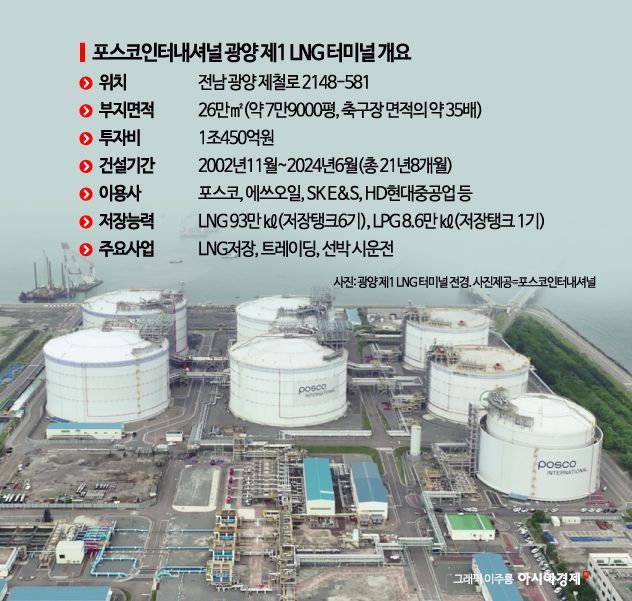
POSCO International's Gwangyang No. 1 Liquefied Natural Gas (LNG) Terminal was comprehensively completed on the 9th after 22 years of construction. This major project, which began in 2002 and involved an investment of approximately 1.045 trillion KRW, is expected to play a key role in energy security.
The completion ceremony held in Gwangyang was attended by about 100 people, including Choi Nam-ho, 2nd Vice Minister of the Ministry of Trade, Industry and Energy; Park Chang-hwan, Governor of Jeonnam Province; Jung In-hwa, Mayor of Gwangyang; Kwon Hyang-yeop, Member of the National Assembly; Choo Hyung-wook, President of SK E&S; Lee Sang-gyun, President of Hyundai Heavy Industries; Kim Hwan-yong, Vice President of Korea Gas Corporation; and Lee Gye-in, President of POSCO International.
President Lee Gye-in stated, "Through digital transformation that automates and optimizes the operation and management of the Gwangyang LNG Terminal, we will ensure a stable supply of domestic energy and continuously strengthen our competitiveness in the global energy market."
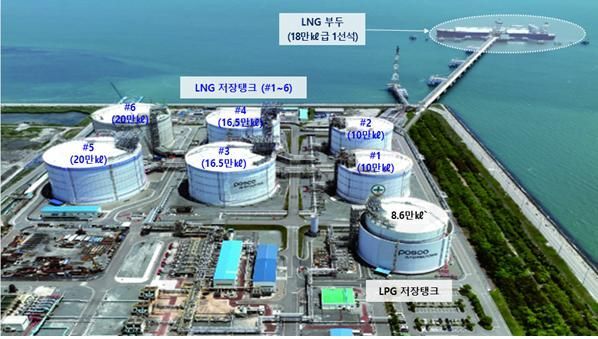
An LNG terminal receives LNG transported by carriers, stores it, vaporizes it, and supplies it to demand points through pipeline networks.
POSCO International’s No. 1 LNG Terminal was the first to be constructed by the private sector. It is equipped with six storage tanks with a total capacity of 930,000 kiloliters (㎘), vaporization and transmission equipment capable of 680 tons per hour, and port facilities that can berth LNG carriers with a capacity of 180,000 cubic meters. Storage tanks 1 through 5 have been operational since 2005, and with the completion of the 6th storage tank with a capacity of 200,000 ㎘, the No. 1 Terminal has been comprehensively completed.
The newly completed LNG terminal not only supplies natural gas for power generation and industrial processes as a national key industry but also provides comprehensive services including unloading, storage, vaporization, and transmission of natural gas directly imported by users such as POSCO, S-Oil, and SK E&S.
Notably, the 5th and 6th storage tanks feature cryogenic high manganese steel developed by POSCO for the first time in the world and applied domestically for the first time. Cryogenic high manganese steel is characterized by excellent impact toughness and strength in extreme environments below -162 degrees Celsius, the temperature required to maintain LNG in liquid form. Additionally, for the ground improvement work on the soft soil of Gwangyang Bay landfill, a new compaction pile method using steel by-products was applied, effectively replacing the use of natural aggregates.
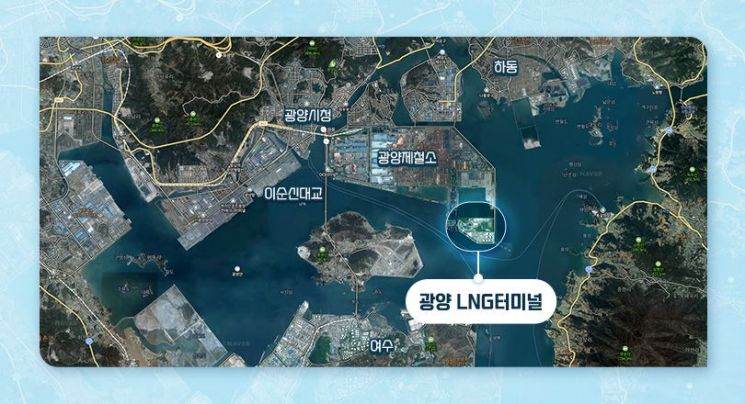
Since 2022, POSCO International has been investing 930 billion KRW to construct the No. 2 LNG Terminal. The No. 2 Terminal (storage tanks 7 and 8) is scheduled to be completed in July 2026. Upon completion, the Gwangyang LNG Terminal will have a total of eight LNG storage tanks with a storage capacity of 1.33 million ㎘. This capacity is enough to supply heating gas for the entire population for 40 days.
Considering that major countries worldwide are recently securing storage capacity in response to energy supply chain crises and increasing LNG demand, the LNG terminal is expected to play a crucial role in energy security.
POSCO International plans to establish a foundation for not only the existing LNG storage tank leasing business but also LNG vessel commissioning, bunkering business, and the promotion of blue hydrogen projects.
The government also intends to ensure fair access for the private sector to Korea Gas Corporation’s natural gas pipeline network. Private LNG power plants that directly import natural gas have demanded stable access to the pipeline network, and in December last year, the establishment of a Pipeline Facility Usage Review Committee was approved.
Vice Minister Choi said, "To efficiently utilize infrastructure such as LNG terminals, natural gas pipeline networks must be accessible fairly to everyone. Through the newly operating Pipeline Usage Review Committee in the second half of this year, we will support objective and fair decisions regarding the adjustment of natural gas inflow volumes for each terminal."
© The Asia Business Daily(www.asiae.co.kr). All rights reserved.



















