Experts Debate on Cause Analysis of Accident
"Brake lights turn on when brake is pressed even if ECU is faulty"
Reason for Emergency Brake System Failure
Need to Improve Reliability of Accident Data Recorder
Experts' analyses on the cause of the wrong-way driving accident near Seoul City Hall Station are divided. While experts who argue the possibility of sudden unintended acceleration point to a potential defect in the Electronic Control Unit (ECU), those emphasizing driver error counter that even if the ECU had malfunctioned, mechanical braking would have been possible if the driver had kept pressing the brake pedal until the end. This article analyzes three technical issues related to the accident and summarizes experts' opinions.
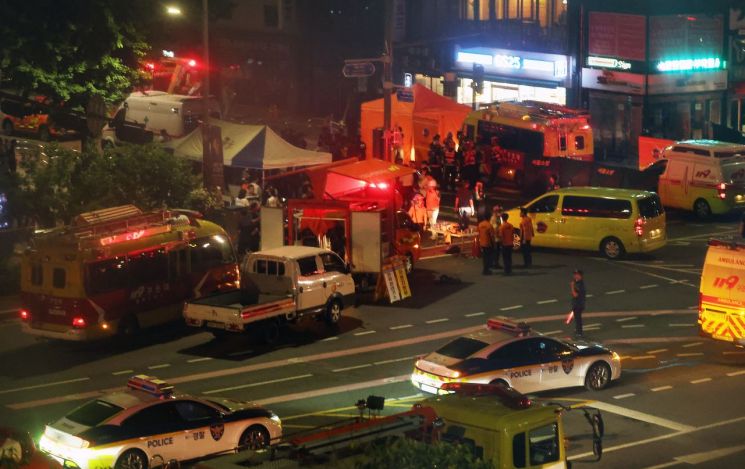 A major traffic accident caused by a passenger car driving in the wrong direction occurred on the 1st at an intersection near Seoul City Hall Station.
 [Photo by Yonhap News]
Can brake lights fail to turn on if the ECU breaks down?
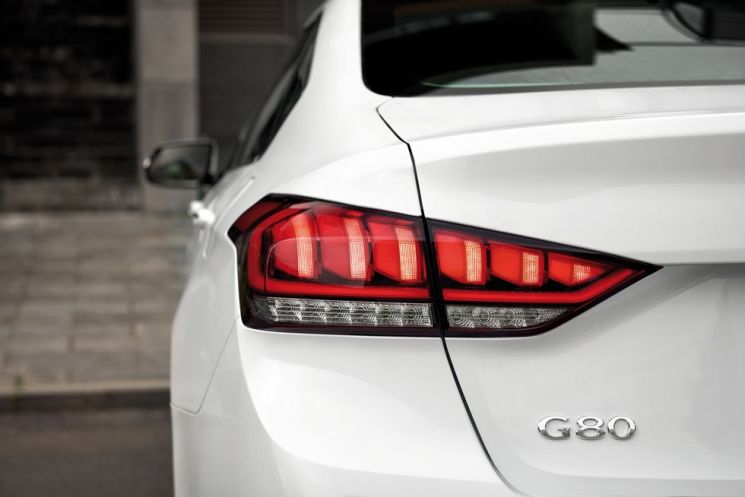
Automotive master Park Byung-il recently made this claim on a radio broadcast. Diagnosing sudden unintended acceleration as a highly likely cause of the accident, he stated, "This vehicle model determines whether the brake lights flash after passing through the ECU," and argued, "If the ECU breaks down, the brake lights may not turn on even if the brake pedal is pressed." The vehicle involved in the accident is a 2018 gasoline 3.3 G80 Genesis. According to police analysis, the CCTV footage of the accident showed that the brake lights of this vehicle did not turn on throughout the wrong-way driving.
Other experts, including the manufacturer, disagreed with his opinion. While the Genesis G80 equipped with electronic safety assistance devices has an ECU that can intervene in the flashing of brake lights, it cannot turn off the brake lights when the brake pedal is physically pressed. Of course, when electronic safety functions such as Smart Cruise Control, which automatically adjusts the distance to the vehicle ahead, or the Emergency Stop Signal (ESS), which rapidly flashes the brake lights to warn rear vehicles during sudden braking, are activated, the ECU plays a role in turning the brake lights on and off.
However, when a person presses the brake pedal with their foot, the signal does not pass through the ECU. In the vehicle's basic structure, the brake and brake lights are connected by simple physical wiring like a switch. Moreover, the accident vehicle is a model before the full introduction of electronic brakes and uses a hydraulic (mechanical) brake system. Professor Lee Ho-geun of Daeduk University’s Department of Future Automotive Engineering explained, "Brake lamps turn on whenever the brake pedal is pressed, even if the ignition is off," adding, "There is no possibility that the ECU would intervene to prevent the brake lights from turning on when the brake pedal is pressed."
Why did the emergency braking system not activate?
Some raise the possibility of an ECU defect because the vehicle's emergency braking system did not activate during the accident. Genesis’s Forward Collision-Avoidance Assist (FCA) uses radar and camera sensors to detect pedestrians or obstacles and emits warning sounds when the distance becomes close. Just before a collision, it applies emergency braking.
However, the FCA did not activate in this accident. There are three possible reasons. Currently sold Genesis models have FCA as a standard option, but in 2018 it was an optional feature. The driver may not have purchased this function at the time of delivery. Secondly, the driver may have turned off this function or the prerequisite function called Electronic Stability Control (ESC). According to the 2018 Genesis G80 user manual, this function can be turned on or off via the instrument panel settings and only operates when ESC is enabled.
Lastly, even if all FCA functions are enabled, the system can be deactivated if the driver fully presses the accelerator pedal or sharply turns the steering wheel. Since automatic braking by the car can sometimes be more dangerous depending on the situation, the driver’s intention takes precedence over the FCA function.
Recently, domestic new cars have been equipped with a Pedal Misapplication Prevention System (PMSA). While the FCA function is deactivated if the driver fully presses the accelerator pedal, the PMSA limits motor torque and cuts off power (fuel) supply if the driver makes sudden pedal operations while an obstacle is detected.
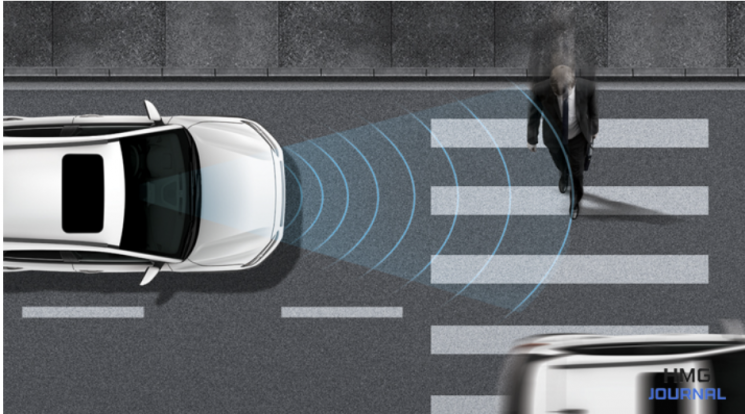 Example of Forward Collision-Avoidance Assist (FCA) equipped in Hyundai Motor Group vehicles
 [Photo by HMG Journal]
Can the EDR really be trusted?
The driver involved in the suspected sudden unintended acceleration accident raised concerns about the reliability of the Event Data Recorder (EDR), which is accepted as key evidence in court. They argue that data recorded by the EDR, a peripheral device, cannot be trusted if the ECU, the brain of the vehicle, malfunctions. In this accident, the EDR recorded that the driver pressed the accelerator pedal more than 90% just before the accident.
Experts agree that the EDR has limitations as a device to prove sudden unintended acceleration. However, among the data sources currently used for traffic accident analysis, the industry consensus is that the EDR is the most reliable. In other words, while EDR records cannot be a "magic box" that reveals the cause of all accidents including sudden unintended acceleration, it is the most useful data for accident analysis in modern science.
Professor Choi Young-seok of Wonju Hanla University’s Department of Future Mobility Engineering said, "If the vehicle malfunctions, the EDR may show 'error data' and fail to record, but it is impossible for false data to be recorded," adding, "However, to reduce the information gap between consumers and manufacturers, the number of data recording items should be increased, and an environment where anyone can access and analyze the data should be created." He continued, "Strengthening driving data recording is a cornerstone for preparing for the autonomous driving era."
© The Asia Business Daily(www.asiae.co.kr). All rights reserved.



















