June Gimbap Price Index Stays in 130s for 5 Months
Seaweed Prices Surge Due to Frozen Gimbap Exports
Tuna Gimbap Already Surpasses 5,000 Won
The price of gimbap, a representative affordable food for the common people, has been soaring for several months. The rise in seaweed prices, known as the "black semiconductor," continues due to the export surge of frozen gimbap, coupled with the increase in vegetable prices, including spinach, amid the rainy season. The price of gimbap, which has been a valuable meal for office workers, is on track to surpass an average of 3,500 won in Seoul.
According to Statistics Korea on the 9th, the consumer price index for gimbap last month was 132.70, up 5.2% from 126.12 the previous year. This figure also far exceeds the overall consumer price index of 113.84 in June. The consumer price index for gimbap has been rising more steeply this year. It increased from 129.68 in January to 130.37 in February, then to ▲130.67 in March ▲131.61 in April ▲132.40 in May, maintaining the 130 range for five consecutive months from February to June.
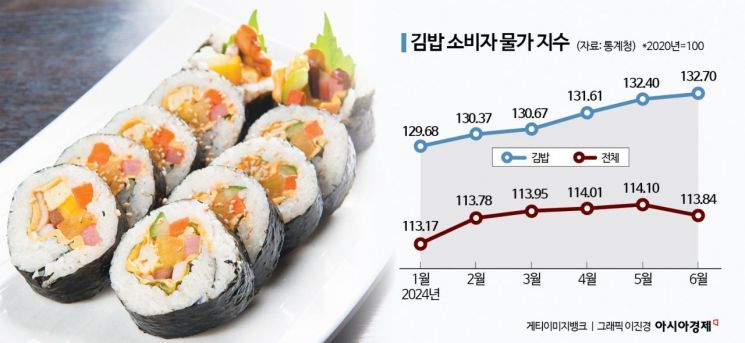
Gimbap Prices Rose Especially Amid Lunchflation... Soared Along with Seaweed Export Surge
The rise in gimbap prices, which provided a simple and delicious meal, is the result of increased costs for key ingredients including seaweed. According to the Korea Agro-Fisheries & Food Trade Corporation (aT) Agricultural Products Distribution Information, the wholesale price of dried seaweed is on average 10,700 won per bundle (one bundle = 100 sheets of seaweed), up 55.4% from last year, and the consumer price for 10 sheets of dried seaweed rose 30% to 1,326 won compared to last year.
The increase in seaweed prices is due to the global popularity of seaweed and gimbap. Seaweed, boasting excellent taste and nutrition, has established itself as a key export item, earning the nickname "black semiconductor." According to the Korea Customs Service, the export value of dried seaweed in June was approximately 50.02 million USD (about 69.2 billion won), setting a new record.
The rise in frozen gimbap exports has also fueled the increase in seaweed prices. The export volume of frozen gimbap in June was tentatively estimated at 164 tons, equivalent to about 5.06 million rolls.
On the other hand, seaweed production is declining due to rising seawater temperatures caused by climate change. As demand for seaweed increases while supply decreases, seaweed prices are soaring.
Besides seaweed, the prices of various vegetables used in gimbap are also burdensome. The retail price of spinach rose 30.1% in one week to 1,276 won per 100g. This is 65.5% higher than a month ago and 38.6% above the average of previous years. Carrots rose 5.6% in one week to 6,177 won per kilogram, which is 11.5% higher than a month ago and 74.8% more expensive compared to the average price.
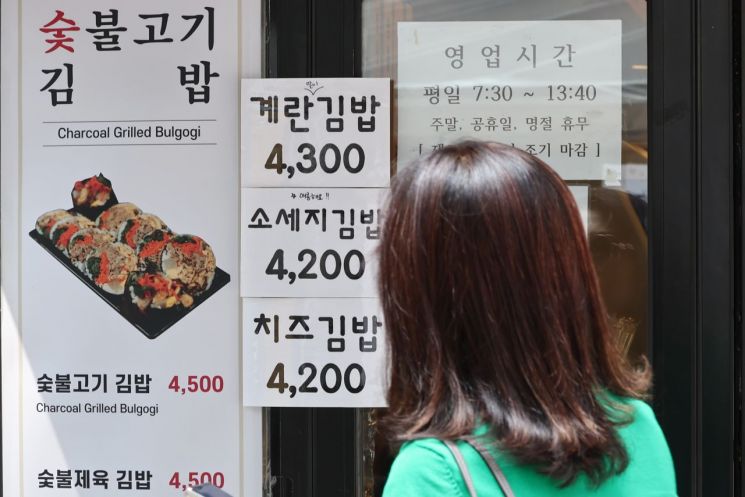
Even Large Corporations Join Frozen Gimbap Exports... Gimbap Prices Expected to Keep Rising
The upward trend in gimbap prices is expected to continue for the time being. Both small and medium-sized enterprises and large corporations are entering the frozen gimbap export market, increasing total production. Sajodaerim, which started exporting frozen gimbap in April, shipped a total of 36 tons combining the first and second initial shipments and additional orders. This corresponds to about 155,000 rolls of gimbap. They plan to export about 72,000 rolls monthly thereafter. Vegetable prices may rise further due to summer disasters such as heatwaves and typhoons following the rainy season.
Accordingly, the average price of a basic gimbap roll in Seoul is expected to exceed 3,500 won soon. According to the Korea Consumer Agency's comprehensive price information portal, Chamgaga, the price of gimbap in Seoul last month was 3,423 won, rapidly rising from 2,908 won in June 2022 and 3,200 won in June last year. Tuna gimbap, the next most popular after basic gimbap, is already sold at 5,000 won in major franchises. In Seoul, Gobongmin Gimbap is priced at 5,000 won, Kim Ga Ne at 5,500 won, and Gimbap Cheonguk ranges from 4,500 to 5,000 won.
© The Asia Business Daily(www.asiae.co.kr). All rights reserved.


















