Ministry of Science and ICT Announces Measures to Combat Voice Phishing
In the future, artificial intelligence (AI) technology will be used to determine whether someone is impersonating an acquaintance or involved in voice phishing, and a simple phishing report function is expected to be introduced on mobile phone devices.
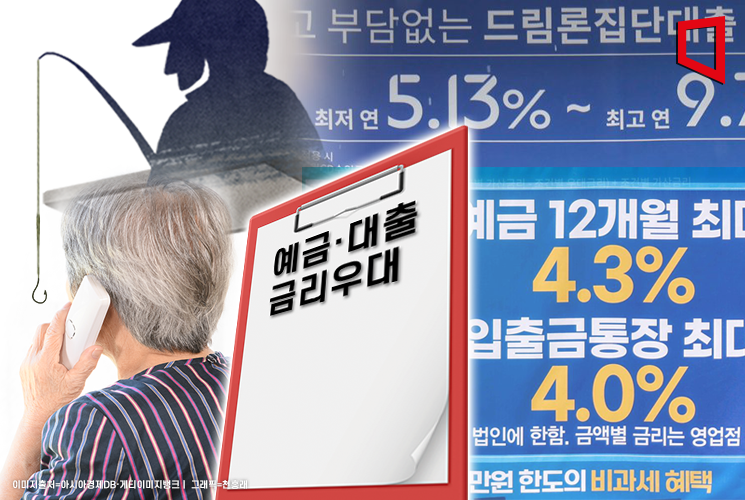
On the 8th, the Ministry of Science and ICT announced measures to respond to voice phishing in the telecommunications sector at the joint task force meeting on eradicating voice phishing and illegal private financing, chaired by the Director of the Office for Government Policy Coordination.
Since the beginning of this year, voice phishing crimes using digital new technologies have become more sophisticated, and bait and spam messages have increased significantly, creating a need for additional countermeasures.
Accordingly, the Ministry of Science and ICT plans to ▲prevent the creation of illegal spam accounts, the activation of burner phones, and identity theft, ▲expand awareness methods to prevent citizens from falling victim to voice phishing, ▲enable blocking of lines used in crimes or when damage occurs, and ▲establish a response system utilizing AI technology.
First, the requirements for entering the text message resale business, which sends mass text messages to customers, will be raised, and management and supervision of business operations will be strengthened.
In addition, to block the mass activation of burner phones, the restriction period for multiple line subscriptions under the same name will be extended from the current 30 days to 180 days, and identity verification procedures will be strengthened.
Promotion of the identity theft prevention service (M-safer), which allows easy and simple prevention of illegal use of mobile phones stolen under one’s name, will also be expanded.
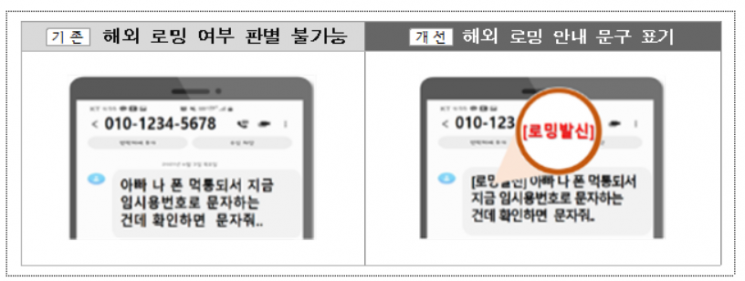
By displaying overseas roaming notification messages, damage caused by sending impersonation messages through abuse of mobile phone roaming services will be prevented, and the application of the 'Safe Mark Display Service' on messages sent by public and financial institutions will be expanded.
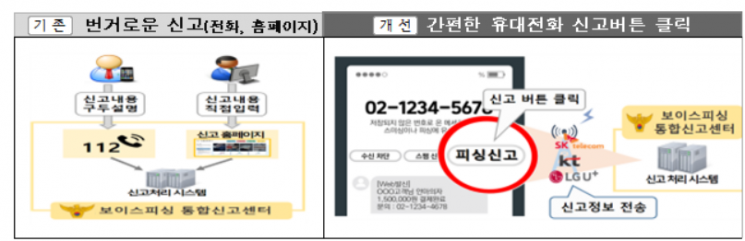
Following the introduction of the 'Spam Report' button on mobile phone devices in February last year, a 'Phishing Simple Report' button will be introduced.
If the caller ID is manipulated to make calls or send messages, not only the corresponding line but also all connected telephone lines and message sending accounts will be blocked to strengthen the phone number blocking policy.
A 'One-Stop Voice Phishing Guard (tentative name)' system will be established to quickly process necessary measures when a suspected voice phishing situation occurs. Until now, ordinary citizens had to connect and authenticate individually by institution and step to perform related actions such as inquiry, cancellation, and blocking, which was cumbersome.
For new methods such as deep voice, developing voice phishing detection technology using AI and data is important. Accordingly, the Financial Supervisory Service plans to provide 'criminal call data' it holds to the private sector to commercialize phishing crime identification technology early and promote voice watermarking institutionalization.
Telecom companies are developing services that use AI technology to detect and block spam messages and malicious applications, analyze call context to determine phishing, and notify the user and their family.
Lee Jong-ho, Minister of Science and ICT, stated, "We plan to continuously discover countermeasures to respond to evolving voice phishing crime methods and strive to eradicate voice phishing."
© The Asia Business Daily(www.asiae.co.kr). All rights reserved.
!["The Woman Who Threw Herself into the Water Clutching a Stolen Dior Bag"...A Grotesque Success Story That Shakes the Korean Psyche [Slate]](https://cwcontent.asiae.co.kr/asiaresize/183/2026021902243444107_1771435474.jpg)


















