Bilateral Reciprocal Access Agreement (RAA) Signed
Mutual Military Entry Facilitated Between Both Countries
Japan Participates in US-Philippines Joint Exercise 'Balikatan'
As China’s offensive in the South China Sea intensifies, Japan and the Philippines have signed a Reciprocal Access Agreement (RAA) to facilitate troop deployments and counterbalance the situation.
According to major foreign media including the Associated Press on the 8th (local time), Japan and the Philippines held a 2+2 meeting in Manila attended by their foreign and defense ministers and signed the agreement. The signing was witnessed by Philippine President Ferdinand Marcos Jr., with Japanese Foreign Minister Yoshimasa Kamikawa and Philippine Defense Secretary Gilberto Teodoro signing the accord. The agreement is expected to come into effect after ratification by the legislatures of both countries.
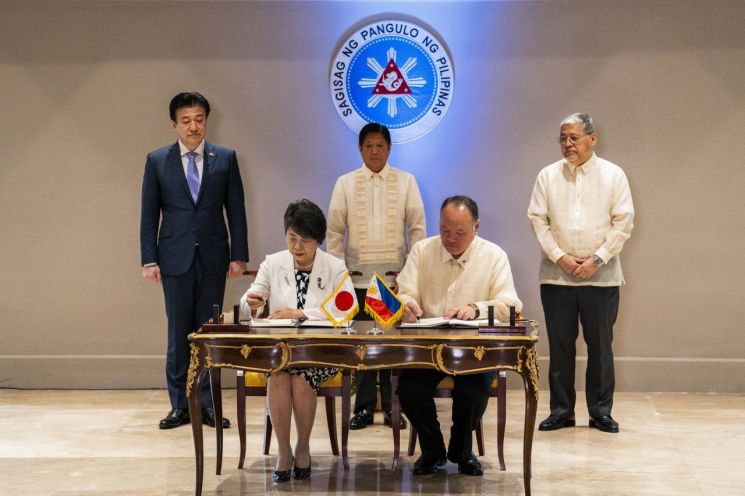
The newly signed RAA aims to facilitate the entry of Japanese Self-Defense Forces and the Philippine military into each other’s countries for joint training exercises and disaster relief operations. Once the RAA is in effect, Japan will be able to participate as a full member in the annual large-scale joint military exercise “Balikatan,” which has previously included the United States and the Philippines as participants with observer status. The Philippines is the first country in Asia, including ASEAN (Association of Southeast Asian Nations), to sign an RAA with Japan.
John Bradford, former U.S. Department of Defense official responsible for Japan, said, “This agreement can be expected to lead to more bilateral activities,” adding, “The RAA will reduce the costs of joint exercises between the two countries and shorten the time and procedures required from proposals to actual troop deployments.”
The agreement comes amid escalating Chinese military provocations in the South China Sea. Last month, the Chinese Coast Guard attacked a Philippine Navy boat at the Second Thomas Shoal in the Spratly Islands, causing casualties. Earlier this month, a Chinese super-large patrol ship intruded into the Philippine Exclusive Economic Zone (EEZ) in the South China Sea and anchored there. In response, the Philippines is strengthening its air force by pursuing the acquisition of multi-role fighters such as the U.S. F-16.
Japan and the Philippines have been strengthening defense cooperation with the United States to counter China’s aggressive territorial claims in the South China Sea. In April, U.S. President Joe Biden, Japanese Prime Minister Fumio Kishida, and President Marcos held a historic first trilateral summit in Washington D.C., officially establishing a trilateral joint defense framework.
Renato Cruz de Castro, professor of international studies at De La Salle University, emphasized, “Japan wants to impress upon the United States that it is a core part of U.S. security and the most reliable military presence and ally for the U.S. in the South China Sea region.”
© The Asia Business Daily(www.asiae.co.kr). All rights reserved.
!["The Woman Who Threw Herself into the Water Clutching a Stolen Dior Bag"...A Grotesque Success Story That Shakes the Korean Psyche [Slate]](https://cwcontent.asiae.co.kr/asiaresize/183/2026021902243444107_1771435474.jpg)
















