Hankyungyeop Releases '2024 Economic Policy Survey' Report
Geopolitical Conflicts Identified as Biggest Source of Anxiety
The business community of OECD member countries forecasted that the global economy will adapt to global uncertainties and recover in the second half of this year. However, they expressed concerns that energy and transportation supply chain disruptions caused by geopolitical conflicts in Ukraine and the Middle East could pose risks to the global economy.
The Korea Economic Organization Association (KEOA) announced on the 9th the '2024 Economic Policy Survey' report conducted by the OECD Business and Industry Advisory Committee (BIAC) targeting member country organizations. KEOA participates in BIAC as the representative of the Korean business community, and this survey included representative organizations from 37 countries accounting for 99.9% of the OECD member countries' GDP.
According to the 2024 BIAC Economic Policy Survey, 59% of OECD member country business organizations rated the business environment in the second half of this year as "good," indicating that the global business environment is expected to maintain a moderate growth trend.
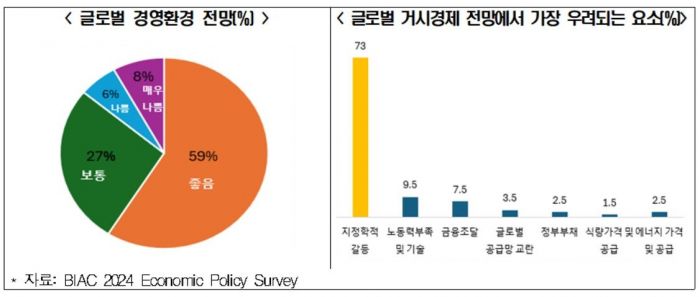
The most concerning factor in the global macroeconomic outlook for the second half of the year was "geopolitical conflicts (73%)," which was the most frequently cited. Following the war in Ukraine, escalating conflicts in the Middle East such as Israel-Hamas are interpreted as being taken seriously by OECD member country business organizations.
Regarding the sectors most affected by geopolitical instability, more than half pointed to "energy (75%)" and "transportation (64%)." In particular, concerns about transportation increased significantly from 13.8% in last year's survey to 64%, a rise of 50.2 percentage points, marking the largest increase within a year. This appears to reflect the prolonged war's significant impact on transportation costs, delivery delays, and increased logistics uncertainty.
BIAC analyzed, "Geopolitical conflicts will greatly affect infrastructure development and cross-border trade for it. Especially considering the impact on transportation equipment manufacturing, there will be considerable pressure not only on logistics but also on related equipment trade in regions such as Eastern Europe."
About 81% of OECD member country business organizations expect the corporate environment to "slightly improve" in the second half of the year. Among factors affecting corporate competitiveness, improvements in regulatory environment (10%) and workforce and technological advancement (18%) were found to be the slowest. On the other hand, access to financial resources (73%), adoption of digital technologies (71%), and infrastructure investment (65%) were cited as corporate competitiveness factors expected to improve in the second half. BIAC stated, "To strengthen corporate competitiveness and create a business-friendly environment worldwide, efforts should focus on improving regulatory reforms and workforce issues, which received the lowest response rates."
Regarding sectors requiring structural reforms (multiple responses), digital transformation and infrastructure (75%), human resources (68%), and public infrastructure (62%) were cited. Notably, investment in human resources rose by 30 percentage points from 38% last year, indicating that attracting talent will be a major topic in the current global economy.
The main obstacles to promoting structural reforms (multiple responses) were identified as lack of political will (78%) and negative public perception of reforms (63%). Particularly, the response citing lack of public awareness surged from 8% last year to 63%, suggesting that governments worldwide are struggling to gain public consensus for structural reform initiatives. BIAC emphasized that strong government efforts to promote structural reforms are necessary for economic recovery, and it is important to encourage public participation and build consensus during this process.
Kim Bong-man, Director of the International Headquarters at KEOA, pointed out, "Despite unprecedented conditions such as the war in Ukraine and supply chain disruptions, the global economy is showing resilience, but additional growth momentum is needed for a full recovery. Domestically, strengthening corporate competitiveness through regulatory reforms and building public consensus on reforms are necessary, while externally, preparations for ongoing uncertainties such as geopolitical conflicts and efforts to secure talent are required."
© The Asia Business Daily(www.asiae.co.kr). All rights reserved.
![Clutching a Stolen Dior Bag, Saying "I Hate Being Poor but Real"... The Grotesque Con of a "Human Knockoff" [Slate]](https://cwcontent.asiae.co.kr/asiaresize/183/2026021902243444107_1771435474.jpg)
















