The Supreme Court has ruled that it is not illegal to use the statistical values from the monthly labor statistics survey report, which do not reflect distinctions by gender according to relevant laws, when calculating the average wage that serves as the standard for insurance benefits to be paid to workers recognized as having industrial accidents.
This is because arbitrarily deriving new figures by using government statistical values to apply gender-based distinctions could lead to errors, and different standards should not be applied depending on the size of the workplace.
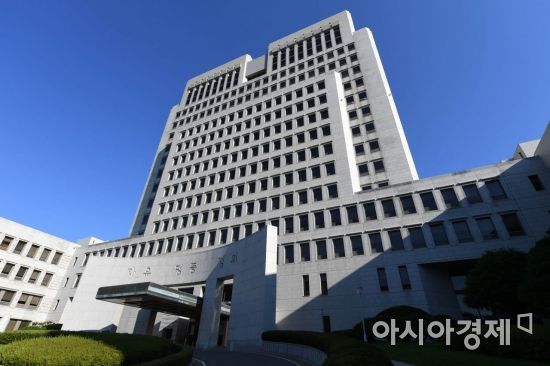
According to the legal community on the 8th, the Supreme Court's First Division (Presiding Justice Kim Seon-su) overturned the lower court ruling that had ruled in favor of plaintiffs A and B in their appeal against the Korea Workers' Compensation and Welfare Service's denial of their request to correct their average wages, and remanded the case to the Seoul High Court.
The court stated, "The lower court's judgment contained an error in the legal interpretation regarding the calculation of special average wages, which affected the ruling," as the reason for the reversal and remand.
A and B worked as precious metal craftsmen at a precious metal manufacturing company, engaged in dust-related work, and were diagnosed with pneumoconiosis in 2005 and 2006 respectively, receiving a disability grade (grade 11).
When deciding the industrial accident insurance payments to be made to the two, the Korea Workers' Compensation and Welfare Service referred to the monthly labor statistics survey report published by the government at that time in accordance with the Industrial Accident Compensation Insurance Act, its enforcement decree, and enforcement rules. This was to apply a special average wage more favorable to workers than the average wage calculated under the Labor Standards Act. The method involved finding the total wages of workers similar in industry, workplace size, and job type to A and others in the report and calculating the average wage based on that.
At that time, Article 38, Paragraph 5 of the Industrial Accident Compensation Insurance Act stipulated, "When calculating insurance benefits for workers receiving benefits due to occupational diseases such as pneumoconiosis, if applying the average wage calculated under the Labor Standards Act is deemed inappropriate for worker protection, the amount calculated by the method prescribed by Presidential Decree (hereinafter referred to as 'special average wage') shall be used as the average wage of the worker."
The then enforcement decree, Article 26, Paragraph 2, defined "'the amount calculated by the method prescribed by Presidential Decree' under the above law as the amount calculated by considering the wages of workers of the same gender and job type belonging to businesses similar in industry and size to the business the worker belongs to, based on the date the occupational disease was confirmed, as prescribed by the Ministry of Labor Ordinance."
Finally, the then Ministry of Labor Ordinance, Article 12 of the Enforcement Rules of the Industrial Accident Compensation Insurance Act, stipulated that "'the amount calculated according to the Ministry of Labor Ordinance' under the enforcement decree means the amount obtained by summing the monthly wages of workers of the same gender and job type belonging to businesses similar in industry and size to the business the worker belongs to, for the one year period from the end of the quarter two quarters prior to the quarter including the date the occupational disease was confirmed, as reported in the monthly labor statistics survey report prepared by the Minister of Labor, divided by the number of days in that period."
The report presented three main types of statistics.
The first was statistical values dividing manufacturing workers' total monthly wages by workplace size: size 1 (10 to 29 employees), size 2 (30 to 99 employees), size 3 (100 to 299 employees), size 4 (300 to 499 employees), and size 5 (500 or more employees).
The second was statistical values divided by workplaces with 10 or more employees and 30 or more employees, and the third was statistical values divided by small to medium-sized workplaces (10 to 299 employees) and large workplaces (300 or more employees).
However, in the first type of statistics, the job types were classified into 'production workers' and 'management, office, and technical workers' (hereinafter management/technical workers), and statistical values were separately surveyed by gender as male and female, but statistical values classified by both job type and gender (e.g., male production workers, female management/technical workers) were not surveyed.
On the other hand, in the second and third types of statistics, statistical values reflecting both gender and job type, such as male production workers, female production workers, male management/technical workers, and female management/technical workers, were surveyed.
The Service applied the total monthly wages of 'manufacturing, size 1 (10 to 29 regular employees), production workers' from the monthly labor statistics survey reports written over the previous year as of September and October 1997, respectively, to calculate the special average wages for A and B in accordance with the relevant enforcement decree and rules.
A's workplace closed in September 1997, with six regular employees at the time of closure, and B's workplace closed in October of the same year, with 25 regular employees at the time of closure.
Then, A and B requested the Service, arguing, "The total wages should consider not only size and job type but also gender," and asked, "Please calculate the insurance benefits based on the average wage calculated from the total monthly wages of workers classified in the monthly labor statistics survey report as 'manufacturing industry, size 10 or more, production workers, male' and pay the difference from the insurance benefits already paid," but their request was denied, leading them to file a lawsuit.
The first and second instance courts ruled in favor of the plaintiffs, stating, "When determining where the injured workers fall within the monthly labor statistics survey report, all comparison items such as industry, size, gender, and job type should be considered as much as possible."
The first instance court judged, "The defendant could have calculated the wages of workers in businesses similar in industry and size to those the plaintiffs belonged to, and of the same gender and job type as the plaintiffs, according to the monthly labor statistics survey report, but issued the decisions in this case on the premise that gender could not be distinguished, which is illegal and must be canceled."
The second instance court ruled, "By subtracting the total wages of male production workers in workplaces with 30 or more employees from the total wages of male production workers in workplaces with 10 or more employees in the statistics, one can derive the total wages reflecting all factors: industry (manufacturing), size (10 to 29 employees), gender (male), and job type (production worker)."
However, the Supreme Court overturned the lower court ruling, stating, "There is a risk of error if new figures are derived by using multiple statistical values with different classification criteria and survey items instead of using the statistical values presented in the report."
The court explained, "The lower court assumed that the plaintiffs belonged to male production workers in manufacturing size 1 workplaces and used a method of subtracting the statistical value of male production workers in workplaces with 30 or more employees from that of male production workers in workplaces with 10 or more employees in the second type of statistics, thereby deriving the total monthly wages reflecting all four factors stipulated in the relevant provision: industry (manufacturing), size (size 1), gender (male), and job type (production worker). However, the defendant applied statistical values reflecting only three factors excluding gender to calculate the special average wage and rejected the plaintiffs' request to correct their average wages. Therefore, the decision in this case cannot be considered lawful," it stated.
Furthermore, the court pointed out, "The method used by the lower court can only be applied to workers in size 1 workplaces and cannot be applied to workers in size 2 to size 5 workplaces," adding, "Using different statistical methods depending on workplace size undermines fair compensation."
The court also noted, "If new figures are derived by using multiple statistical values with different classification criteria and survey items instead of using the statistical values presented in this case's statistics as is, there is a risk of error," and "There were several instances in the statistics where the 'number of employees at the end of the previous month' and the 'number of employees at the end of the current month' based on a specific month differed. Applying the lower court's method in such situations cannot produce accurate figures, and in fact, there were cases where the total wages for a specific month became negative."
Finally, the court concluded, "Since the relevant provision stipulates that wage statistics surveyed in the monthly labor statistics survey report must be used for the special average wage, finding workers similar to the relevant worker must inevitably be limited by the survey items of the report," and "Therefore, cases where some of the four factors required by the provision are not considered, as in this case, may occur, but this is a result anticipated by the provision, so it is not necessary to forcibly derive values reflecting all four factors."
© The Asia Business Daily(www.asiae.co.kr). All rights reserved.
![Clutching a Stolen Dior Bag, Saying "I Hate Being Poor but Real"... The Grotesque Con of a "Human Knockoff" [Slate]](https://cwcontent.asiae.co.kr/asiaresize/183/2026021902243444107_1771435474.jpg)
















