On the 7th (local time), the runoff results of the French general election showed that the left-wing coalition New Popular Front (NFP) is expected to take the position of the largest party, defying expectations. The second place is predicted to be the pro-government coalition including President Emmanuel Macron's ruling party, while the far-right National Rally (RN) and its allied forces, which led in the first round, are expected to fall to third place. No party secured a majority in the National Assembly, complicating future government operation scenarios.
Left-wing coalition 'surprise' expected first place

French media BFM TV reported, citing exit polls from polling agencies, that out of the total 577 seats in the National Assembly, the left-wing coalition is expected to win 178?205 seats, the pro-government coalition 157?174 seats, and RN 113?148 seats. The final results predicted by polling agency IFOP also showed the left-wing coalition with 180?205 seats as the largest party, the pro-government coalition with 164?174 seats, and RN with 120?130 seats.
This completely overturns the forecast made after the first round of voting held on the 30th of last month, which predicted that the far-right party would become the majority in the parliament. In the first round, RN and its allied forces received 33.2% of the vote, ranking first, while the left-wing coalition received 28%, and the pro-government coalition only 20%.
This outcome appears to be the result of large-scale candidate unification by the left-wing coalition and the pro-government coalition to block RN candidates' election in the second round. With the runoff results, RN, which was on the verge of seizing parliamentary power, has once again hit a high wall in French politics.
The left-wing coalition, predicted to become the largest party in the National Assembly, expressed gratitude for voters' choice and announced their intention to proceed with government operations. Jean-Luc M?lenchon, leader of La France Insoumise (LFI) within the left-wing coalition, said, "Voters have created a victory for the left-wing coalition that was thought impossible," and Olivier Faure, leader of the Socialist Party belonging to the NFP, emphasized, "Tonight, France has rejected RN's rule."
RN, which led in support throughout the election but fell to third place at the end, expressed regret. Jordan Bardella, leader of RN, said, "We will stand with the French people more than ever," and "As the opposition, we will continue a tougher struggle against the government."
'Hung parliament' again... Prime minister appointment difficulties
The runoff results of the general election produced a 'hung parliament' again, where no camp secured the majority of 289 seats. In the general election held shortly after the 2022 presidential election, President Macron's pro-government coalition also fell short of a majority with 245 seats. It was the first time in 20 years that the ruling party in France failed to secure a majority in the National Assembly.
With no majority party emerging, the prime minister appointment process is expected to enter a foggy phase. In France, the president appoints the prime minister, but the National Assembly can pass a vote of no confidence against the prime minister and the cabinet, effectively rejecting them. Therefore, it is customary in France for the president to appoint a prime minister who has the support of the majority party in the National Assembly.
The NFP, expected to become the largest party, is pressuring President Macron to grant them the right to form the government. President Macron appears unwilling to entrust government operations to the far-left party LFI. Accordingly, conflicts are expected between NFP and Macron during the upcoming prime minister appointment process. It is also not entirely impossible that President Macron, despite opposition from the opposition parties, may appoint a prime minister from the pro-government coalition, which became the second-largest party in the National Assembly. RN, once considered a strong candidate to produce the next prime minister, has been pushed to the third-largest camp and has effectively lost the opportunity to participate in government operations.
Prime Minister Attal resigns after six months
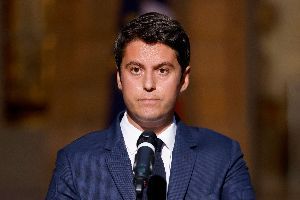
Meanwhile, French Prime Minister Gabriel Attal (pictured) announced his intention to resign, taking responsibility for the pro-government coalition failing to secure the largest party status in the general election exit polls. Attal, who served as Minister of Education, was appointed as the youngest prime minister in the Fifth Republic in January this year. Due to President Macron's decision for an early general election, he will step down from the prime minister position after just six months.
© The Asia Business Daily(www.asiae.co.kr). All rights reserved.
![Clutching a Stolen Dior Bag, Saying "I Hate Being Poor but Real"... The Grotesque Con of a "Human Knockoff" [Slate]](https://cwcontent.asiae.co.kr/asiaresize/183/2026021902243444107_1771435474.jpg)

















