Lettuce Up 17% and Ssam Cabbage Up 26% in One Week
Rising Trend Expected to Continue Due to Heatwave and Typhoon Even After Monsoon Ends
As the monsoon season fully sets in, the prices of leafy vegetables for wraps have skyrocketed, deepening the worries of restaurant owners.
According to the agricultural product distribution information from the Korea Agro-Fisheries & Food Trade Corporation (aT) on the 7th, the retail price of red leaf lettuce was 1,178 KRW per 100g on the 5th, rising 17.3% in just one week. Compared to the price of 872 KRW a month ago, it is 35.1% more expensive. Additionally, the price of wrap cabbage (small cabbage) rose 26.0% in a week to 3,032 KRW per head, which is 29.1% higher than a month ago. Perilla leaves also increased by 2.2% in a week to 2,087 KRW per 100g.
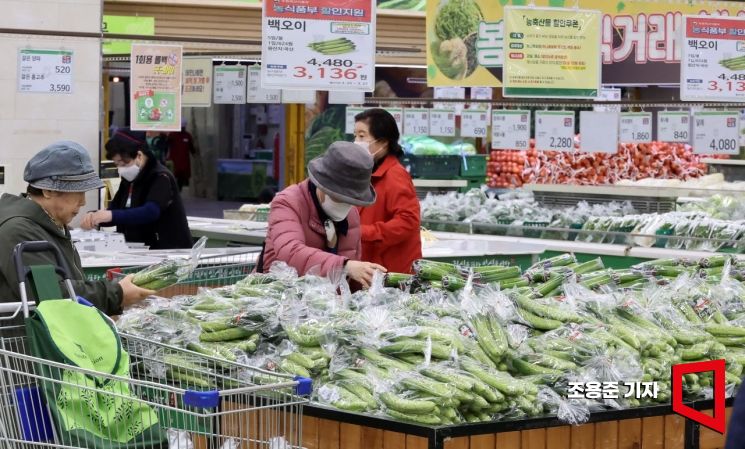 As fruit and vegetable prices soar, causing a crisis in meal costs, citizens are shopping at the Hanaro Mart Seongnam branch in Seongnam, Gyeonggi Province on the 25th of last month. Photo by Jo Yongjun jun21@
However, the price of red leaf lettuce, a representative leafy vegetable for wraps, is at a similar level compared to the average price over three years excluding the maximum and minimum prices from 2019 to last year. Wrap cabbage is 23.5% more expensive than the average, and perilla leaf prices have risen 10.2% above the average.
Prices of some vegetables are already on the rise. The retail price of spinach increased 30.1% in a week to 1,276 KRW per 100g. This is 65.5% higher than a month ago and 38.6% more expensive than the average. Carrots rose 5.6% in a week to 6,177 KRW per 1kg. Compared to a month ago, this is an 11.5% increase, and a staggering 74.8% surge compared to the average. Due to the increased cost burden, some restaurants and side dish shops have stopped using carrots or spinach as ingredients altogether. Moreover, meat restaurants and raw fish restaurants, despite the price hikes, cannot avoid serving leafy vegetables for wraps to customers and sometimes resort to reducing the portion sizes.
The problem is that even after the monsoon ends, agricultural product prices may rise further due to summer natural disasters such as heatwaves and typhoons. In particular, cabbage prices are expected to increase as the cabbage cultivation area this summer is projected to shrink by 5% compared to the average. Last year, due to heatwaves and heavy rains in August, cabbage shipments significantly decreased, causing wholesale prices to soar 2.5 times within a month.
Meanwhile, on the 2nd, the Korea Rural Economic Institute (KREI) forecasted that prices of cabbage, radish, and carrots this month will be higher than a year ago, but prices of melons and watermelons will decline. In its July issue of the 'Agricultural Outlook' report, KREI predicted that the wholesale price of cabbage would rise 11.1% year-on-year to 9,000 KRW per 10kg this month.
KREI also expects that the production volume of summer radish will decrease by about 10% compared to a year ago due to reduced cultivation area, leading to a 21.8% increase in wholesale prices to 15,000 KRW per 20kg. This is a 30.1% rise compared to the average.
On the other hand, KREI forecasts that prices of seasonal fruits and vegetables this month will be lower than the same month last year. Melons are expected to drop 26.1% year-on-year to 22,000 KRW per 10kg, watermelons to fall 13.4% to 1,900 KRW per kg, and tomato prices to decrease 15.6% to 20,000 KRW per 10kg.
© The Asia Business Daily(www.asiae.co.kr). All rights reserved.
![Clutching a Stolen Dior Bag, Saying "I Hate Being Poor but Real"... The Grotesque Con of a "Human Knockoff" [Slate]](https://cwcontent.asiae.co.kr/asiaresize/183/2026021902243444107_1771435474.jpg)
















