Assemblyman Yang Bu-nam vs. Kang Wi-won, Co-Chairs of the Democratic Party National Innovation Council Showdown
Consensus Endorsement as 'Stable Practice' vs. 365 Party's 'Innovation' to Break Established Interests
The upcoming city and provincial committee chair elections, scheduled ahead of the Democratic Party of Korea's national convention in August, have become a hot issue in the Gwangju region.
Until now, it has been customary for the incumbent lawmaker to be unanimously endorsed for the Democratic Party's city/provincial committee chair position, but interest is growing as an outsider has declared candidacy, potentially breaking this tradition.
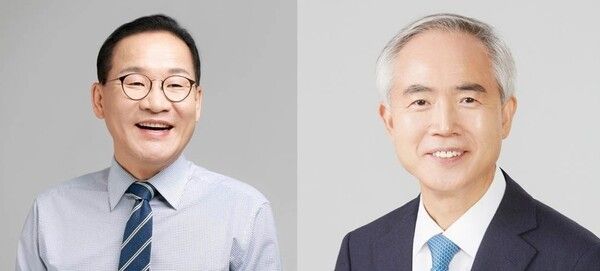 Kang Wiwon, Standing Representative of the Democratic Party of Korea National Innovation Council, who ran for the position of Chairman of the Democratic Party of Korea Gwangju Metropolitan City Party Committee (left in the photo), and Congressman Yang Bunam.
According to the Democratic Party of Korea Gwangju Metropolitan City Party on the 5th, the city party chair election scheduled for mid-month will be contested between National Assembly member Yang Bu-nam and Kang Wi-won, the standing representative of the Democratic Party's National Innovation Council.
With Min Hyung-bae, the only two-term lawmaker in the Gwangju area, deciding to run for the party's Supreme Council, the eight local lawmakers reportedly reached a consensus to unanimously endorse the eldest among them, Yang Bu-nam, for the city party chair.
Earlier, Kang Wi-won, the standing representative of the Democratic Party's National Innovation Council, had already declared his candidacy for the Gwangju City Party chair and had been preparing for it. However, it is reported that in the local political circles, Kang had firmly stated he would not run if Min Hyung-bae decided to run for the city party chair.
Min and Kang, who have had a long-standing relationship, reportedly exchanged various opinions regarding the Gwangju City Party chair position, but ultimately, when Min agreed to the customary unanimous endorsement of the incumbent, political circles buzzed with speculation.
There are rumors that one reason for the unanimous endorsement of Yang was the belief that "if Kang runs, only by fielding a pro-Lee Jae-myung faction like Yang can they win."
Ultimately, with Yang, known as Lee Jae-myung's bodyguard, and Kang, a longtime comrade of Lee Jae-myung, facing off, the contest attracted attention as a 'incumbent vs. outsider' and 'pro-Lee vs. pro-Lee' battle, but recently it seems to have solidified into a 'tradition vs. innovation' frame.
Recently, Kang Wi-won has advocated for "breaking vested interests and innovation," arguing to abandon the custom of lawmakers monopolizing the city party chair position. He pledged to open an era of party member sovereignty through a Gwangju City Party that is open 365 days a year, rather than lawmakers practicing geum-gwi-wol-rae (meaning lawmakers visit their constituencies on Friday nights and return to Yeouido on Monday mornings).
He also set major goals such as "building a party-centered mass party, granting party members the right to nominate candidates in local elections, and establishing a competent Gwangju City Party." He expressed ambitions to eliminate factional candidate nominations by allowing party members to directly exercise nomination rights. He promised to break unfair backdoor nomination practices, establish a transparent system for growth, discovery, and recommendation of candidates, and nurture political activists through grassroots political academies run by the Gwangju City Party.
Yang Bu-nam also promised an era of party member sovereignty. Through party member-centered city party management, he pledged to reflect party members' opinions in important policy directions of both the central and city parties and to transform the city party into a field- and people-centered organization to restore Gwangju (Honam) politics.
?
He also emphasized contributing to regional development and national balanced development through policy focus to make Gwangju a better place to live and to transition the Gwangju City Party's operational system into a collective management system involving eight regional committee chairs.
In Gwangju, known as the heart of the Democratic Party, the upcoming city party chair election, which will serve as a bridge to the central party and lead the Democratic Party, has emerged as a key point of interest: whether to maintain stable management through tradition or to innovate for a new era.
Additionally, attention is focused on how the significant adjustment in the election delegate composition?10% delegates and 90% party members?will affect this city party chair election.
© The Asia Business Daily(www.asiae.co.kr). All rights reserved.
![Clutching a Stolen Dior Bag, Saying "I Hate Being Poor but Real"... The Grotesque Con of a "Human Knockoff" [Slate]](https://cwcontent.asiae.co.kr/asiaresize/183/2026021902243444107_1771435474.jpg)
















