In the UK general election held on the 4th (local time), exit polls indicated that the main opposition party, the Labour Party, would secure a majority in Parliament. Accordingly, Keir Starmer, the leader of the Labour Party and former leader of the main opposition, is set to become the next Prime Minister, marking a regime change for the first time in 14 years.
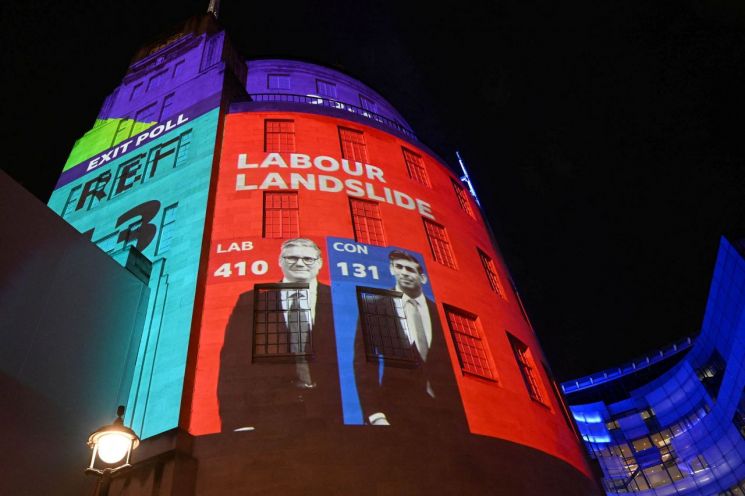
According to exit polls released immediately after the polls closed at 10 p.m. by the BBC and others, the Labour Party is estimated to win 410 out of the total 650 seats in the House of Commons. This exceeds half of the Parliament's seats alone, surpassing the combined seats of other parties by 170. This is slightly less than the Labour Party's landslide victory in the 1997 general election (418 seats), which brought Tony Blair to power.
Leader Starmer expressed gratitude on his X (formerly Twitter) account, saying, "Thank you to everyone who campaigned for the Labour Party in this election, and to everyone who voted for us and believed in the changed Labour Party." Bridget Phillipson, Secretary of State for Education, who secured Labour's first victory in the Houghton and Sunderland South constituency, declared victory, saying, "For the first time in 14 years, the British people have chosen change. They have chosen the Labour Party and Starmer's leadership," adding, "Our country has chosen a brighter future."
On the other hand, the ruling Conservative Party led by Prime Minister Rishi Sunak secured only 131 seats, resulting in the loss of power. This is the worst result since the party's founding in 1834. Compared to the 365 seats won in the 2019 general election, the number of seats has drastically decreased. Some current cabinet ministers, including Chancellor of the Exchequer Jeremy Hunt, are also expected to lose their seats in this election. John Curtice, a polling expert leading the exit poll team, said, "The Conservative Party has suffered tremendous losses," and predicted, "Both the vote share and the number of seats will be the lowest in history." Conservative politician Jacob Rees-Mogg described it as "definitely a terrible night."
The Labour Party's landslide victory and the Conservative Party's crushing defeat had been predicted well in advance of this election. Throughout the six-week campaign, Labour's projected vote share consistently exceeded that of the ruling Conservatives by around 20 percentage points. The Guardian reported, "Exit polls have predicted a Labour landslide," adding, "Polls did not lie." AFP reported, "The 14 years of Conservative rule marked by austerity, Brexit divisions, and scandals are coming to an end." Analysts suggest that British voters' dissatisfaction over Brexit, the pandemic, inflation caused by the Ukraine war, and a surge in illegal immigration has translated into a desire for regime change.
Additionally, the Liberal Democrats are projected to secure 61 seats, the Scottish National Party (SNP) 10 seats, and the far-right Reform UK Party 13 seats. Major foreign media outlets currently regard the Reform UK Party alongside Labour as one of the biggest winners of the election. Reform UK, the successor to the Brexit Party, is expected to win 13 seats, exceeding expectations and entering Parliament independently for the first time. Nigel Farage, the party leader who had failed to enter Parliament seven times previously, welcomed the result, saying, "We will secure many seats nationwide." Meanwhile, the SNP is the next biggest loser after the Conservatives. Due to financial scandals and other factors, the SNP's seats shrank from 48 to 10. In this election, the SNP also lost its position as the majority party in Scotland to Labour.
Since Labour's landslide victory was anticipated early on, there has been little reaction in the current market. In the foreign exchange market, the British pound is trading at nearly unchanged levels against the US dollar. The New York Times (NYT) reported, "One group not surprised by the exit polls is traders," noting, "The expectation of a Labour majority and the belief that this situation does not threaten financial market stability are evident."
Goldman Sachs analyzed that, unlike the political situation in France, a slight increase in fiscal spending under a Labour government could be positive for the UK stock market. Rob Wood, chief economist at Pantheon Macroeconomics, said, "With Labour securing a majority, they will be able to plan a stable policy direction," and predicted that Starmer, who has advocated for both economic growth and social justice, "will attract more corporate investment and foreign investment."
© The Asia Business Daily(www.asiae.co.kr). All rights reserved.

















