A technology that precisely tracks locations without blind spots in smart factories has been developed for the first time in the world in South Korea.
KAIST announced on the 5th that Professor Sungmin Kim's research team from the Department of Electrical Engineering developed a technology that attaches a battery-free tag to a target object and can track its location in three dimensions (with accuracy below 'cm') even when obscured by obstacles.
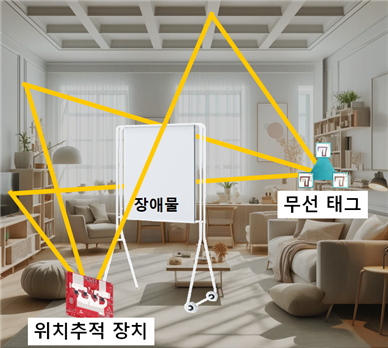 The location tracking technology developed by Professor Kim Sung-min's team enables blind spot-free location tracking by utilizing reflected signals that bypass obstacles. Provided by KAIST
The wireless tag developed by the research team for the first time enables location tracking without blind spots by securing reflected signals that bypass obstacles using millimeter waves (mmWave), which have more than 10 times higher reflectivity compared to existing technology (Ultra Wide Band·UWB).
The principle is that the tag, which generates unique signals depending on the direction of reflection, identifies the propagation path of each signal to track the location of the target. Millimeter waves are radio waves with frequencies ranging from 30GHz to 300GHz and are expected to be used as bands for next-generation standards such as 5G and 6G.
In particular, the wireless tag developed by the research team operates by reflecting surrounding signals instead of generating wireless signals by itself. Like a mirror reflecting ambient light, this saves the power needed to generate signals, enabling ultra-low power operation. For example, it can operate without power using solar cells or run for more than 40 years on a single coin battery, making it suitable for large-scale deployment, according to the research team.
Additionally, it overcomes the limitations of existing technologies whose operating range is restricted due to various indoor obstacles such as furniture and electronic devices, and boasts a 3D location accuracy of 8.3 mm, which is more than 15 times higher.
These strengths increase the potential for use in a wide range of location-based services such as smart factories and augmented reality (AR) in the future. Compared to existing technologies that frequently experience connection failures, this technology can track the exact location of indoor targets more stably, which could expand its application areas and frequency of use.
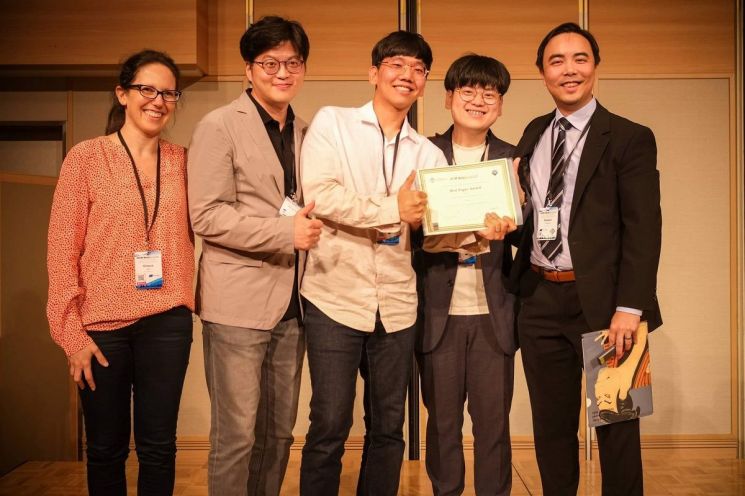 Professor Kim Sung-min (second from the left) is taking a commemorative photo with PhD candidates Bae Kang-min (co-first author) and Moon Han-gyeol (co-first author) after receiving the Best Paper Award at ACM MobiSys 2024. Photo by KAIST
Based on these research results, the research team also achieved the distinction of winning the Best Paper Award at the internationally prestigious conference in mobile computing, ‘ACM MobiSys,’ in both 2022 and 2024. According to KAIST, only Professor Sungmin Kim’s team, the University of Michigan, and Yale University have received the Best Paper Award more than twice at this conference (based on first authorship).
Professor Sungmin Kim said, “The tag operates without blind spots in any indoor environment by using surrounding objects such as ceiling tiles or computer cases as reflectors,” and added, “By solving the stability issues of indoor location tracking, we hope comprehensive location-based services can be widely expanded and adopted.”
Meanwhile, this research was conducted with support from the ITRC Innovation Leap Project of the Institute for Information & Communications Technology Planning and Evaluation and the Samsung Future Technology Fostering Project.
© The Asia Business Daily(www.asiae.co.kr). All rights reserved.


















