In Namibia, Africa... Paper Published in 'Nature'
Life Forms from 280 Million Years Ago, Before the Dinosaur Era
Fossils of a giant creature presumed to be the top predator from 280 million years ago, before the dinosaur era, have been discovered in Namibia, Africa.
On the 3rd (local time), multiple foreign media outlets including the British Guardian and the American CBS reported that the fossil excavation was announced through publication in the scientific journal 'Nature' on the same day. This fossil, resembling a giant salamander-like creature, was named 'Gaiasia jennyae.' The name derives from the 'Gai-As Formation' in Namibia where the fossil was found and the paleontologist Jenny Clarke, an expert in early tetrapod evolution.
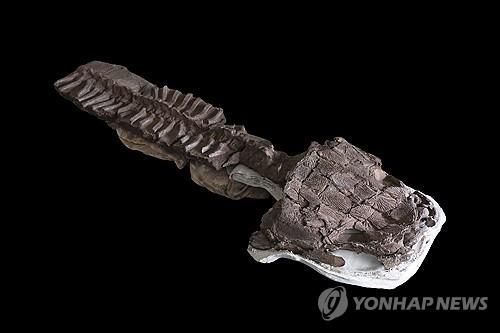
The creature was discovered through at least four incomplete fossil specimens, including skull fragments and an almost complete vertebral column. Gaiasia jennyae is estimated to have had a massive, toilet-shaped head measuring 2.5 meters in length and terrifyingly interlocking fangs. The skull length was about 60 cm, and it likely had large jaws with powerful teeth capable of capturing sizable prey.
Experts believe this animal lurked in cold swamp waters or lakes with its mouth wide open, waiting to ambush prey swimming by, which it would tear apart with its powerful jaws. Additionally, Gaiasia jennyae is analyzed to have been the top predator of its ecosystem and one of the largest carnivores of its time.
Jason Pardo, a postdoctoral researcher at the Field Museum in Chicago and co-author of the study, explained, "Gaiasia jennyae had a large, flat, toilet-shaped head that could open wide to suck in prey. It had very large fangs, and the entire front of its mouth was made up of enormous teeth. Although large, it may have been a relatively slow ambush predator."
The location of the fossil discovery also holds significant meaning. Until now, early terrestrial animal fossils have mostly been found in ancient equatorial wetlands corresponding to present-day Europe and North America. At the time Gaiasia jennyae lived, present-day Namibia is estimated to have been located much further south, nearly level with the northernmost part of the Antarctic continent, possibly part of the massive supercontinent Gondwana. This means it was a very cold place with ice and glaciers, unlike today.
Regarding this discovery, the Guardian described it as evidence that giant predators thrived even in very cold swampy areas. Researcher Pardo stated, "Because we do not know where many animal groups that appeared during the time Gaiasia jennyae lived came from, this discovery is very important," adding, "Further research may provide more answers about major animal groups, including the ancestors of mammals and modern reptiles."
© The Asia Business Daily(www.asiae.co.kr). All rights reserved.

















