Kim Yong-ik Invited Lecture by 'Dolbomgwa Mirae' Chairman
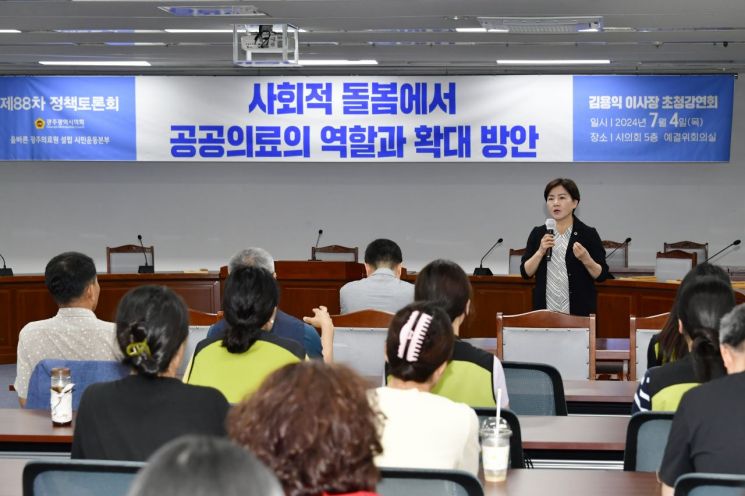
On the 4th, Park Mijeong, a member of the Gwangju Metropolitan Council (Democratic Party of Korea·Dong-gu 2), invited Kim Yongik, chairman of the (Foundation) Care and Future, to hold a lecture titled "The Role and Expansion Plan of Public Healthcare in Social Care."
The lecture was co-hosted by the Gwangju City Council and the Citizens' Movement Headquarters for the Establishment of a Proper Gwangju Medical Center, and was conducted as an opportunity to hear opinions on ▲a paradigm shift in public hospitals ▲the concept and strategy of community care ▲the interconnection and scalability of public hospitals and community care.
Chairman Kim Yongik has worked on institutional improvements in the healthcare sector, having served as a professor at Seoul National University College of Medicine, Senior Secretary for Social Policy at the Blue House, a member of the 19th National Assembly, and chairman of the National Health Insurance Service.
This lecture proceeded in the order of subtitles: the public hospital we need to create, the community care we need to create, strategies for community care, progress of community care, when care and hospitals meet in publicness.
Chairman Kim argued that the role of the state is not only civil engineering but also building social infrastructure that cares for life, and that public hospitals should be equipped with modern facilities, equipment, and personnel, with a scale of 500 beds for urban types and 300 beds or more for rural types.
Additionally, Chairman Kim pointed out the burden of family care and the quality of welfare facilities, proposing the establishment of an integrated system that links and provides the three elements of care services?healthcare, welfare, and housing support?which had been provided in a fragmented manner in the community, centered on the recipients.
He then presented community care as a third space solution for deinstitutionalization and defamilization, emphasizing the need for cyclical care where people receive safe and convenient residential services (visiting services + day and night care services), are hospitalized or admitted only when necessary, and are discharged or released at the appropriate time.
Chairman Kim predicted that the next two years of discussions before the enforcement of the Care Integration Support Act (Act on Integrated Support for Community Care including medical and nursing care) in March 2026, which mandates community care projects and passed the National Assembly last February, will be a critical turning point in forming the community care system.
He also expressed concerns about the risk of failure due to lack of driving force for community care promotion, failure in infrastructure formation, and conflicts among providers, arguing that enhancing the publicness of healthcare and care must be pursued simultaneously.
Assembly member Park Mijeong said, "With low birth rates and aging, the demand for social care is increasing, and people are demanding seamless public services throughout their lives," adding, "With the passage of the Integrated Care Support Act, 'Gwangju-type Integrated Care' is spreading nationwide, and I hope this will be a valuable time to consider the interconnection and scalability of community care and public healthcare."
© The Asia Business Daily(www.asiae.co.kr). All rights reserved.
![Clutching a Stolen Dior Bag, Saying "I Hate Being Poor but Real"... The Grotesque Con of a "Human Knockoff" [Slate]](https://cwcontent.asiae.co.kr/asiaresize/183/2026021902243444107_1771435474.jpg)











