Global Consumers Spotlight Affordable Healthy Meals
"Korean Food Craze... Regaining Identity from 'Korean Sushi'"
Sajo Daerim and Others Join Frozen Gimbap Export Front
Frozen gimbap, which caused a sold-out frenzy in the US due to the K-food boom, surpassed 10 billion KRW in exports for the first time ever in June. Export volume exceeded 1,000 tons, with 5 million rolls of gimbap crossing borders in just one month. Gimbap is gaining increasing demand as a cost-effective and healthy meal in the era of global lunchflation (lunch price + inflation).
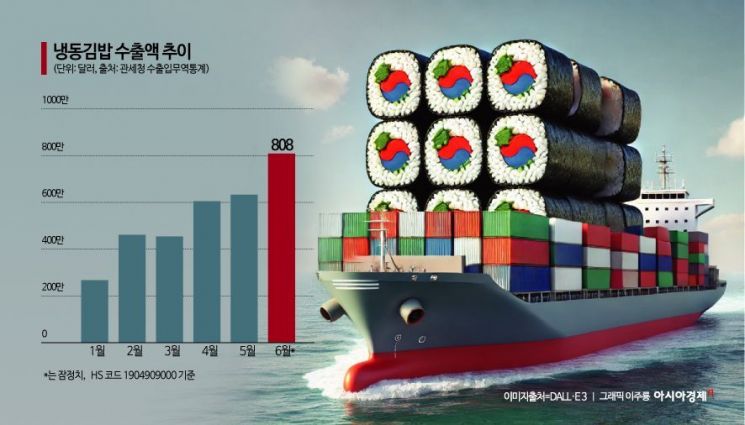
June Gimbap Exports Surpass 10 Billion KRW... 5 Million Rolls Shipped
According to customs export-import trade statistics on the 4th, June gimbap export value was tentatively estimated at 8.08 million USD (approximately 11.2 billion KRW). This represents about a 475% increase compared to the export value of 1.41 million USD a year ago. It is also three times the export value of 2.67 million USD in January this year. Frozen gimbap export values have continuously grown as follows: 4.61 million USD in February, 4.54 million USD in March, 6.05 million USD in April, and 6.32 million USD in May.
The explosive popularity of frozen gimbap is even more tangible when looking at export volume. June gimbap export volume is tentatively estimated at 1,164 tons. Assuming one roll of gimbap weighs an average of 230 grams, about 5.06 million rolls were exported.
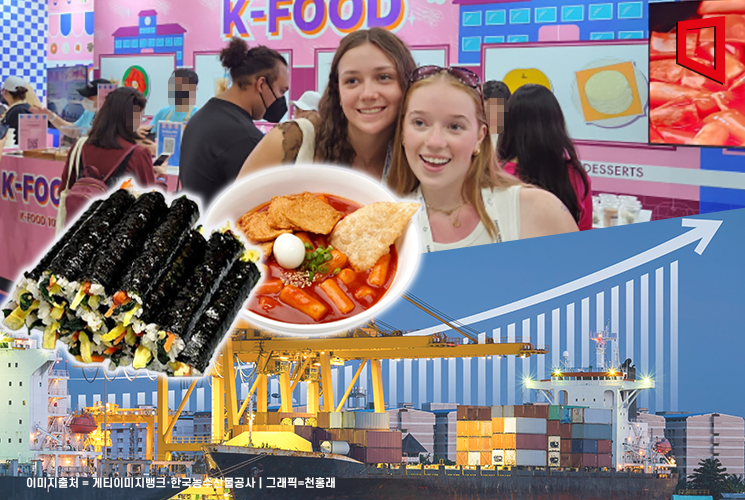
Why Gimbap, Once Called 'Korean Sushi,' Has Found Its True Name... 'Healthy Food' and 'Cost-Effectiveness'
Korean frozen gimbap gained instant popularity last year through word of mouth on online communities and social media platforms like TikTok. When frozen gimbap sold at the US major supermarket Trader Joe's ran out of stock, a plea saying "Please stop buying gimbap" was posted on the community Reddit.
In fact, frozen gimbap was not a K-food product that domestic food companies had long focused on exporting like ramen or dumplings. Its recognition was low enough that it was called 'Korean sushi' instead of gimbap. The soaring popularity of gimbap is attributed to the vegetarian trend and cost-effectiveness amid lunchflation.
First, a health food craze has been sweeping major US cities for several years. Gimbap, wrapped with seaweed (gim) and filled with various leafy and root vegetables and rice, appealed to health-conscious consumers. Moreover, while gimbap in Korea usually contains ham, it is difficult to export meat-containing foods to the US. Therefore, domestic food companies had no choice but to produce vegetarian frozen gimbap, which matched US consumer needs.
Gimbap also serves as a cost-effective meal in the global era of high prices. In the US, a meal with a sandwich or hamburger typically costs 20 to 30 dollars. However, one roll of frozen gimbap costs about 4 dollars, making it a truly 'cost-effective' food.
'Bokmansa' Was the First to Export Frozen Gimbap Domestically... Export Front Expands with Sajo Daerim and Others
The company that first developed and exported frozen gimbap domestically is 'Bok-eul Mandeuneun Saramdeul (Bokmansa).' Bokmansa developed freezing technology for gimbap from 2018 to 2020 and first exported frozen gimbap to Hong Kong. Currently, it has expanded exports to 19 countries including the US, Canada, France, Indonesia, and Kuwait.
The company that sparked the frozen gimbap craze with the Trader Joe's sold-out incident is 'Olgot.' Olgot expects its daily production volume to increase fivefold from the current 80,000 units to 400,000 units by November when its factory expansion is completed.
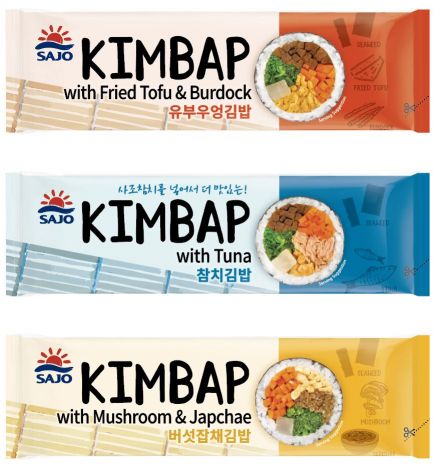
As frozen gimbap rapidly gains popularity, more domestic companies are entering the export front. Sajo Daerim started producing and selling frozen gimbap to the US in April. Since April, a total of 36 tons, including initial 1st and 2nd shipments and additional orders, have been loaded onto ships bound for the US. This corresponds to about 155,000 rolls of gimbap. Sajo Daerim plans to export about 72,000 rolls monthly going forward. Other companies such as Lotte Wellfood are also exporting frozen gimbap.
An industry insider said, "Amid rising interest in various Korean foods thanks to the popularity of K-culture and K-food, frozen gimbap is gaining attention as it meets global consumers' trends for healthy food and cost-effectiveness."
© The Asia Business Daily(www.asiae.co.kr). All rights reserved.
![Clutching a Stolen Dior Bag, Saying "I Hate Being Poor but Real"... The Grotesque Con of a "Human Knockoff" [Slate]](https://cwcontent.asiae.co.kr/asiaresize/183/2026021902243444107_1771435474.jpg)


















