Conflict Over Differential Application Leads to Business Sector's Non-Participation
Initial Draft Discussion Halted Before It Could Begin
With the introduction of differentiated application by industry having failed, the Minimum Wage Commission has entered the full-scale race to decide next year's minimum wage. Earlier, during the voting process on the agenda to introduce differentiated application, conflicts between labor and management surfaced, and the business sector responded with a full boycott, making deliberations expected to be difficult.
The Minimum Wage Commission under the Ministry of Employment and Labor held its 8th plenary meeting on the afternoon of the 4th at the Government Complex Sejong to decide next year's minimum wage. The meeting was conducted as a half meeting with all employer representatives absent. Earlier, the employer representatives (business sector) informed the Minimum Wage Commission Secretariat of their intention to not attend the meeting. This was in protest against the labor side's disruptive actions during the vote on the agenda for introducing differentiated application by industry.
At that meeting, as the disagreement between the business sector demanding differentiated application of the minimum wage by industry and the labor sector opposing it could not be narrowed, a vote was held, resulting in 11 in favor, 15 against, and 1 invalid, thus the introduction of differentiated application was rejected. During this process, some worker representatives (labor side) from the Korean Confederation of Trade Unions opposed the vote itself, seized the gavel, tore up ballots, and used physical force, which led to strong opposition from employer representatives and a clash, causing the meeting to end without further progress.
Since this conflict arose without either labor or management officially presenting their minimum wage proposals, concerns are emerging that labor-management conflicts will be more severely expressed this year. Since the Minimum Wage Commission began seriously addressing the issue of differentiated application by industry in 2016, this is the first time that labor and management have clashed and used physical force during the voting process.
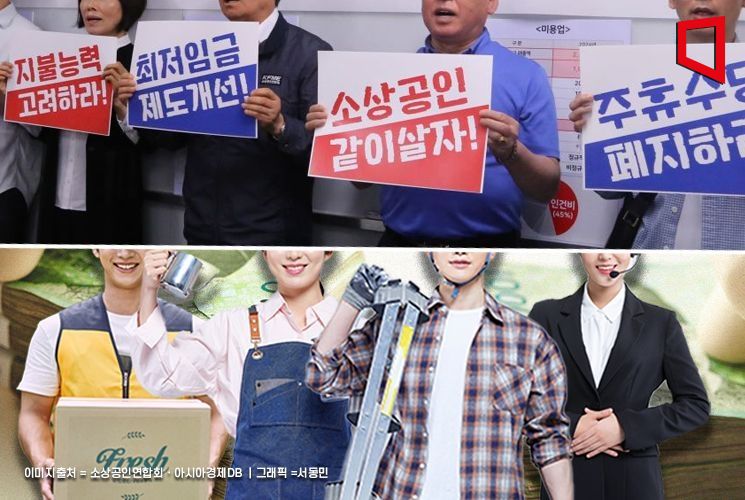
From this day, the Minimum Wage Commission will begin full-scale deliberations to decide the minimum wage. Earlier, Chairperson Lee In-jae of the Minimum Wage Commission requested both labor and management sides at the 5th meeting to present their initial proposals for next year's minimum wage amount. However, since the business sector is absent and only the labor side is presenting initial proposals, it is unlikely that this meeting will make significant progress.
If the employer representatives return to the 9th meeting scheduled for the 9th, the full-scale strategic battle between labor and management to decide next year's minimum wage is expected to begin then. The labor side is expected to demand an increase to around 12,600 KRW per hour citing rapid inflation, while the business sector is expected to request a freeze considering the worsening business conditions mainly for small and medium-sized enterprises. On the afternoon of the meeting day, the labor side held a rally in front of the Ministry of Employment and Labor at the Government Complex Sejong, stating, "We will put everything into the struggle to achieve a real increase in the minimum wage and the right of all workers to unionize, and fight to the end."
This year's minimum wage is 9,860 KRW per hour, and attention is focused on whether it will exceed 10,000 KRW. Even a 1.4% (140 KRW) increase compared to this year would push next year's minimum wage over 10,000 KRW. The 1.5% increase in 2021 was the lowest ever.
The minimum wage deliberations involve 9 worker representatives, 9 employer representatives, and 9 public interest commissioners appointed by the government. If negotiations between the stakeholders, the labor and employer sides, break down, the public interest commissioners, as intermediaries with expertise and neutrality, step in to mediate. Although the Minimum Wage Commission failed to meet the statutory deliberation deadline (June 27), it declared it would adhere to the official announcement date. According to the Minimum Wage Act, the Minimum Wage Commission must decide the minimum wage by 20 days before the Ministry of Employment and Labor's official announcement date (August 5 every year).
© The Asia Business Daily(www.asiae.co.kr). All rights reserved.
!["The Woman Who Threw Herself into the Water Clutching a Stolen Dior Bag"...A Grotesque Success Story That Shakes the Korean Psyche [Slate]](https://cwcontent.asiae.co.kr/asiaresize/183/2026021902243444107_1771435474.jpg)
















