Interview with Chugaeyeol, President of the Korean Music Copyright Association
Korean Music Industry Ranked 7th Worldwide
Copyright Fee Awareness Similar to Developing Countries... Fair Rights Must Be Guaranteed
"237 won per month"
This is the amount the court set as the music usage fee for one convenience store location in a lawsuit filed by the Korea Music Copyright Association against convenience store operators in 2022. Despite the global popularity of K-pop ushering in a golden age for the Korean music industry, the copyright market falls short of this success.
 Choo Gayeol, Chairman of the Korea Music Copyright Association, is being interviewed on the 14th at the Korea Music Copyright Association in Gangseo-gu, Seoul. Photo by Jinhyung Kang aymsdream@
Choo Ga-yeol, a singer, lyricist, composer, and head of the trust management organization managing the music copyrights of over 50,000 lyricists and composers, serves as the chairman of the Korea Music Copyright Association (hereafter Hanumjeohyeop). He emphasizes that updating copyright fees to match the global era is an urgent task. "According to the International Federation of the Phonographic Industry (IFPI) 2024 Global Report, the Korean music industry ranks 7th worldwide. However, the music copyright fee market ranks only 10th. When comparing per capita GDP to per capita music copyright fees, Italy, with a GDP similar to Korea’s, collects 1.95 times more, Japan 1.37 times more, and Spain 1.42 times more."
Last year, Hanumjeohyeop collected a total of 406.1 billion won in music copyright fees and distributed 388.7 billion won. Although these collection and distribution amounts were the highest ever, the annual copyright fee revenues of music copyright collective management organizations in the United States, France, the United Kingdom, Germany, and Japan have long exceeded 1 trillion won. Chairman Choo stressed that for the copyright market to grow to the level of advanced countries, a rightful awareness of value must be established. Below is an interview with Chairman Choo.
-What is the current scale of music copyright fees collected relative to the music industry in Korea?
▲According to the 2023 Global Collections Report published by the International Confederation of Societies of Authors and Composers (CISAC), Korea ranked 10th in music fee collections. However, in terms of copyright fees as a percentage of GDP, Korea ranked only 31st at 0.016%. Although the status of K-culture is rising daily and K-pop’s popularity is sweeping the world, domestic awareness of copyright fees remains at a level similar to developing countries. The court has treated music copyright as trivial. In a 2022 lawsuit filed against BGF Retail, the operator of convenience store CU, the court set the monthly music usage fee per store at 237 won instead of the claimed 20,000 won. From the creators’ perspective, seeing the value decrease rather than increase must be deeply disappointing.
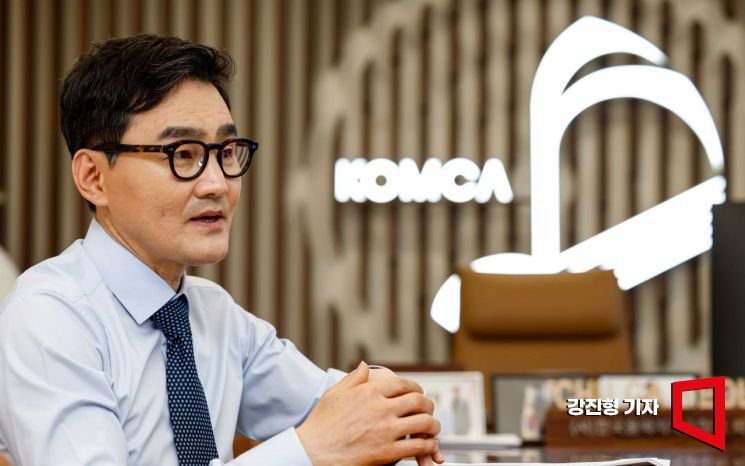 Choo Gayeol, Chairman of the Korea Music Copyright Association, is being interviewed on the 14th at the Korea Music Copyright Association in Gangseo-gu, Seoul. Photo by Jinhyung Kang aymsdream@
-Foreign copyright trust organizations have expressed opposition to Korea’s low copyright fees and said they would collect fees directly. If this imbalance continues, could this lead to a rush of such withdrawals?
▲This is the biggest concern of the association. It’s like a dam with a single breach barely being held back. If the current situation prolongs, we might face a time when we have to call U.S. copyright organizations directly to get approval to play Michael Jackson’s music. Just as they have advanced levels, we must also guarantee rightful rights, but if this unequal structure continues, smooth usage will become a matter of time. This could escalate into a cultural war over music copyrights.
-The Fair Trade Commission imposed fines on Hanumjeohyeop, accusing it of overcharging copyright fees to 59 broadcasters including the three major terrestrial broadcasters, sparking so-called ‘power abuse’ controversy.
▲It is absurd to say that an association run centered on creators committed ‘power abuse.’ For the past 40 years, broadcasters have never once submitted complete music usage details (cue sheets) to the association. Therefore, the only way to collect copyright fees was to charge fees based on existing management costs with post-settlement as a premise. The fees broadcasters currently pay are also far below international standards.
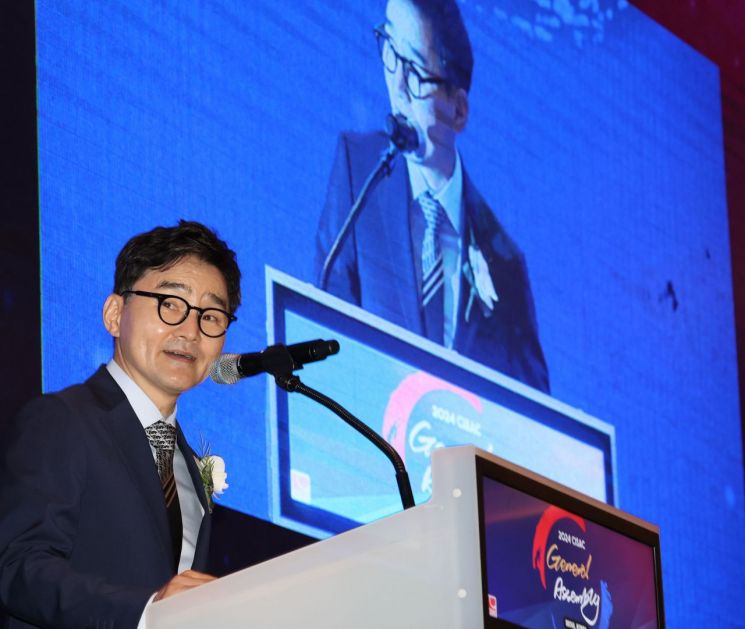 Choo Gayeol, Chairman of the Korea Music Copyright Association, is delivering a welcoming speech at the CISAC World Congress held at the Conrad Hotel in Yeouido, Seoul, on the morning of the 30th. The International Confederation of Societies of Authors and Composers (CISAC), founded in 1926, has 225 copyright organizations from 116 countries worldwide as members. It is the largest non-governmental organization related to copyright, with about 5 million creators in the cultural and artistic fields, including music, drama, and literature, participating as members. [Image source=Yonhap News]
-The recently held CISAC General Assembly has attracted attention. What significance does it hold?
▲CISAC is like the UN of the copyright industry, representing the voices of about 4 million creators worldwide. After being re-elected as a board member in 2022 following 2019, it has focused on international exchanges. This led to a shift from Japan’s previous 90% share of overseas copyright fee collections to growth in Europe, the Americas, Southeast Asia, and other regions. Exchange and coexistence with these regions lay the foundation for securing the long-term growth and influence of K-pop. As the Korean Wave expands, we must respond more swiftly to increase overall market collections. Additionally, this year’s assembly held meaningful discussions on protecting creators’ rights in the emerging AI era, a global hot topic.
-With the association’s 60th anniversary this year and your term ending next year, what goals do you have as chairman?
▲Just as the K-pop market and online video services (OTT) have grown brilliantly, I plan to do my best to protect creators’ rights and realize fair copyright fees. Above all, the goal for 2026 is to reach 500 billion won in collections. I believe my role is to lay the foundation for opening a 1 trillion won music copyright market befitting the status of K-content.
© The Asia Business Daily(www.asiae.co.kr). All rights reserved.
![User Who Sold Erroneously Deposited Bitcoins to Repay Debt and Fund Entertainment... What Did the Supreme Court Decide in 2021? [Legal Issue Check]](https://cwcontent.asiae.co.kr/asiaresize/183/2026020910431234020_1770601391.png)


















