Operation of 33,000㎡ Siheung Clean Energy Center for 20 Years
Supplying City Gas to 8,283 Households Using Food Waste and Manure
Hyundai Engineering & Construction produces biogas by utilizing organic waste resources such as food waste and sewage.
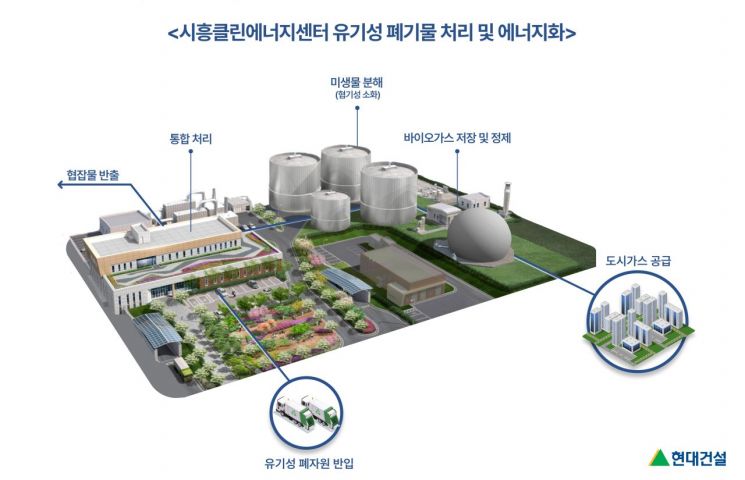 The structure for organic waste treatment and energy conversion at the 'Siheung Clean Energy Center' located in Siheung, Gyeonggi Province.
 [Image provided by Hyundai Engineering & Construction]
On the 3rd, Hyundai Engineering & Construction held a completion ceremony for the Siheung Clean Energy Center at the Siheung Water Environment Center in Gyeonggi Province and announced the start of full-scale biogas production. The event was attended by Im Byung-taek, Mayor of Siheung, Jo Jung-sik, Member of the National Assembly, Kang Yong-hee, Head of Civil Engineering Division at Hyundai Engineering & Construction, Kim Tae-hee, Head of Project Financing (PF) Office 1 at Korea Development Bank, and other local government and participating organization officials.
The Siheung Clean Energy Center is an integrated treatment facility for sewage sludge, food waste, and sewage, built within the Water Environment Center with a total floor area of 33,430㎡. It processes 540㎥/day of sewage sludge, 145㎥/day of food waste, and 60㎥/day of sewage generated in Siheung City, producing biogas through waste reduction and energy conversion.
Hyundai Engineering & Construction completed the Clean Energy Center on the 28th of last month after a 39-month construction period, including 10 months of trial operation starting in March 2021. The center is expected to produce and supply city gas for the next 20 years.
When organic waste resources such as sewage sludge, food waste, and sewage from the Water Environment Center are gathered at the Clean Energy Center, they undergo preprocessing, anaerobic digestion, digestion sludge treatment, and wastewater treatment. The biogas produced through these processes is refined and utilized as approximately 4.6 million Nm³ of city gas annually. This amount can supply about 8,283 households per day and is distributed throughout Siheung City.
With the full operation of the Siheung Clean Energy Center, it has become possible to accommodate the increased organic waste resources resulting from urban development and population growth. The odor problem from waste resources has also been effectively resolved through high-concentration odor removal facilities and underground installation of the facility.
Hyundai Engineering & Construction began technology development in 2008 by establishing a pilot facility in Cheongna, Incheon, and has since obtained environmental new technology certification and green certification related to biogas production from organic waste. The company has also focused on securing core technologies by registering numerous domestic and international patents.
For example, the Chungju Food Bioenergy Center in Chungbuk processes food waste to extract biogas, which is then used as a raw material to produce hydrogen supplied to a nearby hydrogen hybrid charging station. Additionally, Hyundai Engineering & Construction is strengthening its competitiveness in related projects by undertaking the private investment project for the Gumi Metropolitan Integrated Biogas Facility in Gyeongbuk and the national project for the Inje Integrated Biogas Energy Facility in Gangwon.
A Hyundai Engineering & Construction official stated, "We will actively lead the next-generation energy market and build a sustainable ecosystem."
© The Asia Business Daily(www.asiae.co.kr). All rights reserved.

















