Wolf Salute in Euro 2024 Match Against Austria
Germany: "Right-Wing Extremism and Racism Must Be Rejected"
Turkiye Claims "It's Merely a Historical and Cultural Symbol"
As the 2024 European Football Championship takes place in Germany, the 'wolf salute' performed by a T?rkiye player during the match against Austria has sparked a diplomatic conflict between the host country Germany and T?rkiye.
On the 3rd (local time), foreign media including AFP reported that the Turkish Ministry of Foreign Affairs summoned the German ambassador to T?rkiye to protest against German politicians' criticism of the Turkish player's celebration. The controversial celebration occurred during the round of 16 match between T?rkiye and Austria held the previous evening in Leipzig, Germany. T?rkiye center-back Merih Demiral (Al-Ahli) made the wolf salute with both hands after scoring his second goal in the 14th minute of the second half.
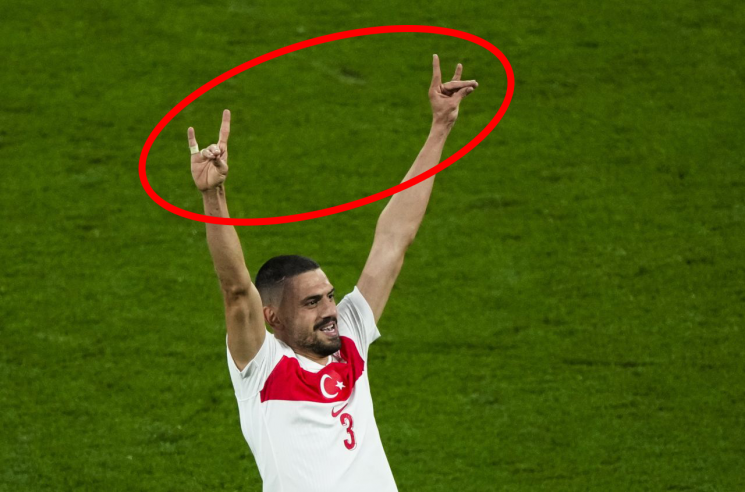 The controversial celebration occurred during the round of 16 match between Turkey and Austria held the previous evening in Leipzig, Germany. Turkey center-back Merih Demiral (Al Ahli) made a wolf salute celebration with both hands after scoring his second goal in the 14th minute of the second half.
 [Photo by AP·Yonhap News]
The wolf salute is a hand gesture where the thumb, ring finger, and middle finger are joined together while the other two fingers are extended straight, resembling the side profile of a wolf. In Germany and other parts of Europe, this gesture is recognized as the greeting of the far-right Turkish extremist group 'Grey Wolves.' The Grey Wolves define other ethnic groups such as Kurds and Jews as enemies, excluding the mainstream Turkish ethnic group. Consequently, the German Office for the Protection of the Constitution classifies this group as far-right extremists and monitors them, as they have over 10,000 members in Germany.
However, some argue from a Turkish perspective that the wolf salute is not necessarily a symbol of far-right extremism. The Turkish people regard the wolf as sacred because, according to tradition, a wolf appeared to guide them to safety during hardships in Central Asia. As Demiral mentioned, it can be seen as an ethnic tradition rather than a political statement. Mesut ?zil, a former German national football player of Turkish descent, also once had a tattoo of a symbol associated with the Grey Wolves.
After the match, Demiral sparked controversy by stating at a press conference, "The celebration is related to my identity as a Turkish person," and "I hope to have more opportunities to show this celebration." In response, the Union of European Football Associations (UEFA) announced that it would investigate Demiral's 'inappropriate behavior' on the same day.
German Interior Minister Nancy Faeser said regarding the celebration, "Symbols of Turkish far-right extremists have no place in our stadiums. We will never tolerate turning the European Football Championship into a stage for racism," urging UEFA to conduct an investigation. However, the Turkish Ministry of Foreign Affairs argued that investigating historical and cultural symbols for political motives is inappropriate and claimed, "The reaction shown by German authorities towards Demiral includes xenophobia."
© The Asia Business Daily(www.asiae.co.kr). All rights reserved.
![Clutching a Stolen Dior Bag, Saying "I Hate Being Poor but Real"... The Grotesque Con of a "Human Knockoff" [Slate]](https://cwcontent.asiae.co.kr/asiaresize/183/2026021902243444107_1771435474.jpg)
















