A general election to elect 650 members of the House of Commons for a five-year term is being held on the 4th (local time) in the UK. The ruling Conservative Party, which has lost public support due to an economic recession and successive scandals, is expected to suffer the "worst defeat since its founding," with the Labour Party likely to succeed in a regime change for the first time in 14 years. Keir Starmer, the leader of the Labour Party who is widely regarded as the next prime minister, predicted the regime change during his final campaign rally, saying, "Only a few yards remain until the start of this historic day."
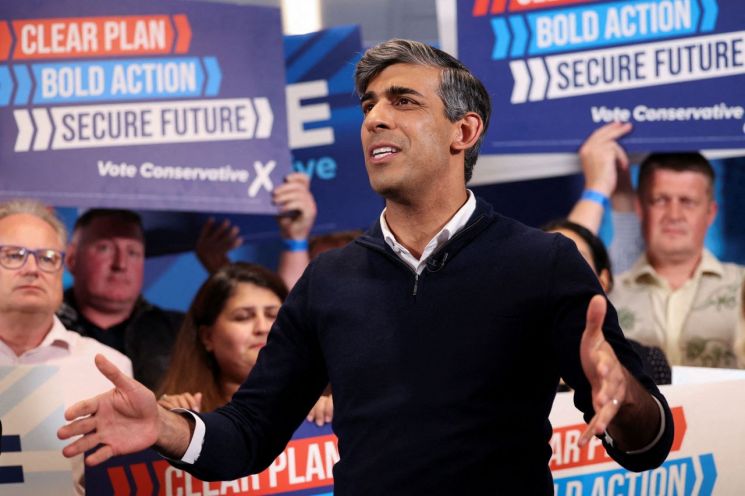 Rishi Sunak, Prime Minister of the United Kingdom leading the ruling conservative party
 [Image source=AFP Yonhap News]
On the 3rd, a day before the general election, the UK’s BBC broadcast aggregated major opinion polls, estimating that the ruling Conservative Party would receive only 16-26% of the vote, far less than the Labour Party’s 34-44%. This is the lowest vote share since the Conservative Party was founded. Throughout the six-week election campaign, the projected vote share gap between the Conservative and Labour parties consistently remained around 20 percentage points.
With the Labour Party’s landslide victory and the Conservative Party’s worst defeat already considered a foregone conclusion, the key issue is the number of seats. In a survey released the previous evening by YouGov, the Labour Party was expected to secure 431 out of 650 seats in the House of Commons, while the Conservative Party was projected to win only 102 seats. On the same day, a Survation poll forecasted the Conservative Party’s seat count at a historic low of just 64 seats. Some polls even warned that the Conservative Party might lose its position as the main opposition party to the Liberal Democrats.
The anticipated defeat of the ruling Conservative Party had been raised early on. Such low approval ratings suggest that British voters’ dissatisfaction has grown significantly over issues such as Brexit (the UK’s withdrawal from the European Union), the pandemic, inflation caused by the war in Ukraine, and a surge in illegal immigration. The Wall Street Journal (WSJ) noted, "Voters want change," adding, "No British party has ever served more than five consecutive terms. Since Brexit, the UK economy has struggled and has been further hit by the pandemic and the war in Ukraine." A new term, ‘Bregret’ (Brexit + regret), has even emerged locally to describe regret over Brexit.
Contrary to Prime Minister Sunak, a former Goldman Sachs executive, emphasizing rapid economic recovery when announcing the early general election, voters are giving the Conservative Party failing marks on economic performance. According to The Guardian, real wages in the UK rose in double digits from 1970 to 2007 but stagnated in the 0% range during the 2010s when the Conservative Party was in power. After the global financial crisis, the Conservative Party, which returned to power in 2010, drastically cut public spending to manage national finances, leading to a deterioration in public services that burdened the lives of Britons. Meanwhile, the tax burden increased. According to The Sun, the UK’s taxes have risen to the highest level since World War II.
Additionally, scandals such as former Conservative Prime Minister Boris Johnson’s party scandal and former Prime Minister Liz Truss’s fiscal policy failures have fueled calls for regime change. During the election campaign, a scandal broke out involving 15 Conservative Party members and officials allegedly betting on the date of the early general election. Pollster Andrew Cooper said of Prime Minister Sunak, "He is being hit all over the country," adding, "If this were a boxing match, it would have been called off by now." The Conservative Party’s pledges on tax cuts and tough immigration policies also failed to sway voters.
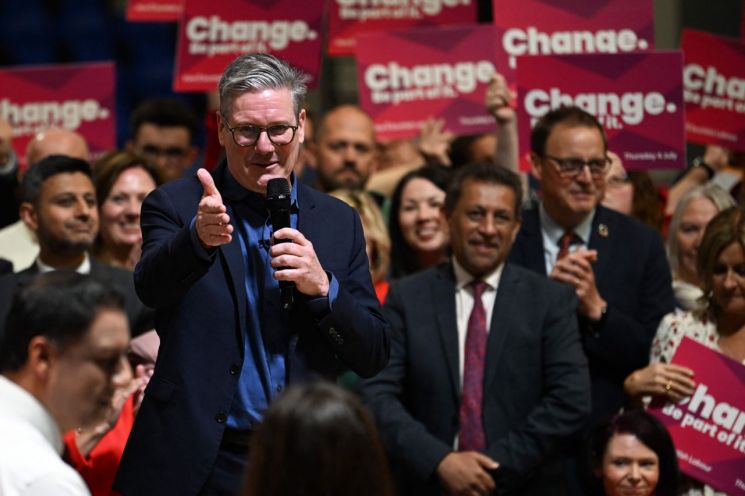 Keir Starmer, leader of the Labour Party and a leading candidate for the next UK Prime Minister
 [Image source=AFP Yonhap News]
In the final press conference held the day before the election, when asked if he would take full responsibility for the election results, Prime Minister Sunak replied, "Yes." While avoiding a direct answer about the most memorable moments during his tenure, he hinted at difficult external circumstances. He said, "There are many things I want to do, but the reality was dealing with the situation at hand," adding, "You have to play the cards you are dealt." In contrast, Starmer, confident of a Labour landslide, said that the cabinet to lead the UK after the election is already prepared and emphasized, "We will work vigorously from day one." He declared, "Let’s rebuild the UK with the Labour Party. We are ready."
© The Asia Business Daily(www.asiae.co.kr). All rights reserved.


















