The domestic aviation industry invested a total of 5.8453 trillion KRW in safety last year. This represents an increase of 1.6155 trillion KRW (38.2%) compared to the 2022 investment amount of 4.2298 trillion KRW.
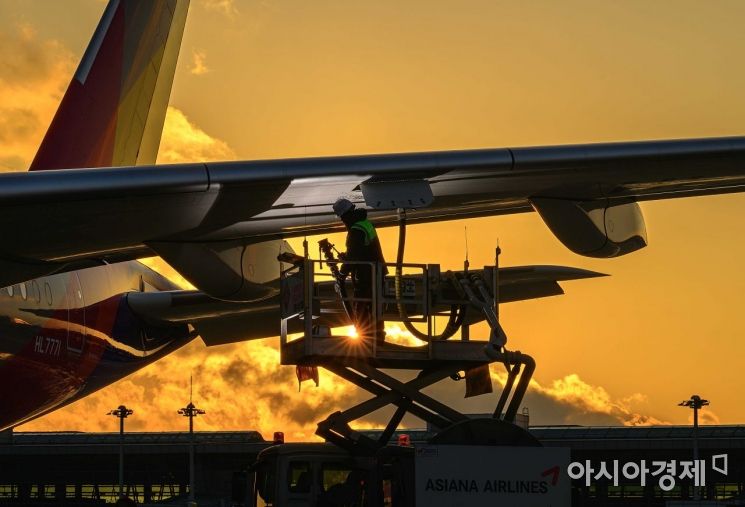 An Asiana Airlines official is conducting the final inspection while refueling a plane preparing for departure on the runway of Incheon International Airport Terminal 1. Photo by Jinhyung Kang aymsdream@
The Ministry of Land, Infrastructure and Transport announced on the 4th the 2023 safety investment performance and future investment plans compiled from disclosures by 18 aviation transport operators, including air carriers and airport operators. The disclosure system, introduced to encourage voluntary safety investments by the aviation industry, was piloted for three years starting in 2020 and was first implemented last year.
The Ministry and the Aviation Safety Technology Institute explained that most airlines increased their investment performance compared to the previous year.
Among international transport operators, major airlines and low-cost carriers (LCCs) invested 4.364 trillion KRW and 1.2143 trillion KRW respectively over the past year. By airline, Korean Air invested 2.7914 trillion KRW and Asiana Airlines 1.5727 trillion KRW, marking increases of 51.6% and 35.7% compared to the previous year, respectively.
For LCCs, Jeju Air invested 493.5 billion KRW, T'way Air 251.2 billion KRW, Air Busan 229.3 billion KRW, Jin Air 111.9 billion KRW, Air Seoul 60.4 billion KRW, Eastar Jet 30.2 billion KRW, Air Premia 26.1 billion KRW, Air K 7.4 billion KRW, and Air Incheon 4.4 billion KRW. Among these, Air Busan (-11.9%), Jin Air (-71.4%), and Air Incheon (-61.4%) saw decreases in investment compared to the previous year.
Regarding airport operators, Korea Airports Corporation invested 89.5 billion KRW, a 20.7% increase from the previous year, while Incheon International Airport Corporation invested 169.2 billion KRW, a 3.1% decrease. The decrease for Incheon International Airport Corporation was due to reduced costs for purchasing firefighting and de-icing vehicles.
The airlines’ investment by category was highest in maintenance costs, replacement costs for aircraft over 20 years old, and engine and parts purchases. Maintenance costs amounted to 2.94 trillion KRW. Preventive maintenance costs (2.53 trillion KRW, 86.1%) were higher than corrective maintenance costs (410 billion KRW, 13.9%) for faults occurring during operation. The Ministry stated that airlines are making efforts to strengthen their preventive maintenance systems.
Replacing 14 aging aircraft with new ones cost 1.19 trillion KRW. The average aircraft age was 12.2 years, maintaining the previous year’s level of 12.0 years. To prepare for engine failures that could cause long delays, airlines invested 1.32 trillion KRW to secure additional spare engines, anticipating increased aviation demand.
Airlines’ safety investment performance is reflected in the allocation evaluation of transport rights. Koo Kyung-soo, Director of Aviation Safety Policy at the Ministry, said, "Aviation safety is the top priority and core competitiveness of airline management," adding, "Investing appropriately in aviation safety according to company size, rather than viewing it as a cost, drives aviation demand and leads to healthy growth of the aviation industry."
© The Asia Business Daily(www.asiae.co.kr). All rights reserved.

















