Minority Party's Last Resort to Block Bill Passage
Repeated Speeches, Rule Objections, and Personal Remarks
Triggered When Over One-Third of Total Members Demand
First Initiator This Time: Yusangbeom, People Power Party Lawmaker
The People Power Party has entered into a 'filibuster,' the last means for a minority party to block the passage of a bill. This is an attempt to prevent the passage of the 'Chae Sang-byeong Special Prosecutor Act,' which was submitted to the plenary session on the 3rd under the leadership of the Democratic Party of Korea.
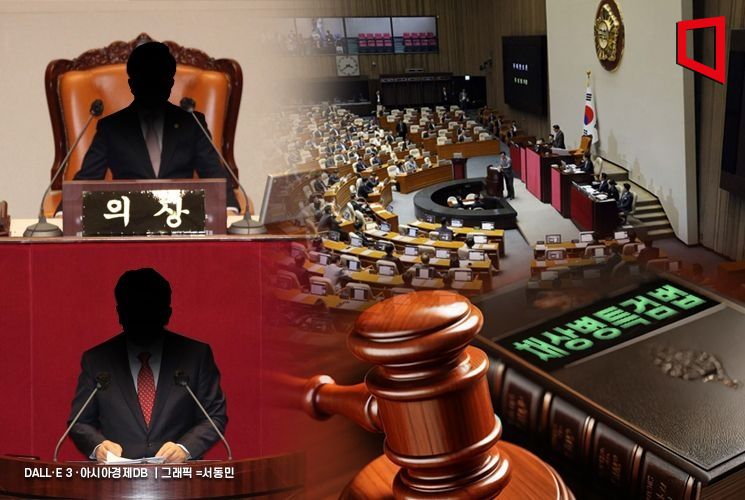
A filibuster refers to an act in the National Assembly where minority party members use legal methods and means to deliberately obstruct the progress of parliamentary proceedings to prevent the majority party's unilateral actions or for other necessary reasons. Common tactics include long speeches under the pretext of questions or statements of opinion, repeated procedural speeches, excessive procedural or personal remarks, strict adherence to formal procedures, continuous proposals of various motions and amendments, unlimited opposing debates, refusal to attend, and mass walkouts.
A filibuster can be initiated if more than one-third of the total members request it regarding an agenda item submitted to the plenary session, and it can be stopped only if there are no more debaters or if more than 60% of the total members agree.
In South Korea, filibusters were abolished in 1973 but revived in May 2012 as part of the National Assembly Act (commonly known as the National Assembly Advancement Act).
When the Democratic Party was in opposition, a filibuster to block the passage of the Anti-Terrorism Act in February to March 2016 set a record of 192 hours. The filibuster began with Democratic Party lawmaker Kim Kwang-jin on February 23, 2016, at 7:07 p.m. Following this, Democratic Party lawmaker Eun Soo-mi conducted an unlimited debate lasting 10 hours and 18 minutes on February 24 to block the passage of the Anti-Terrorism Act, and on February 27, fellow party member Jung Chung-rae spoke for 11 hours and 39 minutes. Finally, the floor leader Lee Jong-gul conducted an unlimited debate for a total of 12 hours and 31 minutes, setting the longest filibuster record in constitutional history.
Before this, the longest filibuster in South Korea was by Shin Min-dang lawmaker Park Han-sang in August 1969, who spoke for 10 hours and 15 minutes to block the third-term constitutional amendment.
Later, People Power Party lawmaker Yoon Hee-suk broke the record on December 12, 2020, by conducting a filibuster opposing amendments to the National Intelligence Service Act and others, lasting a total of 12 hours and 47 minutes.
In April 2022, the People Power Party used filibusters to oppose the then-ruling Democratic Party's 'Prosecutorial Reform' bills (amendments to the Prosecutors' Office Act and the Criminal Procedure Act). At that time, the Democratic Party countered with a 'salamis tactics' by splitting the session into smaller parts to end the filibuster and forcibly pass each bill. They utilized the National Assembly Act provision that considers a filibuster ended if the session ends during the filibuster and requires the agenda to be voted on promptly in the next session. Unlike the usual relay debates by opposition party members against a bill, the Democratic Party placed 'supporting debaters' among the 'opposing debaters,' and this tactic was repeated.
The dictionary definition of a filibuster is a debate without time limits, but in reality, there are limits. There is a rule that allows a forced end to the debate if more than three-fifths of the total members agree after 24 hours from the start of the debate.
The filibuster started by the People Power Party to block the forced passage of the Chae Sang-byeong Special Prosecutor Act submitted to the plenary session that day is effectively a '24-hour debate.' This is considering the current seat distribution of 108 to 192 between the ruling and opposition parties. About six minutes after the debate started, at around 3:45 p.m., 170 Democratic Party members submitted a 'motion to end the debate,' so the filibuster is expected to end on the afternoon of the 4th.
© The Asia Business Daily(www.asiae.co.kr). All rights reserved.

















