‘Super Rich Ibangin’ Episode 6 Chinese Subtitle Mistranslation
Netflix: "We Will Correct It to Avoid Unnecessary Misunderstandings"
‘The Eight Show’ Also Labeled Donghae as Sea of Japan
Netflix is facing controversy for labeling 'kimchi' as the Chinese-style spicy pickled vegetable 'labaichai' in the Chinese subtitles of its original variety content.
Recently, through online communities, it was revealed that in episode 6 of the Netflix variety show 'Super Rich Foreigners,' released on May 7, kimchi was labeled as 'labaichai.' The program features wealthy individuals of various nationalities experiencing Korea, and the problematic episode included scenes where the cast members gathered to make kimchi. Netflix mistranslated kimchi mentioned in the cast's conversations as 'labaichai' in many Chinese subtitles.
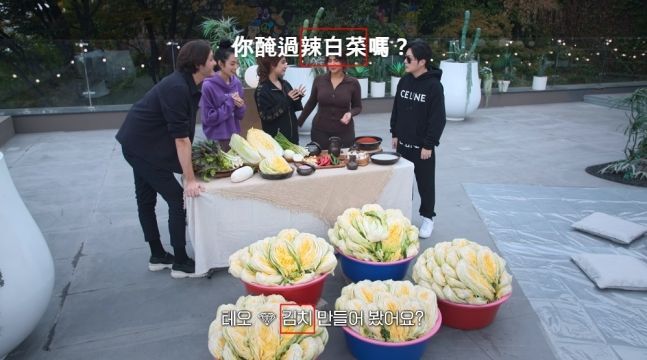 A scene in the Chinese subtitles of Netflix's 'Super Rich Foreigners' where kimchi is labeled as "Labaichai" (辣白菜) [Photo by Netflix capture]
Our government specifies the Chinese translation of kimchi as ‘xinchi’ (辛奇). Although 'labaichai' is commonly used in China to mean kimchi, experts argue that our kimchi and labaichai are distinctly different. In 2021, the Ministry of Culture, Sports and Tourism partially revised the ‘Guidelines for the Translation and Notation of Public Terms in Foreign Languages’ to designate the Chinese term for kimchi as ‘xinchi,’ a measure taken to counter claims that kimchi originated from Chinese culture.
Professor Seo Kyung-deok of Sungshin Women’s University posted on social media on the 2nd, stating, "I learned about this thanks to many netizens reporting it, and since Netflix has global influence, I immediately sent a protest email." He added, "As China’s ‘kimchi fair’ continues relentlessly, such situations could provide China with an excuse, so it must be corrected quickly." He also pointed out, "Last year, Netflix caused controversy by labeling kimchi as 'paochai' (泡菜) in many Chinese subtitles."
Netflix responded by saying, "We labeled it as 'labaichai' to help overseas viewers who use Chinese characters understand, but we judged that it could cause unnecessary misunderstandings among viewers, so we have decided to label kimchi in Korean content as 'xinchi' (辛奇) going forward." They also stated, "Existing subtitles will be revised to 'xinchi' as well."
This is not the first time Netflix has faced mistranslation controversies. Recently, the Spanish subtitles of the drama 'The Eight Show' caused controversy by labeling the 'East Sea' as the 'Sea of Japan.' In a scene where actor Ryu Jun-yeol sings the national anthem, "East Sea water and Baekdu Mountain" was mistakenly labeled as "Sea of Japan and Baekdu Mountain." Additionally, in 2020, the German subtitles of the movie ‘Time to Hunt’ labeled the East Sea as the Sea of Japan, and in 2021, the Chinese subtitles of the sitcom ‘I Wish the Earth Would End Tomorrow’ mistranslated kimchi as ‘paochai.’
© The Asia Business Daily(www.asiae.co.kr). All rights reserved.

















