Prime Minister Kishida Fumio: "Banknotes Suitable for the Times"
Existing Banknotes Can Continue to Be Used
The Bank of Japan issued three new banknotes with redesigned designs for the first time in 20 years on the 3rd.
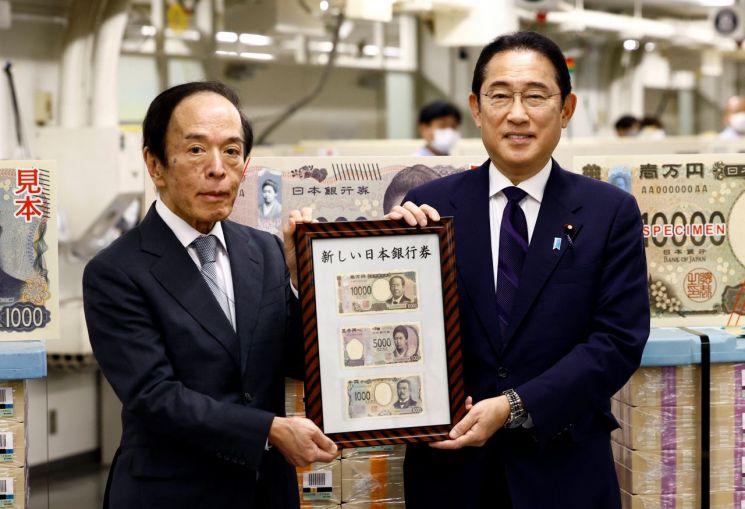 Japanese Prime Minister Fumio Kishida (right) and Bank of Japan Governor Kazuo Ueda are introducing the newly issued 10,000 yen, 5,000 yen, and 1,000 yen banknotes at the Bank of Japan headquarters in Tokyo, Japan, on the 3rd.
 [Photo by Yonhap News]
According to NHK and Kyodo News, the Bank of Japan, the country's central bank, held a ceremony at its headquarters in Chuo Ward, Tokyo, on the morning of the same day to commemorate the issuance of the new banknotes and began circulating the new 1,000 yen, 5,000 yen, and 10,000 yen bills.
Kazuo Ueda, Governor of the Bank of Japan, said at the ceremony, "Today, we plan to release 1.6 trillion yen (approximately 13.7 trillion won) worth of new Bank of Japan notes to the world," adding, "Although cashless payments are progressing, cash will continue to play a major role as a safe and reliable payment method."
Japanese Prime Minister Fumio Kishida visited the Bank of Japan headquarters for an inspection and told reporters, "These are banknotes befitting the new era," and "I hope the new banknotes will invigorate the Japanese economy."
The new 10,000 yen note features a portrait of Eiichi Shibusawa, an economic official during Japan's Meiji era who is known as the "Father of Japanese Capitalism." However, he also served as president of Keijo Electric (the predecessor of Korea Electric Power Corporation) during the Japanese colonial period, leading economic exploitation, and was involved in issuing the first modern banknotes in the Korean Peninsula during the Korean Empire era, making himself the subject of the banknote and bringing humiliation to Korea.
The 5,000 yen note features Tsuda Umeko, known as a pioneer of women's education in Japan, and the 1,000 yen note features Shibasaburo Kitasato, who laid the foundation for modern Japanese medicine.
These banknotes incorporate a world-first hologram technology that creates a three-dimensional image appearing to rotate to prevent counterfeiting.
In Japan, expectations are rising that the new banknotes will have a significant economic stimulus effect. Nomura Research Institute estimates the cost of replacing ATMs and other equipment at about 1.6 trillion yen and predicts an economic effect that could raise Japan's annual nominal gross domestic product (GDP) by about 0.27%.
There is also analysis suggesting that cash hoarded at home by elderly people and others will lead to increased consumption and investment. So-called "jangrong deposits" in Japan are estimated to be around 60 trillion yen (approximately 515 trillion won).
Existing banknotes can still be used even after the currency replacement. Travelers do not necessarily have to exchange their money for the new banknotes.
© The Asia Business Daily(www.asiae.co.kr). All rights reserved.
![From Bar Hostess to Organ Seller to High Society... The Grotesque Con of a "Human Counterfeit" [Slate]](https://cwcontent.asiae.co.kr/asiaresize/183/2026021902243444107_1771435474.jpg)
















