Game Rating and Administration Committee 100-Day Press Conference on Probability Item Information Disclosure
266 Violations Detected in 100 Days of Probability Item Information Disclosure
The world's largest gaming platform, Steam, is confirmed to be considering obtaining qualification as a domestic self-rating classification operator. If Steam acquires the status of a self-rating classification operator, it will enter the domestic regulatory system, which is expected to facilitate smooth collaboration with the Game Rating and Administration Committee regarding compliance with domestic laws such as the probability-type item system.
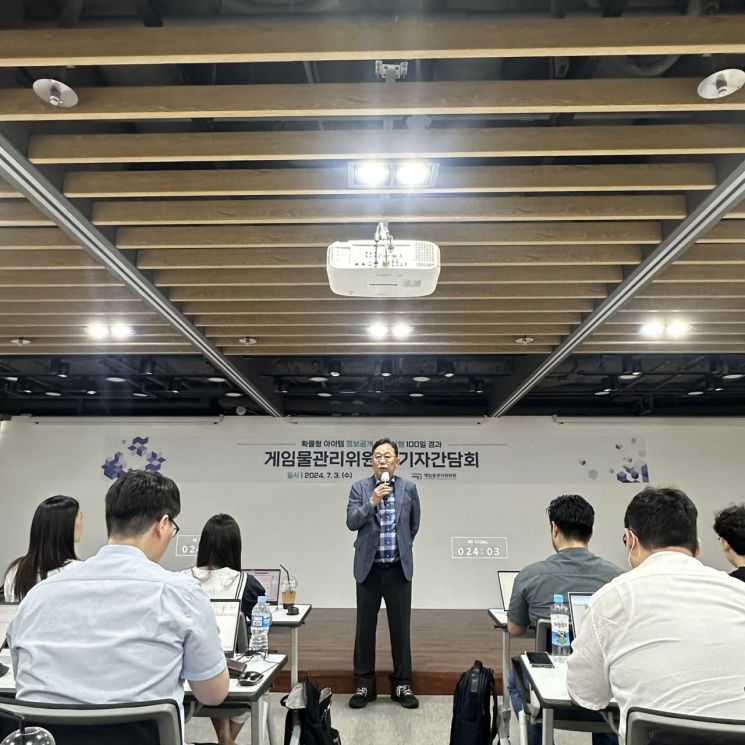
On the 3rd, Kim Gyu-cheol, Chairman of the Game Rating and Administration Committee, stated at a press briefing held at the CKL Corporate Support Center in Jung-gu, Seoul, "In March, we had a meeting with Valve (Steam's operator) in the United States, and they expressed interest in the self-rating classification operator business," adding, "We are discussing under what conditions they will approach this, and we will share the results once they are available."
Until now, Steam has been in a regulatory blind spot under domestic law. The Committee has requested cooperation from platforms like Google and Apple to restrict the distribution of games in the domestic market if game companies fail to comply with corrective recommendations or orders. However, since Steam was not designated as a self-rating classification operator by the government, it was difficult to request such cooperation.
If Valve obtains the status of a self-rating classification operator, our government and institutions will be able to engage not only in the rating classification of games distributed on Steam but also in the probability-type item system upon government request.
Kim Beom-su, Head of the Autonomous Support Division at the Committee, said, "Valve was the first to show interest in becoming a self-rating classification operator," and added, "They requested related materials, and the Committee also sent the relevant documents."
On the same day, the Committee also disclosed monitoring results conducted over 100 days since the implementation of the probability-type item information disclosure system. The Committee established a Game Information Management Team under the Autonomous Support Division to conduct monitoring. If a game operator is found to have violated the information disclosure obligation, the Committee issues a first corrective request, and the Ministry of Culture, Sports and Tourism issues second and third corrective recommendations or orders.
From the system's implementation date on March 22 to June 28, the Committee's post-management results showed 1,255 monitoring cases, 266 corrective requests, and 5 corrective recommendations. All five corrective recommendations were for overseas game companies.
The violations were mostly due to undisclosed probabilities (59%), followed by advertising (29%) and display methods (12%). The complaint reception status was categorized as suspected probability manipulation (49%), undisclosed probabilities (37%), and general inquiries (14%).
Park Woo-seok, Head of the Game Information Management Team at the Committee, explained, "In the case of the five overseas games, the process has proceeded to the corrective recommendation stage," adding, "If corrective orders are not complied with, distribution in the domestic market will be restricted."
At the briefing, the Committee also expressed its stance on issues such as the privatization of game rating classification and overlapping regulatory controversies with the Fair Trade Commission, in addition to the probability-type item information disclosure system.
Regarding the Fair Trade Commission, which has recently shown an active stance on regulating game companies, Chairman Kim said, "It is cautious to evaluate the actions of the Fair Trade Commission," and added, "We believe that the rapidly growing game industry should be viewed with a long-term perspective on how it can be well integrated into Korean society. The Committee will continue efforts to establish the probability-type item information disclosure system according to its own steps."
On the privatization of game rating classification, he said, "Korea is the only country where the government oversees rating classification," and added, "In line with global standards, rating classification is being handled privately, and the Committee is focusing on post-management."
© The Asia Business Daily(www.asiae.co.kr). All rights reserved.
![Clutching a Stolen Dior Bag, Saying "I Hate Being Poor but Real"... The Grotesque Con of a "Human Knockoff" [Slate]](https://cwcontent.asiae.co.kr/asiaresize/183/2026021902243444107_1771435474.jpg)
















