"Speed Creates Research Differentiation"
Emphasizing the Importance of Utilizing 'El Capitan,' the World's No.1 Supercomputer Scheduled to Operate Within the Year
Domestic Science Community 'Restless' Over Delays in Introducing the 6th National Supercomputer Due to Budget Shortages
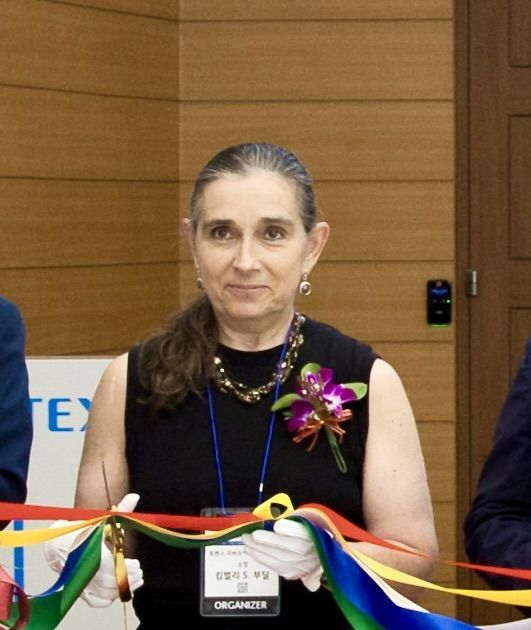 Kimberly Budil, Director of Lawrence Livermore National Laboratory, is cutting the ribbon at the opening ceremony of Nano Korea 2024 on the 3rd. Photo by Ministry of Science and ICT
"We are now entering an era where speed creates differentiation in research."
Kimberly Budil, director of the U.S. Lawrence Livermore National Laboratory, stated the importance of powerful computing power in this way during an interview with reporters after delivering the keynote speech at 'Nano Korea 2024' held at KINTEX in Ilsan, Gyeonggi Province on the 3rd.
Lawrence Livermore National Laboratory is a national laboratory under the U.S. Department of Energy that conducts research on energy, bio, climate change, and more. Recently, it has made groundbreaking progress in the energy field by consecutively succeeding in increasing net energy through laser-driven nuclear fusion ignition. Director Budil is the first female director of the Lawrence Livermore Laboratory.
She emphasized that it plays a revolutionary role in accelerating the outcomes of national research and development (R&D) and advised that the Korean government should actively pursue the introduction of supercomputers.
Director Budil explained, "Computers and artificial intelligence (AI) allow us to quickly find answers within a much broader range of possibilities and also guide the direction. Without the help of computers, relying solely on experiments would require endless testing to verify all possible cases."
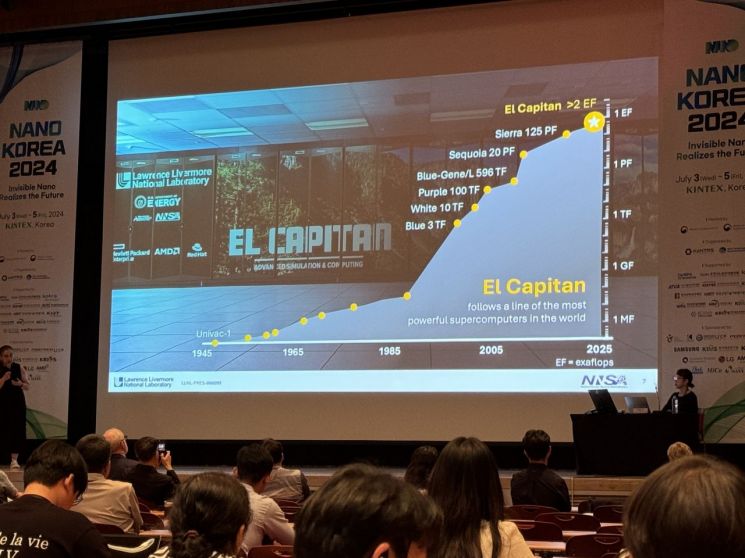 Kimberly Budil, Director of Lawrence Livermore National Laboratory, is explaining the history of the supercomputers owned by the laboratory during the keynote speech at Nano Korea 2024 on the 3rd. Photo by Jongmin Baek
The supercomputer currently used by Lawrence Livermore Laboratory is Sierra. As of 2022 measurements, this computer demonstrated a performance of 125 PF (1 PF equals the ability to perform 1,000 trillion calculations per second), making it the third most powerful supercomputer in the world. Additionally, all 14 computers owned by the laboratory are listed in the 'Top500,' which ranks the world's supercomputers.
The laboratory's ambition for computing power does not stop. In her keynote speech titled "How to Lead Disruptive Technological Innovation," Director Budil emphasized the importance of El Capitan, an exascale (100 quintillion calculations per second) supercomputer scheduled to be operational this year. She expressed confidence that once El Capitan is operational, it will surpass Frontier at the U.S. Oak Ridge National Laboratory, currently the world's number one supercomputer, in performance rankings. El Capitan is expected to achieve calculation speeds exceeding 200 quintillion operations per second. It is known that El Capitan will be used for U.S. nuclear weapons-related research.
The importance of computing emphasized by Director Budil carries significant implications for us. The introduction of the sixth national supercomputer has been delayed due to budget shortages caused by rising prices of graphics processing units (GPUs). When asked whether the Korean government should allocate a budget for the introduction of a national supercomputer to support national R&D, Director Budil avoided a direct answer but indirectly expressed support.
She added, "Computers really help with research. As the previous speaker (Samsung Electronics' Song Jae-hyuk, Chief Technology Officer of the DS Division) mentioned, AI can accelerate our learning speed. Massive computers will accelerate scientific progress. We are now entering an era where speed creates differentiation."
An anonymous official from the scientific community also said, "The Ministry of Science and ICT and the Ministry of Economy and Finance must quickly allocate the budget and finalize the installation plan for the sixth national supercomputer to prevent domestic scientific research from falling behind."
© The Asia Business Daily(www.asiae.co.kr). All rights reserved.
![Clutching a Stolen Dior Bag, Saying "I Hate Being Poor but Real"... The Grotesque Con of a "Human Knockoff" [Slate]](https://cwcontent.asiae.co.kr/asiaresize/183/2026021902243444107_1771435474.jpg)

















