Counterpoint Research Outlook Report
China to Account for 50% of Global BEV Sales by 2027
As China’s BYD and the United States’ Tesla compete for the title of the world’s largest electric vehicle manufacturer, it is projected that BYD will surpass Tesla this year to become the number one seller of battery electric vehicles (BEVs).
Market research firm Counterpoint Research stated in a report on the 2nd (local time), "With global battery electric vehicle sales expected to reach 10 million units this year, BYD’s BEV sales are surging and are likely to overtake Tesla," adding, "This shift highlights the dynamic nature of the global electric vehicle market."
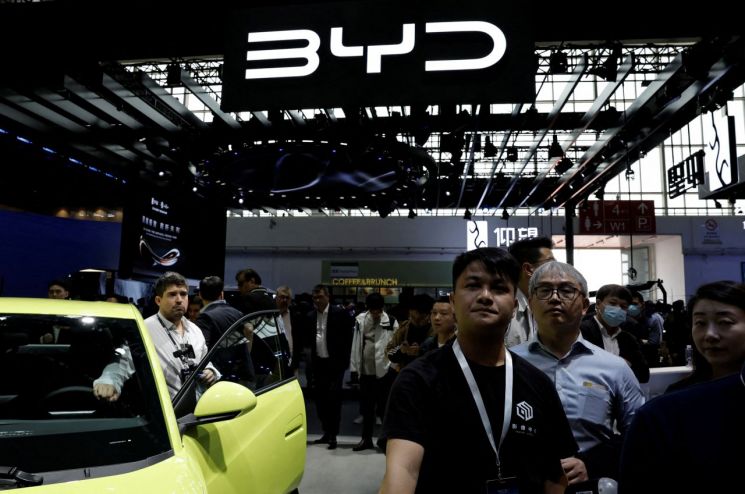
BYD’s BEV sales in the second quarter of this year recorded 426,039 units, an increase of about 21% compared to the same period last year. During the same period, Tesla delivered 443,956 units, a decrease of 4.8%. Previously, BYD had outperformed Tesla for two consecutive years in total production volume?including battery electric vehicles and hybrid vehicles?with 3 million units compared to Tesla’s 1.84 million units. However, excluding hybrid vehicles (1.4 million units), BYD’s pure electric vehicle production (1.6 million units) lagged behind Tesla, resulting in BYD losing the top spot in BEV production.
Counterpoint Research noted, "China, led by BYD, still dominates the BEV market," estimating that China’s pure battery electric vehicle sales this year will be four times that of North America. It further explained, "By 2027, China is expected to account for 50% of global BEV sales, and by 2030, it will sell more pure electric vehicles than North America and Europe combined."
However, the EU’s planned increase in tariffs on Chinese electric vehicles could act as a variable. The European Union (EU) is currently considering imposing provisional tariffs ranging from 17.4% to 38.1% points in addition to the existing 10% tariff, citing China’s low-price offensive as a "clearly foreseeable and imminent threat of damage to EU industry." BYD is expected to be subject to a 17.4% tariff rate. The EU Commission stated, "These tariffs are temporary measures," but added, "If no resolution is reached in discussions with Chinese authorities, they will be applied starting July 4."
Liz Lee, Deputy Director at Counterpoint Research, analyzed, "The EU’s new tariff rates on Chinese electric vehicles aim to create a level playing field for European electric vehicle manufacturers struggling against China’s low-price offensive," adding, "As a result of these tariff measures, Chinese automakers may expand into emerging markets such as the Middle East and Africa, Latin America, Southeast Asia, Australia, and New Zealand."
Meanwhile, on the same day, Tesla’s stock price on the New York Stock Exchange closed at $231.26, up 10.20% from the previous session. This is the highest level in the past six months. The increase is attributed to the company’s second-quarter vehicle delivery results, which, despite declining year-over-year, exceeded market expectations. Dan Ives, Chief Economist at Wedbush Securities, commented, "The worst is behind us," and noted, "After a turbulent six months, the Tesla story has been revitalized."
© The Asia Business Daily(www.asiae.co.kr). All rights reserved.

















