72% of Electric Vehicles Registered Even Without Subsidies
Subsidy Budget Costs 2.6 Trillion Won
Charging Station Budget Achieves Same Effect with Only 15% Usage
An analysis has emerged suggesting that to expand the adoption of electric vehicles, expanding chargers is more important than subsidies. Subsidies incur much higher costs than benefits, whereas chargers can achieve the same effect as subsidies at a much lower cost.
According to "Directions for Improving Eco-friendly Vehicle Adoption Policies" published on the 3rd by Kim Hyun-seok, a research fellow at the Korea Development Institute (KDI), 260,221 new electric vehicles were registered from 2019 to 2022. During this period, it is estimated that 2.6 trillion won in national and local government subsidies were paid. However, the volume of vehicles adopted due to subsidy payments is estimated at 65,926 units, accounting for 27.4% of the total. This means that the remaining 72.6% would have been adopted even without subsidies.
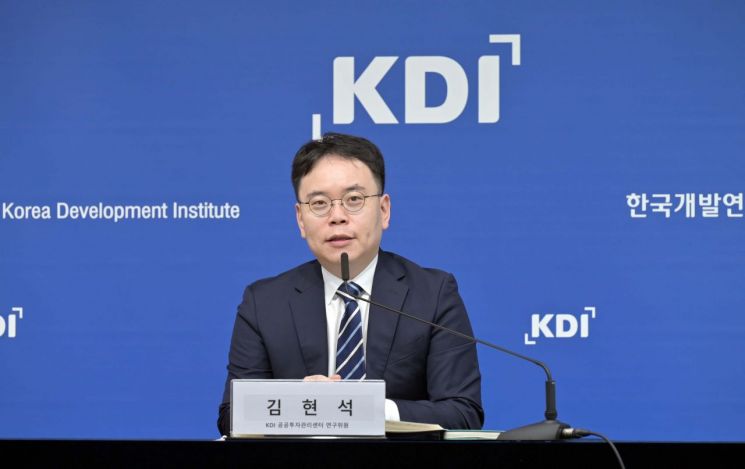 Kim Hyun-seok, a research fellow at the Korea Development Institute (KDI), is presenting the "Improvement Directions for Eco-friendly Vehicle Distribution Policies" at the Government Sejong Complex on the 3rd. Photo by KDI
The effect was higher for charger installation support. To achieve the same scale of effect as subsidies, about 90,000 electric vehicle chargers are needed. Based on the current government support amount, this would cost 390 billion won. It is explained that using only 15% of the subsidy support amount can produce the same policy effect. Although a simple calculation, Research Fellow Kim explains that charger support is more effective than subsidies.
The social benefits of electric vehicle subsidies were also generally found to be less than the costs. Research Fellow Kim assumed the benefits of subsidies as "deadweight loss" and "environmental cost reduction." Then, considering the social cost of greenhouse gases and the eco-friendliness of electricity, a cost-benefit analysis was conducted, and in all scenarios, the ratio did not exceed 1. This means that the costs were greater than the benefits gained from providing subsidies.
Based on these results, Research Fellow Kim argued that the basic direction of eco-friendly vehicle adoption policies should focus on strengthening charging infrastructure rather than providing subsidies. He also proposed continuously reducing the subsidy unit price at the purchase stage. In particular, he pointed out that the government's increase of national subsidies from 6.8 million won to 7.8 million won in the second half of last year, citing sluggish electric vehicle sales, is unlikely to be effective in the medium to long term.
Regarding charging infrastructure, he suggested that qualitative expansion should be achieved beyond quantitative expansion. As the number of chargers increases, proper maintenance such as inspection, repair, and replacement must be carried out so that consumers can feel real convenience. He also analyzed that, in addition to charging infrastructure near residences and residential areas, charging conditions at major hubs such as highway rest areas should be improved, and the proportion of fast chargers, which is insufficient compared to advanced countries, should be increased.
© The Asia Business Daily(www.asiae.co.kr). All rights reserved.
![Clutching a Stolen Dior Bag, Saying "I Hate Being Poor but Real"... The Grotesque Con of a "Human Knockoff" [Slate]](https://cwcontent.asiae.co.kr/asiaresize/183/2026021902243444107_1771435474.jpg)










