If Votes Tie in Elections, Outcome Decided by 'Luck'
Various Methods Like Coin Tossing and Dice Rolling Used
Can the primary election of legislative candidates, a core element of democratic countries, be left to 'luck'? Surprisingly, such cases occasionally occur in the United States. When two candidates in a primary election received an equal number of votes, the winner was decided by a 'coin toss' according to a long-standing tradition.
Recently, local media in Oregon reported that on the 27th of last month (local time), Lisa Pragala was selected as the Democratic candidate in the primary election for the U.S. House of Representatives in the Eugene district. This election was held to replace Paul Holvey, a former state legislator.
However, the process by which Pragala was chosen was somewhat different from a typical election. Since Eugene is considered a Democratic stronghold, the Republican Party did not field a candidate in this election. As a result, only two Democratic candidates competed: Pragala and Doyle Canning.
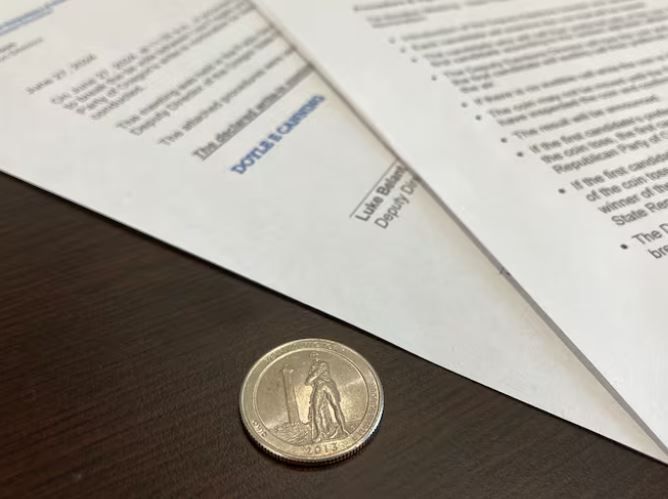 A 25-cent coin used in the Oregon Republican primary election. It is a coin commemorating Oliver Hazard Perry, a legendary admiral of the U.S. Navy. [Image source: Screenshot from the Oregon Secretary of State's official website]
In the earlier Democratic primary, Pragala defeated Canning to become the Democratic nominee. The issue arose with the vacant Republican nomination. Since the Republicans did not present a candidate, Republican voters had to choose between the two Democratic candidates. Fourteen Republican voters cast signed ballots, and surprisingly, the result was a tie with 7 votes each.
According to Oregon state law, if two candidates in a legislative election tie, the final winner must be decided by a 'coin toss.' Accordingly, the two candidates faced a contest that would determine their political fate.
The coin used in the contest was no ordinary coin. It was a specially minted 25-cent coin commemorating Admiral Oliver Hazard Perry, who defeated the British naval fleet during the War of 1812. The winner of the toss was candidate Canning.
However, another state law then came into effect, reversing the situation again. Known as the 'Sore loser' law, it prohibits a candidate who has lost in one primary from running as a candidate in another party's primary. Since Canning had already lost the Democratic primary, his victory in the Republican primary was invalidated.
As a result, Pragala was adopted as the 'sole' candidate for the House of Representatives in Eugene. However, the Republican Party still has the option to convene a convention and nominate a candidate before the November election.
Although ties between competing candidates in elections are very rare, such occurrences sometimes happen in U.S. state elections. In those cases, winners are decided by 'luck' through coin tosses, dice rolls, and similar methods. For example, a coin toss was also used to decide a primary election in a state legislature race in 2016.
Meanwhile, Canning, who won the coin toss but was not ultimately nominated, emphasized that this election should serve as a lesson about 'invalid votes.' In an interview with a local media outlet, he stated, "If the Republican Party had nominated anyone, there would have been no tie, and the outcome would have been different," adding, "Every party must nominate a candidate."
© The Asia Business Daily(www.asiae.co.kr). All rights reserved.

















