Contract for Handling Hwangsan Agency Maintained for Over 20 Years, Renewal Refused
"Abuse of Superior Bargaining Position Constitutes 'Fair Trade Act Violation'"
Filing of 'Claim to Prevent Unfair Trade Practices' and Injunction Lawsuit Initiated
Yeongpung announced on the 3rd that it has taken legal action, stating that "Korea Zinc's unilateral suspension of sulfuric acid handling is an unfair trade practice."
Yeongpung filed a 'Prevention of Unfair Trade Practices' lawsuit against Korea Zinc at the Seoul Central District Court on the 20th of last month regarding the refusal to renew the sulfuric acid handling agency contract, and on the 2nd, it filed a provisional injunction to prohibit refusal of transactions as a preservation measure.
This lawsuit was inevitably initiated by Yeongpung as a response after Korea Zinc unilaterally refused to renew the long-standing sulfuric acid handling agency contract between the two companies and notified the termination of the contract.
Sulfuric Acid Handling Agency Contract Maintained for Over 20 Years... Sudden Notice of Renewal Refusal
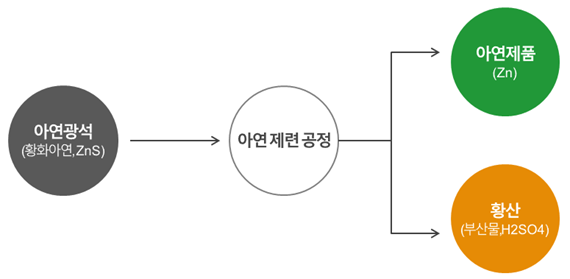
Sulfuric acid is a byproduct that is inevitably generated during the zinc smelting process, and failure to handle it promptly inevitably causes significant disruptions in zinc production.
Both Yeongpung and Korea Zinc, affiliates of the Yeongpung Group, are zinc smelting companies, and since 2000, most of the sulfuric acid produced in their respective zinc smelting processes has been exported through Onsan Port (Ulsan Port). Yeongpung has been using Korea Zinc's Onsan smelter's sulfuric acid tanks and pipelines for a fee during the transportation of sulfuric acid produced at the smelter located in Seokpo-myeon, Bonghwa-gun, Gyeongbuk, to Onsan Port.
This is called 'sulfuric acid handling agency,' and this contractual relationship has been renewed annually and maintained without any incidents for the past 20 years. However, Korea Zinc suddenly notified Yeongpung in April, just two months before the contract expiration date (June 30), that it would refuse to renew the contract.
Since domestic demand for sulfuric acid is low and most must be exported, sulfuric acid can only be shipped from Donghae Port and Onsan Port on the east coast, with Donghae Port already saturated. In this situation, if Korea Zinc refuses the 'sulfuric acid handling agency' and Onsan Port becomes unusable, Yeongpung will be unable to export sulfuric acid, causing considerable disruption to zinc production.
"Korea Zinc Using Refusal of Sulfuric Acid Handling Agency as a Tool in Management Rights Dispute"
Korea Zinc cites reasons such as 'ESG issues, facility aging, and increased sulfuric acid volume at Korea Zinc' for refusing contract renewal, but Yeongpung explains that none of these justify immediate contract termination.
Originally, the contract between Yeongpung and Korea Zinc was not about the sulfuric acid manufacturing process but merely about jointly using two existing storage tanks and some sulfuric acid pipelines of Korea Zinc, which does not impose a significant burden on Korea Zinc.
The prevailing view is that the real reason for Korea Zinc's sudden change in attitude lies in the management rights dispute. In 2022, Korea Zinc secured friendly shares through a series of paid-in capital increases and stock exchanges with Hanwha and LG Chem, initiating a management rights dispute with Yeongpung.
When Yeongpung opposed the third-party allotment paid-in capital increase amendment at Korea Zinc's regular shareholders' meeting in March and filed a 'nullity lawsuit of new share issuance' against new shares issued to HMG Global, a Hyundai Motor overseas affiliate, in the same month, Korea Zinc used this as a pretext to initiate hostile actions against Yeongpung.
Korea Zinc identified Yeongpung as a 'competitor' and simultaneously halted joint raw material purchases, joint sales, and took control of Seorin Trading's management rights, ultimately declaring a unilateral refusal of the 'sulfuric acid handling agency.'
Yeongpung Tried to Establish Its Own Sulfuric Acid Export Facilities but to No Avail
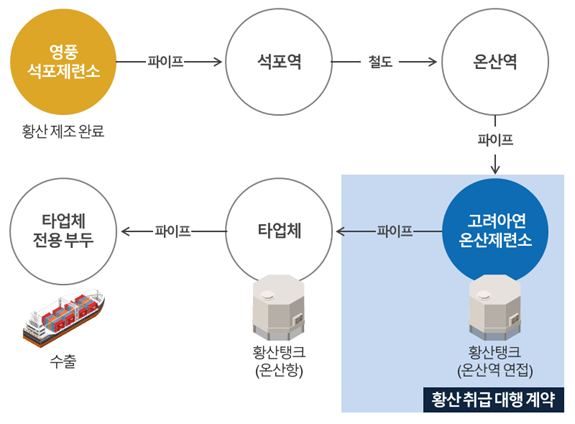
Since 2000, Yeongpung has been striving for over 20 years to handle sulfuric acid independently by establishing export facilities at Donghae Port, but finding an alternative has been structurally impossible. On the east coast, chemical ports capable of sulfuric acid export are only Donghae Port and Onsan Port. Yeongpung established its own export facilities at Donghae Port, but due to its small size and shallow depth, large-scale shipments are impossible, limiting further expansion.
On the other hand, Onsan Port was established within the Onsan National Industrial Complex under the government's large-scale heavy chemical industry promotion policy and is optimized for sulfuric acid export. This is why the Yeongpung Group unified the sulfuric acid export channels of Yeongpung and Korea Zinc to Onsan Port before the 'management rights dispute.'
Non-ferrous metal industry insiders believe it is practically impossible for Yeongpung to establish sulfuric acid export facilities to replace Onsan Port in the short term, and it is also inappropriate at the national level.
To handle the large volume of sulfuric acid produced by Yeongpung, new facilities and infrastructure for sulfuric acid export must be built in another area, which requires considerable time from land acquisition to design and completion, and faces many obstacles such as local opposition. At the national level, since Onsan Port (Ulsan Port) is continuously supported as a specialized liquid cargo handling port, exporting large volumes of sulfuric acid through Onsan Port is considered appropriate.
"Korea Zinc's Refusal to Renew is Abuse of Power, Raising Concerns of Major Disruption in Domestic Zinc Supply Chain Ecosystem"
Yeongpung, the second-largest player in the domestic zinc sales market, produced 331,000 tons of zinc in 2023, supplying 153,000 tons domestically and exporting 178,000 tons. If Korea Zinc refuses to renew the sulfuric acid handling agency contract, Yeongpung's zinc production will be disrupted, causing significant turmoil in the domestic zinc supply chain. This could also create instability in the regional economy and place a heavy burden on the development of the national key industry of non-ferrous metal smelting.
In response, Korea Zinc states that it will prioritize domestic sales to prevent a shortage in domestic supply. Yeongpung argues that Korea Zinc, which holds an overwhelming 56% domestic market share as the number one player, is effectively declaring a monopoly over the domestic zinc sales market. Korea Zinc's refusal to renew the sulfuric acid handling agency contract does not only disadvantage Yeongpung.
The Fair Trade Act strictly regulates such unilateral refusals of transactions, known as 'gapjil,' which exploit superior bargaining positions in dependent situations to hinder business activities, viewing them as unfair refusal of transactions or acts that obstruct business activities and provide disadvantages. Yeongpung believes Korea Zinc's unilateral refusal violates the Fair Trade Act and has taken legal action based on this.
Yeongpung Tried to Find a Compromise but Korea Zinc Rejected It
Regarding Korea Zinc's declaration of refusal to transact, Yeongpung repeatedly explained through certified letters that even with all efforts to establish alternative facilities, it is impossible to do so in the short term and would take at least about seven years, requesting that the sulfuric acid handling agency contract, which has been renewed annually, be extended for one year.
Korea Zinc firmly rejected this and unilaterally notified that it would provisionally provide some sulfuric acid handling agency services for 'up to three months' due to its circumstances. As a result, Yeongpung's sulfuric acid exports are inevitably disrupted.
Yeongpung stated, "We will prove in court that Korea Zinc's refusal to transact is unfair and explain the difficulties in establishing alternative facilities, demonstrating that the refusal to jointly use essential sulfuric acid export facilities for zinc smelting is illegal," and added, "We hope Korea Zinc will withdraw its refusal of the sulfuric acid export agency contract and come to a reasonable negotiation table even now."
© The Asia Business Daily(www.asiae.co.kr). All rights reserved.


















