Winning a Project Hosted by the National Institute of Environmental Research
Hanwha Systems is taking its first step into the hyperspectral satellite business capable of greenhouse gas observation. Spectroscopy refers to the atmospheric chemical spectrum that divides light according to wavelength differences. Hyperspectral divides light into hundreds of bands and stores it in image form, allowing detailed identification of subjects at very long distances.
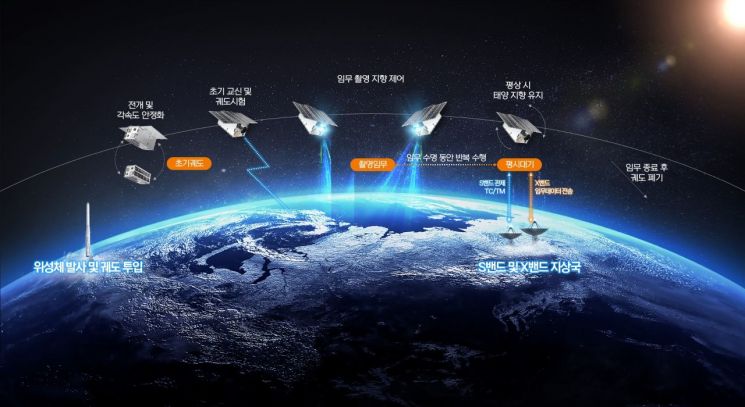 Hanwha Systems 'Ultra-small Hyperspectral Satellite Project for Greenhouse Gas Observation' Operation Concept Diagram /
 [Image provided by Hanwha Systems]
Hanwha Systems announced on the 3rd that it has won the development project for the "miniature hyperspectral satellite for greenhouse gas observation" led by the National Institute of Environmental Research. The company plans to develop a total of five satellites by 2028 and supply them to the National Institute of Environmental Research. The project scale is approximately 40.5 billion KRW.
The hyperspectral satellite is an observation satellite that can closely monitor invisible atmospheric pollutants from space. The satellite to be developed this time will be a miniature satellite weighing less than 50kg. It will orbit in a low Earth orbit below 600km altitude and measure the emissions and distribution of methane and carbon dioxide, the main causes of global warming, playing a role in monitoring areas of concern for excessive emissions.
Hanwha Systems will develop the entire satellite system, from the satellite bus and payload development to system integration. The company plans to provide a total solution for greenhouse gas observation satellites, including launch and operation support. For technology verification, the first miniature hyperspectral satellite for greenhouse gas observation will be launched in the first half of 2027. Subsequently, satellites 2 through 5 will be launched simultaneously in the first half of 2028.
Hanwha Systems expects that additional business opportunities such as exporting and selling satellite systems and image data will be possible targeting countries with the highest greenhouse gas emissions and damage. The company also plans to continue developing hyperspectral satellites capable of observing other greenhouse gas substances besides methane and carbon dioxide.
Seongcheol Eo, CEO of Hanwha Systems, said, "It is significant that Hanwha Systems has successfully entered the hyperspectral satellite market following small SAR satellites," adding, "We will continue to develop various types of satellites and establish ourselves as a leading K-Space company."
© The Asia Business Daily(www.asiae.co.kr). All rights reserved.

















