'Rejection of Differential Application by Industry'... Single Wage Application
Discussion on Minimum Wage Increase Rate Expected to Intensify
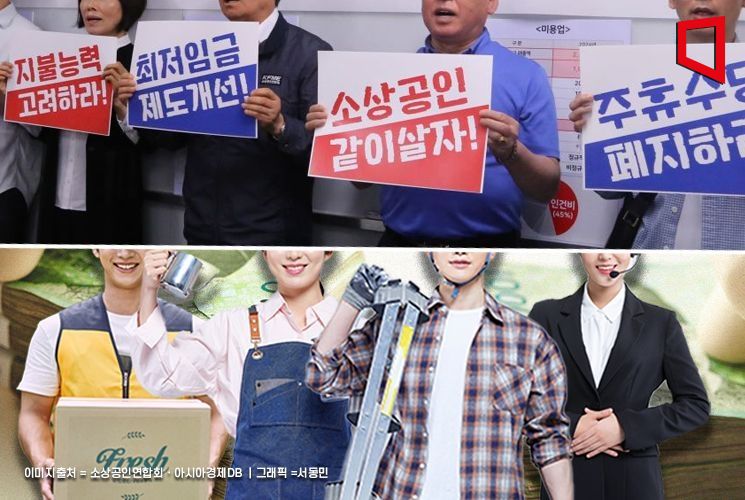
The introduction of a sector-specific differential application system for the minimum wage has once again failed. On the 2nd, the Minimum Wage Commission held a plenary session where the differential application proposal was rejected with 11 votes in favor and 15 against. This was the result of public interest commissioners, who held the casting votes amid sharply divided opinions between labor and management, casting opposing votes.
At the 7th plenary session held at the Government Complex Sejong on the 2nd, the Minimum Wage Commission put to a vote whether to apply sector-specific differentials to next year's minimum wage. The vote resulted in 11 in favor, 15 against, and 1 invalid vote, leading to rejection. Among the 27 commissioners?9 each from workers, employers, and public interest?assuming all worker commissioners voted against and all employer commissioners voted in favor, it is estimated that among the 7 public interest commissioners, 2 voted in favor, 6 against, and 1 cast an invalid vote.
The business community, centered on small business owners, strongly demanded differential application citing management difficulties in some vulnerable sectors, but amid strong opposition from labor, the decision was ultimately made to maintain a single wage. The business community has argued that the minimum wage should be applied differentially in vulnerable sectors such as Korean, foreign, and other simple restaurants, taxi transportation, and chain convenience stores, considering their payment capacity.
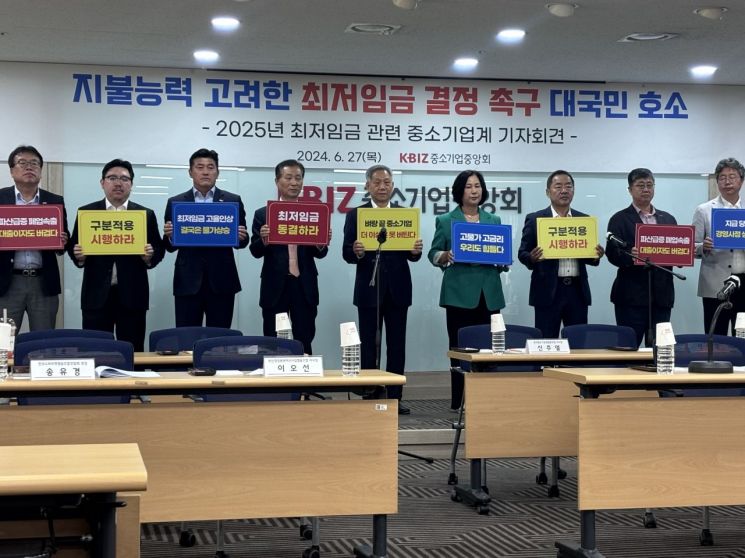
In his opening remarks that day, Ryu Ki-jung, Executive Director of the Korea Employers Federation (KEF) and an employer commissioner, said, "I expect that the decision on whether to apply sector-specific differentials to the minimum wage will be made today," adding, "I hope this will be a historic turning point where our previously uniform and rigid minimum wage system becomes somewhat more flexible."
Another employer commissioner, Lee Myung-ro, Head of the Human Resources Policy Division at the Korea Federation of SMEs, also said, "If there is agreement on the need for differential application, flexibility should be exercised in specifying sectors. The important thing is to implement it first, and modifications or supplements to the sectors can be made later as needed."
Lee also mentioned, "If the difference in the increase rates between the sectors subject to differential application and general sectors is kept small, it can alleviate concerns from the labor side."
On the other hand, the labor side strongly opposes sector-specific differential application, arguing that it constitutes 'discrimination' contrary to the purpose of the minimum wage and will further exacerbate recruitment difficulties by stigmatizing low-wage sectors.
Ryu Gi-seop, Secretary-General of the Federation of Korean Trade Unions (FKTU) and a worker commissioner, clearly opposed the sectors for which the business community demanded differential application, stating, "There is no guarantee that management and manpower difficulties or payment capacity will be resolved by differential application."
Lee Mi-sun, Vice Chairperson of the Korean Confederation of Trade Unions (KCTU), also urged to stop the discussion altogether, saying, "There is no reason to discuss sector-specific differential application that undermines the Constitution and the Minimum Wage Act."
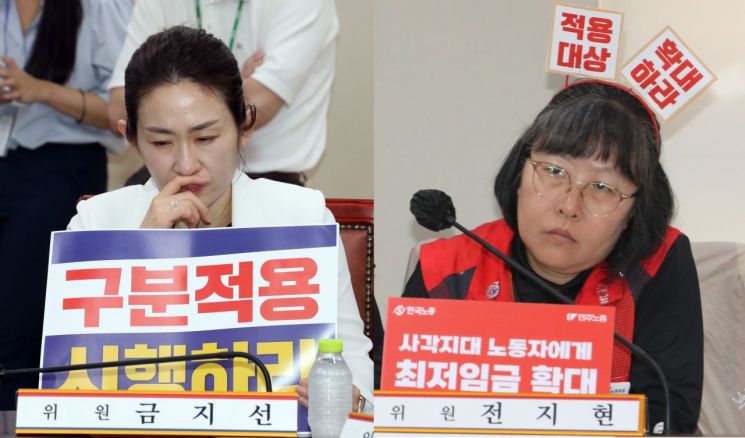
Among the worker commissioners, those from the KCTU side strongly opposed putting the matter to a vote amid uncertainty about the stance of the public interest commissioners who held the casting votes, but as labor and management failed to narrow their differences and remained at an impasse, Chairman Lee In-jae proceeded with the vote.
After the rejection, the business community raised issues with the voting process, and the meeting was temporarily adjourned. With the issue of sector-specific differential application settled for now, the Minimum Wage Commission will move on to the most important discussion on next year's minimum wage level. The minimum wage decided last year for this year is 9,860 KRW per hour, or 2.06 million KRW per month (based on a 40-hour workweek).
The chairman has requested both labor and management sides to submit their initial minimum wage proposals, and differences will be narrowed through subsequent plenary sessions. The deadline for the Minister of Employment and Labor to announce next year's minimum wage is August 5. Considering that administrative procedures such as objections take about 20 days, an agreement must be reached by mid-month.
© The Asia Business Daily(www.asiae.co.kr). All rights reserved.
![Clutching a Stolen Dior Bag, Saying "I Hate Being Poor but Real"... The Grotesque Con of a "Human Knockoff" [Slate]](https://cwcontent.asiae.co.kr/asiaresize/183/2026021902243444107_1771435474.jpg)













