Most Flood-Prone Roads Lack Barriers
Installation Rate Low Due to Budget Shortage
Swift Traffic Ban Measures Also Crucial
It has been one year since the 'Osong Underpass Disaster' occurred, but safety measures for flood-prone underpasses nationwide remain insufficient. There are concerns that a second disaster may occur during the upcoming rainy season.
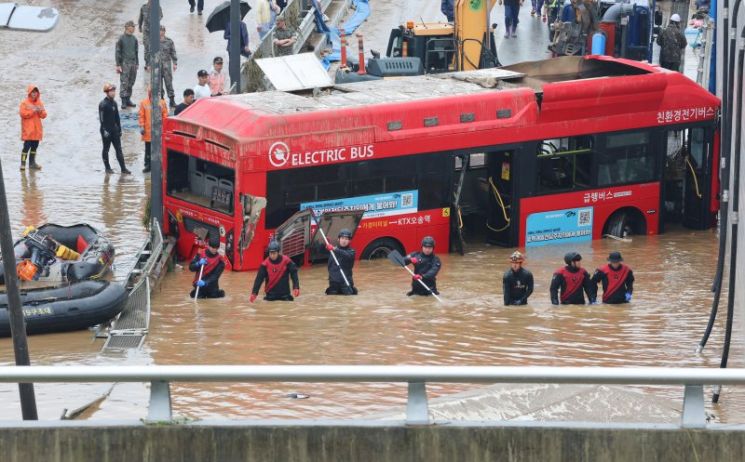 Last year, 119 rescue workers searched for missing persons at Gungpyeong 2 Underpass in Osong-eup, Cheongju-si, Chungbuk, which was flooded due to the collapse of the Miho Stream embankment.
 [Photo by Yonhap News]
According to the Board of Audit and Inspection on the 3rd, among the 182 underpasses nationwide that are at high risk of flooding and maintained by disaster management authorities such as the Ministry of Land, Infrastructure and Transport and local governments, 132 (72.5%) do not have entry blocking facilities installed.
The Board of Audit and Inspection defines 182 underpasses located in flood-risk areas out of 1,086 nationwide underpasses as 'flood-risk underpasses' based on flood risk maps. Entry blocking facilities are safety devices installed in front of tunnel entrances to prevent vehicles from entering the tunnel during emergencies such as heavy rain, thereby preventing secondary accidents. Following repeated flooding accidents, there have been many calls to make the installation of entry blocking facilities mandatory.
In response, since 2019, the Ministry of the Interior and Safety has been supporting the installation of entry blocking facilities on 'flood-risk underpasses' managed by local governments by allocating the 'Disaster Safety Special Grant.' However, due to budget shortages and other reasons, the installation rate remains low. Among 40 underpasses for which local governments requested support for installing entry blocking facilities from 2019 to 2021, only 23 actually received budget execution, accounting for about half.
An official from the Ministry of the Interior and Safety stated, "If local governments request support within the period, the ministry executes the budget. In March of this year, we also surveyed demand from local governments, submitted the results, and understand that support funds have been allocated."
Evacuation facilities inside underpasses for emergencies are also still inadequate. According to guidelines for installing road tunnel disaster prevention facilities, in case of fire or other accidents inside underpasses, equipment and safe spaces must be installed to allow users to evacuate safely. However, the investigation found that among the 182 flood-risk underpasses, 163 (89.6%) of the tunnel sections and 157 (86.3%) of the entrance and exit sections lacked evacuation facilities.
As a result, concerns are growing that similar flooding accidents may recur during the upcoming rainy season. According to the Korea Meteorological Administration, from June 19, when Jeju Island entered the rainy season, until June 29, when the entire country entered the rainy season, heavy rainfall amounting to twice the average precipitation fell nationwide. It is analyzed that even more rain will fall once the full rainy season begins.
Moon Hyun-cheol, a professor in the Department of Disaster Management at Honam University, emphasized, "Heavy rain is expected again this year, but safety facilities to prevent flooding accidents are still insufficient. Since installing entry blocking facilities requires significant time and cost, it is important to gradually expand safety facilities, and it is also crucial that local government heads promptly issue traffic bans and evacuation orders during emergencies."
© The Asia Business Daily(www.asiae.co.kr). All rights reserved.

















