Interview with Kwon Oseong, Robot Business Development Leader
"Platform is Key to Connecting Robot Services and Users"
Also Exploring AI Integration... Saudi Arabia Shows Interest
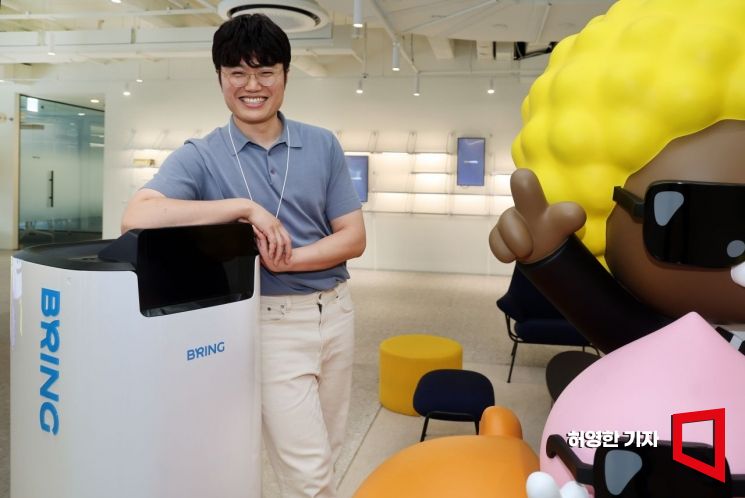 Kwon Oh-seong, Robot Business Development Leader at Kakao Mobility, posed with the robot 'Bring' next to a Kakao character at the headquarters in Bundang-gu, Seongnam-si. Photo by Heo Young-han younghan@
"The very concept of platform-based robot services was unfamiliar in the past. Through the experience of Kakao Taxi service, we aim to make it possible for anyone to experience robots."
Kakao Mobility is strengthening its capabilities as a comprehensive mobility company through the development of robot services. Since its launch in August 2017, the public still strongly associates it with taxi-hailing services, but the company is seeking to transform into a robot service platform.
Kwon Oh-sung, the leader of robot business development at Kakao Mobility, recently said in an interview with Asia Economy, "Just as we made taxi services easy to use, we will lead changes so that anyone can experience robots."
Kwon joined Kakao Mobility in 2021. He was attracted by the prospect of expanding into various fields linked with the platform. He believes that for the robot ecosystem to expand, robots must provide real value and be utilized, and a platform that connects demanders and service providers is necessary. Since Kakao Mobility has been involved in various mobility businesses including taxis and designated driver services, synergy between the robot business and existing services is also expected.
Kwon said, "There are still many constraints to overcome for robots to independently handle a single service. The fastest way to overcome this is not to make robots provide a complete service alone, but to coexist and connect with existing services."
Based on his confidence in the robot platform, he began service development two years ago. However, the concept of platform-based robot services was unfamiliar at the time, making progress difficult. Kwon explained, "When visiting client companies, many purchased robots were unused and just gathering dust, and there were many cases where we were turned away when trying to make sales calls."
After 'heading into uncharted territory' and meeting customers on foot across the country in places like Daejeon, Busan, Daegu, and Jeju, results gradually appeared. A representative case is the introduction of the delivery robot 'LG CLOi ServeBot' by LG Electronics last April, launching the robot delivery service 'BRING.' Based on digital twin technology (which replicates the real world in a digital environment), it moves inside buildings to carry out various delivery commands. Currently, BRING is operating at 'Nudit Seoul Forest,' a complex cultural space in Seongsu-dong, Seoul, and plans to unveil robot delivery services in four areas?offices, hotels, hospitals, and residential apartments?in the second half of this year.
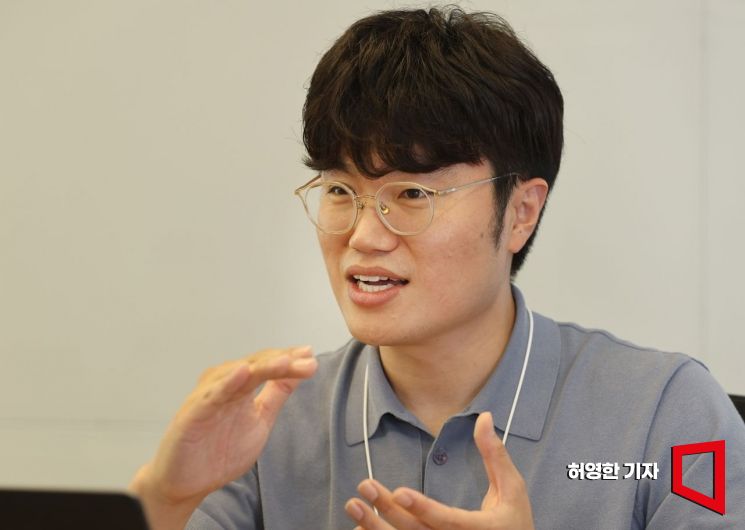 Kwon Oh-seong, Robot Business Development Leader at Kakao Mobility, is being interviewed by Asia Economy at the headquarters in Bundang-gu, Seongnam-si. Photo by Heo Young-han younghan@
Beyond delivery, robot services performing various activities such as security and parking are also planned. Integration with artificial intelligence (AI) is being attempted to enable robots to accumulate data and advance through learning.
Kakao Mobility is also positioning its own robot open application programming interface (API) platform, 'BRING-ON,' as another pillar in the robot business sector alongside BRING. Kwon said, "We need to combine the two aspects of robots and robot services. BRING-ON algorithmizes and automates how to combine task execution units, the order of dispatch, and how to change commands in case of unexpected situations, then delivers these to the robots."
Kakao Mobility’s technological capabilities are recognized overseas as well. Last month, a delegation from the Saudi Data and AI Authority (SDAIA) visited the company’s headquarters and directly observed the delivery robots in operation. The delegation showed a positive response to the robot services and expressed hope for local pilot projects.
Kwon believes monetization is not far off. He said, "What matters is whether we can create the precise services customers want. A platform that can continuously update by reflecting customer needs is essential in the robot field as well, and if this is fulfilled, monetization will follow."
© The Asia Business Daily(www.asiae.co.kr). All rights reserved.


















